


I have been talking to folks about trees for over 40 years now. One question I get all the time is, “Does Spanish moss hurt trees, is it a parasite?” After 40 years, it is time to put this question to rest. Although it is going to be a two-part answer.
Spanish moss is neither “Spanish,” nor a “moss.” It is a type of plant called an epiphyte. Epiphytes are plants that live in trees and have no connection to the ground for water and nutrients. They get water from rainfall and humidity, and nutrients from any organic matter such as dust, bird droppings, or decaying leaves that happen to wash down the tree trunk. Spanish moss gets nothing from the tree other than the support from twigs and branches, so it is not a parasite. Other epiphytes include
orchids, and some ferns. Spanish moss belongs to the Bromeliaceae (bromeliad) family which interestingly enough also contains pineapples.

Spanish moss is beneficial to wildlife in many ways. Birds such as the Baltimore Oriole, swallowtail kites, and the parula warble, all use Spanish moss for nesting material. Both bats and butterflies use Spanish moss as places to hang out and rest.
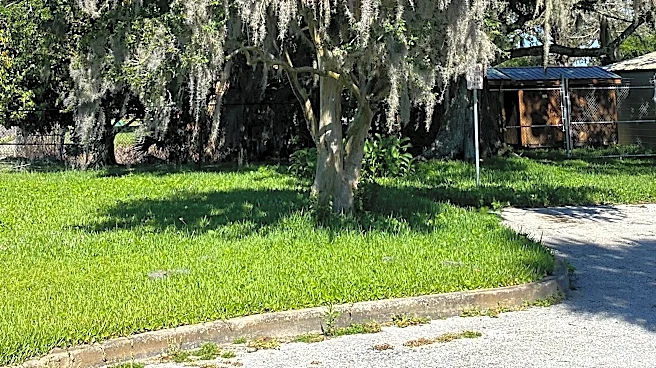
Spanish moss is often seen hanging in large trees such as oak, sweetgum, magnolia, pine and cypress, but are also seen in smaller trees such as crape myrtle. Spanish moss and trees have been living together for a long time. Spanish moss is also iconic in many southern trees. However, concerned homeowners will sometimes see a heavy covering of Spanish moss on a tree and wonder if it should be removed.
It depends.
Most of the time the tree will be fine, but on rare occasions overly thick moss on a tree can negatively impact the tree by shading the leaves, slowing growth, and adding lots of weight to weak branches. But for healthy trees, the impact of Spanish moss is minimal.

If you need to remove Spanish moss because of shading or weight, the options are limited. There are no chemical options that are labeled in the State of Florida for Spanish moss removal. The use of copper fungicides will kill Spanish moss but then you will still have the dead moss to remove. The safest and most effective method to remove Spanish moss is to remove it by hand, or to use a long handled tool with a hook or something similar to grab hold of the moss and pull it down. The process is similar to twisting spaghetti on a fork.
There is one instance in Jacksonville’s history where Spanish moss played a critical role. The Great Jacksonville fire in 1901 that destroyed 146 city blocks was started when a spark from a cooking fire ignited piles of Spanish moss drying on large racks. The Spanish moss was drying at the Cleveland Fiber Factory on the corner of Davis and Beaver Street. The factory used the dried moss as filling for mattresses.
Spanish moss is a familiar and iconic feature of many Southern landscapes, but despite common misconceptions, it does not harm trees or act as a parasite. Overall, Spanish moss is a natural companion of trees and provides numerous benefits to wildlife.
Larry Figart is an urban forestry extension agent with the University of Florida/IFAS.
This article originally appeared on Florida Times-Union: Does Spanish moss kill trees? The truth about the plant