





Jacksonville Mayor Donna Deegan tells her town hall audiences the city achieved a 34% percent drop in uninsured residents when she lists her biggest accomplishments as mayor, but newly released U.S. Census data paints a far different picture by showing the number of uninsured residents grew slightly in Duval County.
Other estimates by groups outside city government show a drop of less than 1% to 2.5% in the number of residents without health insurance, a decline that is far less dramatic than what Deegan has repeatedly cited based on her own office's number-crunching.
Deegan has been using the 34% figure over the past two years, most recently in a video presentation during her current round of town halls highlighting various programs and policies
she's put in place such as improving health care access.
"We've also reduced the rate of uninsured in Duval County by 34%," she says in the voiceover for the video.
City Council member Rory Diamond said Deegan should retire that claim.
He said state and federal policies affect changes in the uninsurance rate, not anything Deegan has done with a public awareness campaign.
"I think you should stop saying things that are clearly not credible," Diamond said. "That statistic is not credible."

Independent reports contradict Deegan on big drop in uninsured
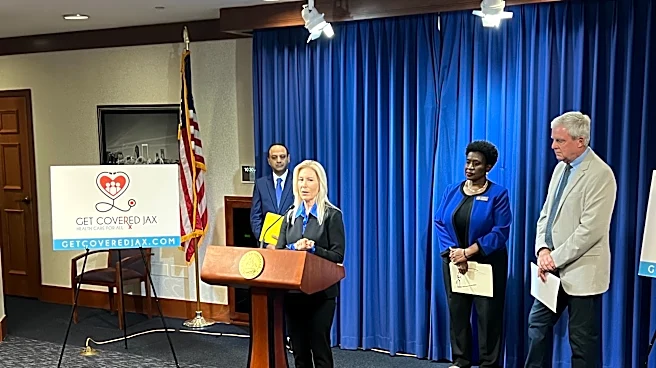
The 34% figure stems from Get Covered Jax, a program Deegan launched that promotes enrollment in Affordable Care Act health insurance plans.
"I want Jacksonville to be a healthier city because health, both physical and mental, is key to our economic prosperity," Deegan said in April 2024. "And the fact that Get Covered Jax helped reduce our uninsured rate by 34% is a tremendous first step in helping us get there."
Deegan's town halls earlier this year also touted that figure in a slide-show presentation that said the city's work on health care access resulted in "Uninsured population reduced by 34%."
And her re-election campaign uses that figure in an Instagram post that says Jacksonville "achieved a remarkable 34% reduction in uninsured residents."
But a U.S Census Bureau report released Aug. 6 doesn't show such gains. According to the Small Area Health Insurance Estimates, Duval County had 101,121 uninsured residents under the age of 65 in 2023 and that increased to 102,123 residents in 2024.
The Census Bureau's annual report is a comprehensive examination of every county in the United States. The report covers the entire spectrum of those with and without health insurance.
While the recent Census report shows a slight increase in Duval County residents without health insurance, reports by other organizations show a small improvement between 2023 and 2024.
The Health Planning Council of Northeast Florida estimates there were 114,620 people in Duval County without health insurance in 2023 and that dropped to 113,905 people in 2024, a change of less than 1%.
Florida Department of Health reports on the uninsured population show 111,474 Duval County residents lacked insurance in 2023 and that declined to 108,742 residents in 2024, a 2.5% drop. The state's report uses U.S. Census data from the American Community Survey.
The small year-over-year changes in those reports show how hard it is to move the needle on the multi-billion dollar health care industry.
Dr. Sunil Joshi, chief health officer on the mayor's staff, has said in the past that since the numbers for uninsured residents are "always in flux and a variety of factors are in play, it's very difficult to give a definitive number. Every data point is simply a snapshot in time."

Deegan has sought to expand health care access in Jacksonville
Deegan has made health care access part of her agenda since she took office three years ago.
She kicked off Get Covered Jax in November 2023 as that year's open enrollment was beginning for Affordable Care Act plans, also known as Obamacare. The public awareness campaign created an online site where people could get basic information about Affordable Care Act plans with a link to the healthcare.gov site where they can actually apply for coverage.
The city didn't use a paid marketing campaign but it deployed social media and outreach to faith centers to spread the word. Deegan held a news conference announcing the initiative and she partnered with WJXT-TV when it called attention to Get Covered Jax during its newscasts.
City officials said at the kick-off news conference that Duval County had 120,000 residents without health insurance. Federal figures showed during open enrollment for Affordable Care Act insurance between November 2023 and January 2024, there were40,276 "new enrollees" from Duval County. Deegan used that figure to say the number of uninsured people "has gone down by 40,267 — a 34% decrease in uninsured individuals."
But being a "new enrollee" in Affordable Care Act plans does not mean someone previously lacked health insurance. Some new enrollees in Obamacare moved from the ranks of the uninsured, but others already had health insurance and switched to the Affordable Care Act for coverage.
The new enrollees could have previously been covered by employee-sponsored insurance or Medicaid. The federal government does not break down how many of the new enrollees previously lacked health insurance versus how many had insurance and were just switching coverage. But outside studies have shown a share of new enrollees already had health insurance while others were moving from the uninsured rolls.

"I think it is fair to say that the vast majority of those who are newly signed up were not in any plan in the previous year," Joshi said in April 2024 of new enrollees from Duval County.
He also noted that the 49% overall increase in the number of Duval County resident enrolled in Obamacare during the enrollment period from November 2023 to January 2024 was well above the statewide increase of 30% for that coverage.
But the health insurance market is bigger than the Affordable Care Act plans. The end of pandemic-related Medicaid coverage hit that part of the market for residents who lost Medicaid insurance.
In a measure of how lack of health insurance affects the health care system, the city's cost of providing subsidies to UF Health Jacksonville for treating poor patients at the safety-net hospital hasn't gone down.
Next year's city budget is set to spend $56 million on those subsidies for the third year in a row. UF Health uses those subsidies to help cover the cost for patients who lack insurance.
This article originally appeared on Florida Times-Union: Independent reports contradict Deegan saying uninsured dropped by 34%