



Vaughn Cochran slid into a booth in Blackfly, the restaurant he owns on the stretch of A1A that runs through St. Augustine, a state road now also known as Jimmy Buffett Memorial Highway.
Cochran recalled one night in particular at the other end of A1A, when was playing at the Chart Room in Key West and Jimmy Buffett walked in.
This sentence — Jimmy Buffett walked into a bar in Key West — isn’t how it sounds now, as Florida prepares to celebrate another Jimmy Buffett Day on Aug. 30, three years after his death.
Cochran says this was early 1972, or maybe, as some of the Buffett lore says, it was late 1971. The exact dates, like a lot of details from that time
and place, are a bit hazy.
Suffice to say, at that point in time, if you’d told someone Jimmy Buffett walked into a bar in Key West, the response likely would’ve been: Who?

He had recorded two albums. The first one, “Down to Earth,” sold 324 copies on its release. The second one, recorded in 1971, wasn’t even released. The record company said it had lost the master tapes (although the company conveniently found those tapes a few years later when Buffett made it big).
Buffett had fled Nashville and come to Florida, broke and recently divorced, taking Jerry Jeff Walker (already famous for “Mr. Bojangles”) up on an offer to crash at his place in Coconut Grove before a gig — only to show up at the club and be told it wasn’t for another two weeks.
That’s when Walker and Teresa “Murphy” Clark took Buffett on a road trip to Key West — and Jimmy Buffett walked into the bar where Cochran was playing.
“He became a part of whatever jam we were doing,” Cochran said. “And we started playing from that night on.”
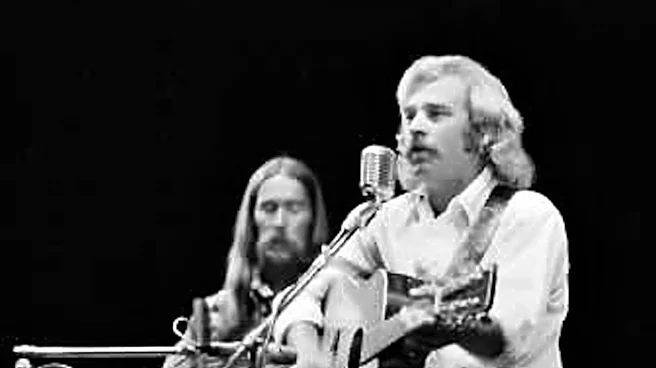
In the beginning, it was three of them: Buffett with his acoustic guitar, Greg “Fingers” Taylor on harmonica, and Vaughn Cochran on washboard.
A story in the Miami Herald on Jan. 30, 1972, had a headline that said: “Singer-Poet-Writer’s Next Gig is Key West.”
It said that this “rising” 23-year-old had decided he was going to move to Key West. It included a photo of the “traveling singer” hanging out with a couple of new friends — one with long hair and a moustache, Vaughn Cochran.

Cochran looks at that photo now and laughs, partly because that is a youthful him in the photo, partly because it isn’t Buffett. That’s how unknown Buffett still was. The paper used a photo that didn’t include him.
But the story, quoting Buffett and Cochran, did capture a bit of the vibe that was ahead. Buffett said he was preparing to move to Key West, work some, record some, maybe get a job cooking on a shrimp boat and, in his spare time, “look at the saltwater and write.”
“That was his introduction into Key West,” Cochran said. “And you know songwriters, they'll do anything to have an experience to write a song about. And I think Jimmy was just completely overwhelmed with the material — the input from the island, the trees, the smells, the people, the girls, the bicycles, everything.”
'Coral Reefer equivalent of Pete Best'
Jimmy Buffett and “Fingers” Taylor both died in 2023. You might say Cochran, now 81, is the lone surviving original Coral Reefer. Although that doesn’t quite do justice to just how far back he goes with the band. Because it wasn’t until 1975 that Buffett branded it the Coral Reefer Band.
And by then Cochran wasn’t in it.
In the book, “Mile Marker Zero: The Moveable Feast of Key West,” William McKeen says Cochran “became the Coral Reefer equivalent of Pete Best in the Beatles.”
In some ways that is hyperbole. There were four Beatles, their place in music history so large that we know them by their first names. In nearly 50 years, there were dozens of Coral Reefers, many with names that all but the hard-core Parrotheads won’t recognize.
But the idea that Cochran narrowly missed being on board one of the wildest rides in music history — one that sold much more than albums, making Buffett a billionaire — holds true.
Cochran wasn’t just a part of Buffett’s band during those early days, when they were playing for drinks in Key West bars, and going on the road, playing small clubs and colleges. He was a part of the band that went on a modest tour for the 1973 release of the album “A White Sport Coat and a Pink Crustacean.”
That album includes “He Went to Paris,” “Grapefruit — Juicy Fruit” and “Why Don’t We Get Drunk.” It was recorded in Nashville with studio musicians. But to promote the album, Buffett took his band on the road to New York City. It was Cochran’s first time there. They stayed at a fancy hotel on Park Avenue and played Max’s Kansas City, a trendy club with the likes of Andy Warhol coming and going.
“It was like, ‘Oh, my God, this is pretty cool,’” Cochran said.
But not long after that, the record label, ABC Dunhill, decided that maybe having a washboard player in the band wasn’t cool. As McKeen wrote in his book, the label executives decided to say something to Buffett about his band — “like maybe he needed to get a real one.”
Fingers and his harmonica stayed. Cochran and his washboard didn’t.
“They let me go because they didn’t feel like I added any class to Jimmy’s band,” Cochran says five decades later, adding that he doesn’t recall a specific conversation. “It was just like they don’t call anymore, you disappear.”
'If I don't die by Thursday ...'
It’s easy to imagine someone lamenting not being on the ride that followed.
Cochran doesn’t do that — partly because he knows where that kind of ride can lead.
“My favorite line of Jimmy’s was, ‘If I don’t die by Thursday, I’ll be roaring by Friday night,” he said with a laugh.
It’s from Buffett’s 1976 song, “My Head Hurts, My Feet Stink and I Don’t Love Jesus” — and Cochran says it sums up a lot of days and nights in 1970s Key West.
But beyond that, a big reason why he doesn’t lament not making it to Margaritaville and beyond is that he has had quite the life after his pre-Coral Reefer days.
He managed to take two of his passions — fly fishing and art — and become renowned for both.
He became a fishing guide, using all that time on the water as inspiration for paintings and sculptures. And he and his wife, Jean, managed fishing lodges in exotic locales — he’s still co-owner of the Blackfly Lodge in the Abaco Islands in the Bahamas — before deciding to sell their house in the Keys and move back to where he grew up in 2003.
After all those years dealing with hurricane after hurricane, they decided to settle away from the ocean, on 2.5 acres in Elkton. Vaughn has a studio that he’s in almost every day.
In that studio, there’s a set of conga drums, a couple of ukuleles, a mandolin, an electric guitar and, yes, a washboard.
“When I just can't stand to paint another drop, I'll pick up one of the instruments, or if a good song comes on, I'll play the conga drums,” he said, adding that as much as he enjoys this it doesn’t top being in a band. “There’s nothing like being on a stage with a bunch of other musicians and it’s working.”
Club Mandible
In many ways, he did experience the Buffett ride — maybe the most memorable part of it, those heady early years in a time and place when Key West has been described as a Florida version of 1920s Paris. With writers, musicians, treasure hunters, drug smugglers and more, with many of them gathering every afternoon for happy hour in the Chart Room.
A new documentary — "Occupational Hazard: The First Coral Reefers" — has been showing at film festivals and heads to theaters in September (and streaming at some point after that). Cochran is in the trailer.
Cochran ended up in Key West in the 1970s because his first wife’s family lived there. He’d graduated from St. Augustine High in 1963, went into the Army, got out before America got deeper into Vietnam, studied art at the University of South Florida and then moved to Key West, where he ultimately became part of the in-crowd: Club Mandible.
The way Cochran recalls the origin of this “club” is that the writer Tom McGuane was doing an interview, perhaps with Rolling Stone, and had been asked if he was a member of any organizations.
McGuane said, yeah, he was a member of Club Mandible. There was no such club. He made it up on the spot. But it was embraced by this group of maybe a couple dozen, including Buffett, McGuane and Tom Corcoran — the bartender/writer at the Chart Room served Buffett his first beer in Key West.
They even had t-shirts. Ugly purple ones. They were on sale at one of the t-shirt shops. So they bought a bunch of them and had their nicknames stitched on the backs.
Everyone in Key West had a nickname in those days, Cochran says. And his was Garnet Wolesley. Someone had seen a photo in a magazine of a 19th century British soldier and they all decided Cochran looked remarkably like him. That became Cochran’s stage name and the one stitched on his purple t-shirt.
"So you would wear your club t-shirt when you went out at night," Cochran said. "Which was every night."
Many years later, Cochran was fishing in Belize, helping the owner of a fishing lodge there. After catching a grand slam, three different billfish, in a matter of hours, he and his crew were cruising through waters more than 500 miles from Key West when the radio crackled and Cochran heard: “Hey, Garnet.”
He looked at it, thinking he recognized the voice.
“Jimmy?” he answered. “Is that you?”
It turned out Buffett had flown on his private jet to Belize City, picked up a float plane and taken it to a yacht. He said to Cochran, “We’re going fishing in the morning.”
Cochran figured he meant how most people fish. By boat. No, Buffett said, “We’re going fishing in the plane.”
The next day they took the float plane, flew over the enormous barrier reef in Belize, touching down when they saw fish, wading to catch them, taking off and repeating.
That was a day in Jimmy Buffett’s world.
The last time Cochran saw him was when he played in Jacksonville in 2021. They had a few minutes to chat before the show, catching up about their children and old friends.
Eventually, it was time for Buffett to move on. He walked Cochran to the door, looked at him with a grin and said: “I can’t believe I’m still getting away with this.”
Shortly after that, he walked onto a stage with the Coral Reefer Band and, along with the crowd, sang some of the hits, some that can be traced back to when he walked into a bar in Key West.
Florida Times-Union columnist Mark Woods: mwoods@jacksonville.com and (904) 359-4212.
This article originally appeared on Florida Times-Union: Meet the man who was part of Jimmy Buffett's original Key West band