




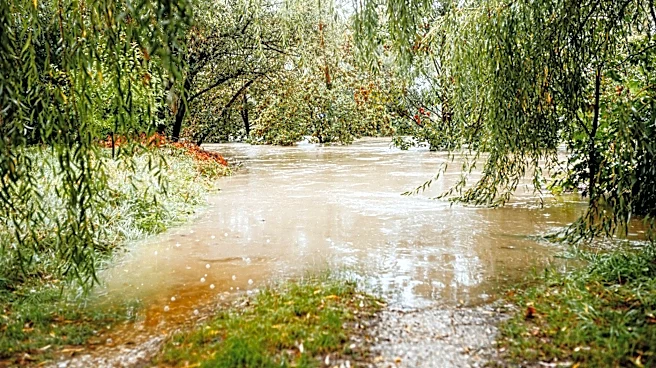


Corpus Christi residents can again water their lawns after nearly 18 months of a total ban prompted by the city’s critically low water supply — a turnaround precipitated by water flows from Texas floods into the lakes that provide the majority of the water to the region.
Stage 3 restrictions were officially lifted in an Aug. 4 news conference, representing a transition to Stage 2 restrictions, which immediately go into effect.
Under Stage 2 restrictions, customers can water their lawns once every other week on a predetermined schedule. The schedule can be found at stage2.corpuschristitx.gov.
The move is driven by the significant rise in the levels of Lake Corpus Christi and Choke Canyon Reservoir — the city’s primary sources of supply — now measuring
at nearly 37% as of the morning of Aug. 4, according to City Manager Peter Zanoni.

That reflects water filling to 67.8% capacity at Lake Corpus Christi and 24.9% for Choke Canyon Reservoir, he said.
Emerging from Stage 3 drought restrictions requires the combined capacities reaching more than 30%.
City officials credited the rain and the community’s water-saving efforts, as well as groundwater well fields in Nueces County, for the change in drought stages.
Although restrictions will ease, officials said that doesn’t mean work to diversify the water supply will be abandoned.
Mayor Paulette Guajardo, in her remarks, described the day as “not the finish line.”
“It's an opportunity to take a deep breath, but it's not an opportunity to become complacent,” she said. “We're still in a long-term drought, and in South Texas, we know better than most that weather can change very quickly. … Reservoir levels rise and they can fall just as fast.”
Stage 2 restrictions
The city’s Drought Contingency Plan outlines the Stage 2 restrictions.
Like Stage 3 drought, violating the rules can mean a fine assessed for as much as $500.
Here are some of the restrictions, as shown in city documents and on the city’s website.
Automatic irrigation systems and hose-end sprinklers may be used for outdoor watering one day every other week, with hours limited to 6 p.m. to 10 a.m. A schedule for when individual properties can be watered can be found at stage2.corpuschristitx.gov.
Watering landscaped areas is permitted on any day between 6 p.m. and 10 a.m., so long as the method used is a hand-held hose with a positive shut-off valve, drip irrigation with a shut-off device or watering can.
Foundation watering can be performed on the same day as outdoor watering is allowed.
Washing cars, boats and other vehicles is permitted by using a hand-held nose with a shut-off nozzle or bucket any day.
The drought stages
The city since December 2024 had been under Stage 3 drought restrictions — called when the combined capacity of the lakes slips below the 20% mark — the most significant of restrictions being a complete prohibition on lawn-watering.
Stage 2 drought, allowing for lawn-watering once every other week, was previously in effect from March 2024 to December 2024.
Transitioning to Stage 1 drought restrictions means the combined capacity must top 40%.
Although consultants expect that the combined capacity of the reservoirs may rise slightly above 40% late this week — and possibly as much as 42% early next week — the city will not transition to Stage 1 restrictions, Zanoni said.
Combined capacity higher than 40% will be short-lived, according to estimates, Zanoni said — potentially for only two weeks.
It could cause confusion, he said.
Stage 3 drought restrictions may need to be evaluated later this year, should there be no beneficial rain in November or December, Zanoni added.
A water emergency
At its lowest, the combined capacity was reported at 8%. Choke Canyon Reservoir was recorded at about 8% at its lowest level, and Lake Corpus Christi about 9%, according to city and state data.
The bump in lake levels means more than just watering lawns — it also represents a substantial delay in a projected water emergency that at one point had appeared nearly imminent.
A water emergency is called when the city is six months from supply falling short of meeting demand. Under rules adopted by the City Council, it would have meant strict water allocations for residents, businesses, wholesalers and industry.
In April, a water emergency had been projected for September. That shifted after May rains to December.
In June, it had been pushed back to September 2027 — and in July, it was announced that projections put a potential water emergency in September 2028.
It’s expected that the combined capacity of the reservoirs will remain higher than 20% until the fall of 2027, Zanoni said on Aug. 4.
Water supply projects
City officials have said the improved circumstances will not slow pursuit of new water supply projects — the total invested by the council amounting to $1 billion, Zanoni said.
Nueces County groundwater well fields have already been developed, but other projects in the works include providing reclaimed water instead of potable water for industrial uses, the proposed Evangeline groundwater well field in San Patricio County and desalination.
There are at least four seawater desalination proposals in various stages of development.
The one that is furthest along is thecontroversial Inner Harbor desalination plant.
The City Council is expected to vote on a contract for its continued design in the coming months.
Kirsten Crow covers city government and water news. Have a story idea? Contact her at kirsten.crow@caller.com.
This article originally appeared on Corpus Christi Caller Times: Corpus Christi drought restrictions downgraded from Stage 3 to Stage 2