







Across more than three years of flight tests, SpaceX's Starship rocket has coasted halfway around the world, exploded in the sky in dramatic fashion and even landed intact in the ocean without sinking.
But the world's largest rocket has never reached orbit.
Now, that could be about to change.
SpaceX's primary objective for a Starship mission it refers to as "flight 14" is for the upper section of the vehicle to finally reach orbital space, where it can fly high around Earth while bound by our planet's gravity. The feat would mark a major milestone in Starship's development as tech mogul Elon Musk's company races to have the launch vehicle ready for NASA's Artemis moon program.
Musk, the world's richest man and CEO of SpaceX, has also for years made
big pronouncements that Starship will not only expand and improve SpaceX's Starlink satellite network, but be the vehicle to take humans to Mars.
Here's why Starship reaching orbit would be a watershed moment for a vehicle that SpaceX is designing to be the first fully reusable rocket ever.
SpaceX plans for Starship to reach orbit in 'flight 14'
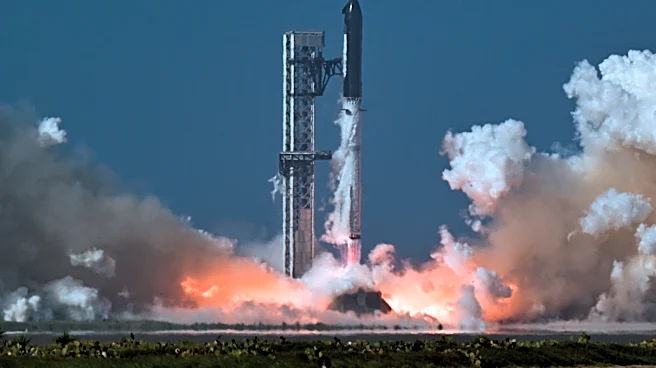
Standing at 407 feet tall when fully stacked, the latest prototype of Starship is not only the largest and most powerful rocket ever launched, but the one SpaceX hopes is able to consistently fly in orbit.
Starship's 236-foot-tall lower-stage booster, known as Super Heavy, is the section of the rocket that provides the initial burst of thrust at liftoff before quickly separating from the rest of the spacecraft. The 171-foot-tall upper-stage vehicle, often called Ship, is the section designed to eventually fly in space.
If all goes to plan, SpaceX's 14th flight test of its Starship rocket – targeted for Tuesday, Sept. 22, at SpaceX's Starbase headquarters in Cameron County, Texas – will mark the first time that the upper-stage reaches orbit.
What's the difference between orbit and suborbit?
Vehicles that reach suborbital trajectories are not only at lower altitudes, but are not up high enough to completely circle Earth. As a result, suborbital flights into space end with spacecraft falling back to Earth.
Achieving orbital flight, on the other hand, means a spacecraft is traveling much faster and higher as to continually fly around Earth.
As SpaceX explains on its website, that means Starship will have to move sideways so fast that, even though gravity is pulling it down, Earth is curving away beneath it so the vehicle doesn't come back down. In an area known as low-Earth orbit – the same region where the International Space Station resides – Starship will have to be traveling at about 17,500 mph, according to SpaceX.
Why hasn't Starship reached orbit in first 13 launches?
For Starship's first 13 flight tests, which began in April 2023, SpaceX said it opted to intentionally fly the upper-stage of the rocket on what it referred to as a "passively safe suborbital trajectory."
In essence, that meant Starship's engines shut off at the end of its ascent burn to prevent it from having the forward velocity necessary to reach orbit, SpaceX explained in a post on its website. The lower trajectory ensured that if SpaceX lost control of the spacecraft, it was on a path to reenter Earth's atmosphere and crash land into a pre-determined location that minimized danger to those on the ground.
"This mission design allowed us to gather flight data about hardware in a real flight environment while maximizing public safety," SpaceX explained.
Now that SpaceX is planning orbital flight tests, Starship will still fly on a "passively safe suborbital trajectory" until the flight controllers determine that certain conditions are met for the vehicle to fire its engines once more to reach orbit, the company said.
Flight 14 expected to last 10 hours
Previous Starship test flights have lasted about an hour. But the next mission could last for nearly 10, according to SpaceX.
Once the Super Heavy booster and its 33 Raptor-class engines complete its job and separate to land off the Gulf Coast, SpaceX then expects Starship's upper-stage to reach an altitude of more than 170 miles high, where it's expected to complete six orbits of Earth.
Along the way, the flight control team will monitor the vehicle's systems to make sure everything is working as intended and an early water landing is not required. If no issues arise, the upper-stage will eventually fire one of its six Raptor engines to execute a controlled deorbit and landing in the Pacific Ocean to the west of Chile, according to SpaceX.
What's on the horizon? Orbital propellant transfer, upper-stage reuse
Demonstrating Starship's ability to fly in orbit would be a significant success for SpaceX amid concerns for years that development of the rocket has come slower than expected.
Once the upper-stage is proven to be capable of orbital flight, SpaceX can turn its attention to other crucial objectives necessary for Starship to become operational.
That includes refueling Starship's upper-stage midflight – a maneuver required for the vehicle to reach distant destinations like the moon and Mars. The complex process requires two Starships equipped with docking adapters to meet in orbit to transfer hundreds of tons of super-cooled propellant.
Ultimately, SpaceX plans to one day be able to consistently return the upper-stage of the Starship spacecraft for a controlled landing after flight so that it can be reused again and again. While the company already reuses lower-stage boosters on its smaller Falcon 9 rocket – and even reused a Super Heavy booster on a Starship – a rapidly reusable upper-stage that has traveled to and from space would be unprecedented in the spaceflight industry.
What is Starship? SpaceX develops world's largest rocket for moon, Mars
SpaceX is developing Starship to be a fully reusable transportation system that can carry huge satellites and other payloads to space.
Musk's vision has long been for Starship to be an interplanetary vehicle that takes humans to Mars, where they can establish a self-sustaining colony. While Musk has indicated that SpaceX will focus on building a lunar city first, the company has already announced a human-led expedition to Mars' orbit – though it has not set a target date.
SpaceX is also under contract with NASA to develop a lunar lander configuration of its Starship – known as the Human Landing System – to ferry astronauts to the moon under its Artemis program.
Eric Lagatta is the Space Connect reporter for the USA TODAY Network. Reach him at elagatta@usatodayco.com
This article originally appeared on Corpus Christi Caller Times: After 3 years of tests, SpaceX targets Starship's first trip to orbit