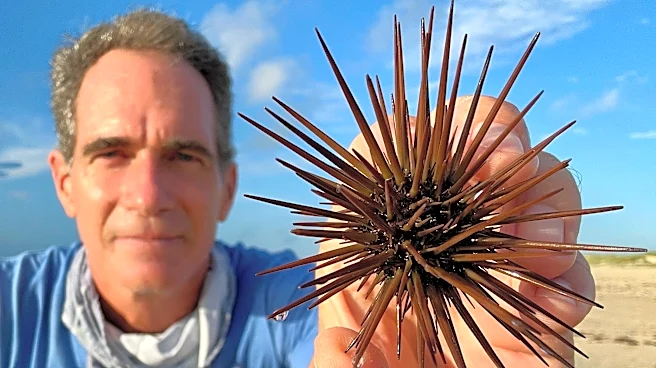








This week, I came across something I definitely wasn’t expecting to find during my Beachcombing survey: a live sea urchin floating on a piece of debris.
It was an Atlantic purple sea urchin, Arbacia punctulata, a species I normally associate with rocky areas such as jetties. This one was miles away from the nearest jetty, apparently catching a ride on debris that eventually washed ashore.
When I picked it up, I realized it was still alive. Fortunately, I carry a glass jar with me for exactly this reason. You never know when a live animal might need a little help getting back home.
The urchin went into the jar and joined me for the next couple of hours as I continued my survey by electric bike. Eventually, I made it to the jetties in Port Aransas,
where I have seen plenty of this species over the years, and released it back into the Gulf.

Atlantic purple sea urchins range from Massachusetts through the Gulf and into parts of Central and South America. Despite their name, they can appear very dark purple or nearly black.
Like other sea urchins, they have an amazing feeding structure called Aristotle’s lantern. It contains five teeth that allow the urchin to scrape and chew food. Atlantic purple sea urchins are omnivores, feeding on algae as well as sponges, bryozoans, mussels and other small animals.

And yes, people eat sea urchins. The edible portion are the gonads, commonly called uni, particularly in Japanese cuisine. More than 40 sea urchin species are harvested around the world, although Atlantic purple sea urchins are not currently a commercially harvested species. Researchers have even investigated whether they could someday have potential as seafood.
For this particular urchin, however, its biggest adventure may have simply been surviving an unexpected ride down the beach and getting a little help finding its way back home.
Jace Tunnell is the director of community engagement for the Harte Research Institute at Texas A&M University-Corpus Christi. His Beachcombing series appears in newspapers, as a weekly video on YouTube and KEDT PBS, and as a weekly feature on KEDT NPR. Follow Jace at harteresearch.org, Facebook (@harteresearch) and Instagram (@harteresearch).
This article originally appeared on Corpus Christi Caller Times: A displaced sea urchin gets a ride back to the Gulf