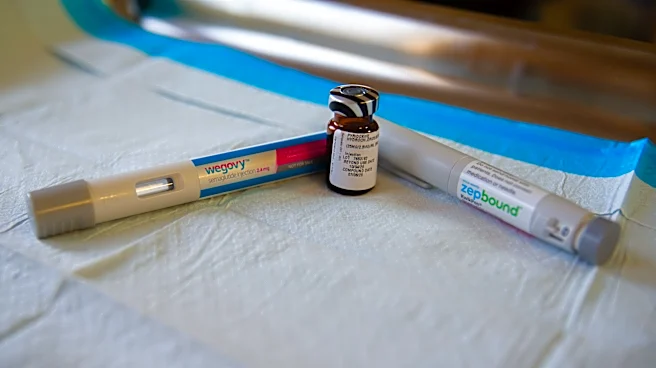







About 1 in 8 adults in the United States is currently taking a GLP-1 medication and nearly 1 in 5 has tried one, according to health care website Pabau.
While medications like Ozempic (semaglutide) and Mounjaro (tirzepatide) have become household names, the rush to snag one has sparked a growing divide between quick-access commercial trends and clinical medical realities.
Local medical experts and health practitioners caution that GLP-1s are not a magic cure-all, but rather a single "tool" in a complex, lifelong weight management process.
As high out-of-pocket costs drive consumers away from traditional primary care and toward online vendors or medical spas, health professionals
warn that skipping comprehensive medical screenings, ignoring essential lifestyle modifications or using unregulated alternative drugs can lead to serious health complications and rapid weight regain.

How GLP-1s work
Dr. Lloyd Stegemann, a metabolic and bariatric surgeon at The Better Weigh Center in Corpus Christi, said people tend to have misconceptions when it comes to how body weight fluctuates. People who go on a diet to lose weight may become frustrated and confused when weight loss plateaus.
Stegemann said that the human body actively fights weight loss by treating caloric deficits as a threat to its internal balance. When fat levels drop, the body signals the brain, pancreas and muscles to restore those lost reserves.
This biological response is where GLP-1 medications come in by blocking the internal signals that trigger weight regain, curbing cravings and helping patients feel full when eating.
Common side effects of the medication are gastrointestinal, such as nausea, constipation and pancreatitis.
People using these medications can lose up to 20% of their body weight, Stegemann said, making GLP-1s the most effective medical weight-loss tool to emerge in two decades.
GLP-1s are just one 'tool' for weight loss
But Stegemann and other medical experts warn that the drug alone cannot maintain weight loss without comprehensive environmental changes including diet, exercise, stress management, medication usage and maintaining a proper sleep routine. He said weight loss is easy, but maintenance is difficult.
Oceana Luxe Medspa, a medical spa on Holly Road, uses GLP-1s in its practice, and staff members said they agree that managing patient expectations and teaching daily habits needs to come before administering the medication.
Cynthia Yzaguirre, a nurse practitioner at the spa, said it's important to set up long-term behavioral changes when first meeting with patients.
"During the initial consultation, it's so important to go over expectations and let them know that GLP-1s aren't the only thing that will solve their problem," Yzaguirre said at the spa. "We need to make sure they're doing lifestyle modifications with eating and exercise. The GLP-1s are just a tool and a foundation to build on everything."
Michelle Bauer, spa director of Oceana Luxe, agreed and said that long-term success rests entirely on post-treatment coaching and symptom management rather than just giving a shot.
"GLP-1s are just a tool," Bauer said. "People really need to change a lot of things to be successful with weight loss. ... That's what will make them successful in the long run. It's not just the medication — it's an entire system."
Why the source of your GLP-1s matters
Beyond lifestyle changes, health officials urge consumers to proceed with caution when sourcing GLP-1 medications online or through third-party vendors, like medical spas.
Dr. Diana Grair, medical director for the University of Houston Health Family Care Center and clinical associate professor, said online sources for these medications lack clinical accountability.
"The danger lies when you have patients who go online filling out questions to get shipped some products," Grair said. "We have two problems there. The first is there was no proper screening or evaluation for things that can potentially be dangerous when taking these medications."
Grair said medical screenings should include a full medical history to see if patients have a history of thyroid cancer, diabetes, eating disorders or mental health issues and what medications they are currently taking.

"The second problem is not knowing what they are truly shipping you and how it's coming to you," Grair said. "Shipping conditions for these drugs are probably not being done correctly and we're not sure if the drug is legitimate or experimental."
An increase in internet research on peptides has surged over the past year, according to experts at Licensed Peptides, a supplier of research peptides for laboratory research.
Peptides are short chains of amino acids that act as fundamental building blocks of proteins and serve as chemical messengers throughout the body, Grair said.
"Semaglutide [Ozempic] and tirzepatide [Mounjaro] are peptides," Grair said. "But there are these other 'peptides' out there that people are trying that haven't been approved by the [Food and Drug Administration] that are not safe for consumption. These include retatrutide and cagrilintide. People need to be careful when looking for avenues for weight loss and only use FDA-approved ones."
Grair said out-of-pocket costs for brand-name GLP-1s have pushed consumers toward compounded alternatives, raising additional questions about supply chain transparency.
Compounded GLP-1s are custom-mixed, lower-cost versions of semaglutide or tirzepatide made by pharmacists — often sold in vials rather than brand-name, injectable pens — that mix the active ingredient locally rather than going through the standard FDA approval process.
While compounded drugs offer lower prices, Stegemann warned that providers must carefully screen their pharmacies to guarantee purity and safety.
"I'm a big believer in compounded medicine," Stegemann said. "You just have to source it from a proper pharmacy. If a spa does that, great. If it's cheaper, that's great too. Just make sure you know where it's being sourced from. Reputable places will be transparent with you."
While at Oceana Luxe, the Caller-Times asked to snap a photo of the medication the medical spa provides. Bauer said pictures of the GLP-1s the spa has on site weren't allowed to be captured.
"We can't let you take any pictures because we can't reveal our sourcing," Bauer said. "Our sourcing is proprietary."
The medical spa instead offered to allow a photo be taken of an undisclosed GLP-1 medication in a syringe.
Asked about her business' level of transparency regarding GLP-1s, Bauer said the reason she did not want to disclose her spa's sourcing was to "simply protect us from any unnecessary auditing that could cause business disruption for us."
The FDA has recommended that compounded forms of GLP-1s only be used in patients whose medical needs cannot be met by an FDA-approved drug.
"We want to be as compliant as possible with the FDA because we value what this medication does for our customers," Bauer said. "The reason I mentioned why I don’t want to disclose my sourcing is just to protect us. It’s not because what we’re doing is wrong — it’s mostly just to avoid any unnecessary eyes on our practice or undue surveillance."
She said that if patients were to ask her for transparency on where medications are sourced from, she will "explore" with them to get to the "bottom line" to secure trust.
Grair cautioned that any medical spa or website offering quick access without thorough medical background checks or transparency of medication sourcing should be considered a red flag for consumers.
"If you go somewhere and they just give you the medication — no questions asked — that should make you realize something is wrong," Grair said. "If you need this medication, go somewhere that is trustworthy."
John Oliva covers entertainment and community news in South Texas. Have a story idea? Contact him at john.oliva@caller.com.
Consider supporting local journalism with a subscription to the Caller-Times.
This article originally appeared on Corpus Christi Caller Times: Experts talk realities, red flags of taking GLP-1 medications