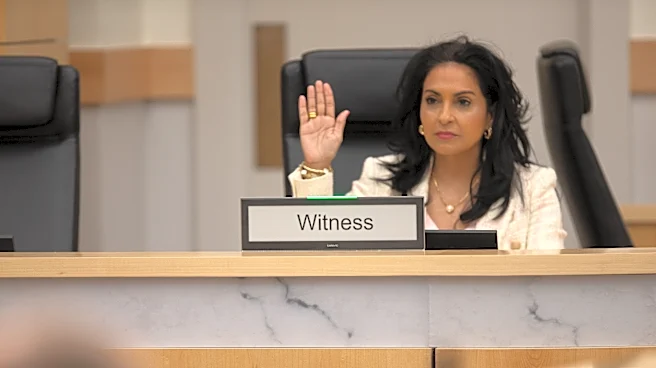






Mayor Paulette Guajardo testified in the second day of her removal hearing for nearly four hours, covering broad ground to include when she had known about allegations made against hotel developers, her role in advancing a tax incentives agreement and whether she had improper communications with company representatives.
She was pressed also about claims that others have made that a crime may have potentially been committed during the process that led to a $2 million tax incentives agreement for the development of a downtown Homewood Suites hotel.
The questions were posed by Doug Allison, the legal representative of the registered voters seeking her removal, and at times led to tense exchanges.
Guajardo has long maintained that she has committed
no wrongdoing and on July 23 disputed Allison’s assertions, along with some other witnesses’ testimony.

It was the first live testimony in the hearing, which had launched July 22. It concluded the case made by petitioners. Guajardo’s case will be heard in two weeks, on Aug. 6 and Aug. 7.
The previous day had focused on a series of depositions that had been taken as part of a civil lawsuit filed by hotelier Ajit David against the city of Corpus Christi and Guajardo, about four months after tax incentives were approved for his competitors in 2024.
Allison represents David in the lawsuit. David is also one of the petitioners for Guajardo’s removal.
The aim of the pending lawsuit is different than the removal hearing. In the private litigation, David seeks to invalidate the agreement between the city’s board that oversees sales tax incentives for economic development and Homewood Suites hotel developers Elevate QOF LLC.
The videotaped depositions had included testimony from past and present city staff, as well as economic development officials.
July 23 opened with the deposition of Philip Ramirez, a developer with Elevate QOF LLC, before Guajardo was sworn in for questioning by Allison.
The proceeding was paused multiple times by City Councilwoman Kaylynn Paxson, the presiding officer of the removal hearing, to remind Guajardo, Allison and Guajardo’s attorney, John Flood, to stick to questions and answers instead of arguing.
“The issue here is not ‘did you commit a crime’ and the issue here is not even ‘did Philip Ramirez commit a crime,’” Allison said, addressing Guajardo. “The issue here is whether or not there is grounds for your removal or other discipline because of misconduct, malfeasance, incompetence or willful neglect.”
The petition
The wheels of the hearing were put into motion about four months ago when the majority of the City Council voted to move forward with a citizens’ petition for Guajardo’s removal.
The request was based on accusations that Guajardo had committed misconduct or malfeasance — more specifically, that she had been aware of allegations that Elevate QOF LLC had used misleading materials as part of its ask for the tax incentives, but pushed through an agenda item approving the agreement.
Petitioners further alleged that Guajardo had committed perjury in a deposition taken as part of David’s lawsuit.
The controversy originated with a screenshot of a U.S. Federal Emergency Management Agency press release announcing the date that new flood maps would take effect.
Neither the date of the news release nor the release number appeared in the screenshot that was used as part of presentations made in 2023 and 2024 about the project and the purpose of the funding.
That’s because showing the April 2022 news release date would have upset the timeline in which developers could claim to have not known about the updated flood maps, according to Allison’s version of events.
The original stated basis for the $2 million in tax incentives had been “additional cost associated with newly defined FEMA AE flood zone requirements,” he said.
Allison argued that the maps were not newly defined, but had been in the public sphere for several years before final adoption, and that there had been a deliberate effort to conceal the dates by using text boxes to cover them.
Ramirez has denied allegations of wrongdoing.
In his videotaped deposition, Ramirez said he had been who created the slideshow and described the question on the dates as an inadvertent formatting issue.
What had mattered wasn’t the date of the press release, he said, but the date that appeared in the news release announcing when the new maps would go into effect — October 2022.
There wasn’t an intent to mislead, Ramirez said.
“It appears that it was just a formatting error of some sort — an accidental formatting error, nothing more, nothing less,” he told Allison in his 2025 deposition.
The application
Allison in his narrative traced a line back to a 2023 board meeting of the Corpus Christi Regional Economic Development Corp. where Guajardo had served as a member.
There, the request had been linked to expenses to meet “newly defined FEMA AE flood zone requirements,” according to Allison.
Tax incentives are tied to infrastructure projects, he said.
Allison showed a record of a text message sent by Guajardo during a CCREDC board meeting to Deven Bhakta, a developer with Elevate QOF, asking about the economic impact of the hotel.
Bhakta’s response, in part, thanked Guajardo “for looking out for us.”
Her intent, Guajardo told Allison, was to verify the number, not to advocate for Bhakta but instead support the project.
Asking Bhakta questions and receiving responses was “inviting him into the room so you can be his mouthpiece,” Allison said.
The presentation had included the FEMA screenshot, Allison said, and the CCREDC ultimately voted to recommend the project be awarded about $1 million in tax incentives to address FEMA issues.
Guajardo said the funding had been approved for FEMA costs, but also because of economic development discussions — “the fact that [it was] going to revitalize … what it was going to do to the downtown area.”
The application then went to the city’s Type B Board, the panel that oversees economic development agreements for sales tax incentives, where the same screenshot was shown.
Type B Board members had approved $2 million in incentives, the then-board president stating the funding was not to resolve the FEMA issues but instead to invest in a “capstone project in the downtown area to spur other development.”
The agreement subsequently went to the City Council for two affirmative votes.
In the first — approved Feb. 20, 2024 — verbiage had focused on FEMA.
In the second — approved April 23, 2024 — the language didn’t mention FEMA and focused on helping to finance retail, public space and outdoor dining.
Now-former Assistant City Manager Heather Hurlbert testified in her videotaped deposition that the amendments were made to clarify the Type B Board’s recommendation.
It had initially been planned that a second vote on the original ordinance would be held Feb. 27, 2024. However, it was withdrawn.
Guajardo said decision-making was based on the materials she had been given.
She didn’t know whether a “false narrative” had been employed by developers, but that “it was not the right narrative,” Guajardo said.
Allison suggested that she had agreed that the slide had been intentionally altered.
“I'm not going to attest to that,” she said. “But it was definitely a different slide.”
An investigation
In large part, Allison focused on when Guajardo had known about allegations made against the developers and the extent of her knowledge.
He said City Manager Peter Zanoni had called Guajardo on Feb. 25, 2024, to let her know that he had met with David and that David “is making a complaint about an altered document.”
Phone logs of Bhakta and Ramirez’s data, obtained through David’s litigation, showed Guajardo called both on the same day, Allison said.
On Feb. 26, 2024 — the day before the incentives had been planned to go to a second vote — phone logs showed there were about a dozen calls between Guajardo and either Ramirez or Bhakta, according to Allison.
Guajardo said she did recall what they had talked about on calls.
“It’s not uncommon for any council member to talk to the project, the developer, the builder or what have you,” she said. “But to say that we were doing something conniving about something is not true.”
Officials investigated the allegations following the complaint.
In her deposition, Hurlbert had described the screenshot as a forgery, and Zanoni in his deposition agreed.
Guajardo countered that neither was qualified to make that determination.
Zanoni said in his deposition said that he had told several council members, including the mayor, likely in March, that “what appears to be a forgery of a federal document tied to this award money” had been brought to his attention.
Zanoni told her he would investigate the allegations, Guajardo said, but she was not told “a federal law had been broken.”
Information outlining allegations was presented during an April 16, 2024, executive session, Allison said.
Guajardo said she was aware there had been an executive session item, but didn’t recall “exactly what was put up” and that she may have walked out to her office or the restroom.
“I don't recall it being presented precisely because I don't think I was actually in the room at that moment, but I know that that took place,” she told Allison.
Although Zanoni had told council members that there was an altered document, “he hadn't let the council know that his investigation had concluded and given us the results of that investigation,” she said.
More questions
Although Allison had earlier noted that the removal hearing wasn’t a criminal case, he raised several times questions on how different people assessed the use of the screenshot.
Corpus Christi police, coordinating with the Nueces County District Attorney’s Office, had “found no prosecutable crimes” in their review, Flood said.
Guajardo was not interviewed as part of the law enforcement investigation, Allison said, and the police department did not subpoena native computer data for more information on the slide or text messages.
It was a “fluff investigation,” he said.
“Whether or not there's a prosecutable offence is absolutely, positively still an open question,” Allison said, adding that he would “look forward” to asking District Attorney Jimmy Granberry questions, should he testify.
Kirsten Crow covers city government and water news. Have a story idea? Contact her at kirsten.crow@caller.com.
Consider supporting local journalism with a subscription to the Caller-Times.
This article originally appeared on Corpus Christi Caller Times: Corpus Christi mayor testifies in removal hearing. Here's what she said