






Corpus Christi residents will have the chance to vote on eliminating a controversial drought exemption fee program for industry approved by a previous City Council in 2018.
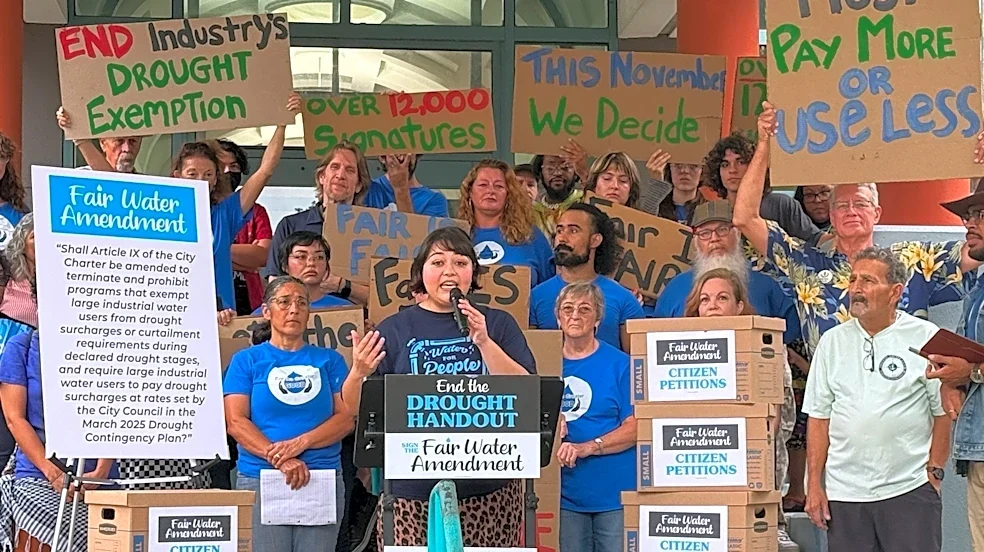
Commonly referred to as the Fair Water Amendment, Proposition B on the Nov. 3 ballot seeks to end the voluntary program that allows participating large-volume water users to pay a fee in exchange for exemption from drought surcharges if the surcharges were implemented.
Participating industries currently pay an upfront fee of 31 cents per every 1,000 gallons of water used each month regardless of drought conditions.
The revenue generates $6 million annually and goes toward funding development of new water supply projects.
If approved by voters, Proposition B would amend Article
IX of the City Charter to prohibit programs that exempt large industrial water users from drought surcharges or curtailment requirements during declared drought stages.

The amendment would also institute mandatory surcharge rates in certain drought conditions specifically for industrial water users.
Supporters argue the amendment would make industrial users pay their fair share during droughts, while city officials and some leaders believe eliminating the program could jeopardize funding for future water projects.
Breakdown of the amendment
The Fair Water Amendment petition was launched at the beginning of the year in an effort to address recurring residential water conservation.
The petition collected 12,700 verified resident signatures, and the City Council voted to send the measure before voters on Aug. 11.
These are the rates Proposition B would require all industrial water users to pay during each drought stage:
- Stage 1: no surcharge
- Stage 2: $3 per 1,000 gallons over a baseline of 12.842 million gallons
- Stage 3: $6 per 1,000 gallons over a baseline 12.842 million gallons
- Water emergency: $12 per 1,000 gallons over a baseline of 12.842 million gallons
If passed by voters, Proposition B would take effect in 2031 due to a provision in the City Charter stating the city may repeal the program within a notice of five years.
Supporters
Proposition B was officially endorsed by the Nueces County Democratic Party and the Coastal Action Network, a coalition that includes advocacy groups Chispa Texas, Coastal Watch Association and Hillcrest Residents Association.
A news release from the county Democratic Party pointed out that the city’s water rate structure is not up for vote but rather how water conservation and costs are equally shared across all customer classes.
Armon Alex, director of the Fair Water Amendment campaign, said allowing Corpus Christi citizens to be involved in the conversation about water management has been the basis of the campaign.
Alex believes there is an opportunity to generate money to fund drought-resistant water projects without the exemption program. He said that revenue from drought surcharges, if they were implemented, would make up for the $6 million annual revenue from the exemption fee if the amendment passes.
Isabel Araiza, co-founder of For The Greater Good and local organizer involved with the campaign, believes the measure is beyond political party lines.
Residents from all walks of life have supported the initiative, she said.
“We really need to try not to get sucked into those ‘us versus them,’ ‘red versus blue’ discourses because we all need water,” she said. “Those kinds of things should not be dictated by what party we’re members of, but by what type of policies actually improve or enhance people’s well-being.”
Opponents
City Councilman Roland Barrera voted to deny the amendment from the ballot, agreeing with a “climate charter” designation in August. Under Texas law, a charter provision or amendment that addresses climate change or the municipality’s environmental impact needs approval from the Texas Legislature before appearing on a ballot.
Barrera said he’s not opposed to industry paying increased surcharges during certain drought stages but is concerned about losing revenue to support future water infrastructure.
He believes that without the program, funding development of water projects, including debt service and infrastructure costs, would be spread among all ratepayer classes, including residents.
Assuming the area is relieved of drought due to new water resources becoming online, then this would have implications, he said.
“This Fair Water Amendment actually reduces the rate for industry because if we find more additional water resources and we’re never in drought, then no one pays. No one’s assessed a penalty or a fee," Barrera said.
Drought surcharges written within the Drought Contingency Plan beginning at Stage 2 have not been enforced on any Corpus Christi Water customers.
Imposing surcharges for customers during a water emergency and halting the program were discussed in a March 31 council meeting, but action was not taken.
City Councilman Gil Hernandez voted to approve the amendment for the ballot but distinctly because organizers followed the City Charter process and collected the required signatures.
He believes it is a bad policy.
“It's like putting parking fees in your constitution, but what constitutes a parking violation is in another document,” he said, referring to the Drought Contingency Plan, which outlines when drought stages are triggered. The plan is separate from the City Charter.
“[The amendment] doesn't take into account the items that are in the Drought Contingency Plan that would initiate the fee or a surcharge … It's not written properly to where it would gain the effect that they're trying to accomplish.”
The Nueces County Republican Party officially opposed Proposition B for a similar reasoning.
Nueces County Republican Chair Carmen Calderone Jr. said in a Sept. 28 news release that the party is against the amendment in part due to questionable legal enforceability.
“Putting specific rates, fees, drought surcharges, and regulatory requirements into the City Charter risks locking Corpus Christi into policies that may not fit our needs in the future,” the news release said.
The Coastal Bend Industry Association and the newly formed Citizens for Responsible Policy Political Action Committee oppose Proposition B.
Campaign finance
The Fair Water Amendment has received substantial funding from one primary source totaling $125,000 between Jan. 1 and June 30.
Texas Campaign for the Environment, a nonprofit organization, has supported the campaign through a sister nonprofit dedicated to research and education, according to the website.
The Texas Campaign for the Environment Fund financially supports various campaigns across the state against industry expansion and pollution.
The organization first planted roots in Corpus Christi in 2018 and has been tracking greenhouse gas footprints across the Gulf Coast.
From the period of July 1 to Sept. 24, TCE, which files finances under the Fair Water Political Action Committee, contributed a total of $21,750 listed in the Oct. 5 campaign finance report.
The Green Advocacy Project, a nonprofit advocating for clean energy, contributed $40,000 accounted for in the Oct. 5 report.
Examining the citizen-led campaign
Water policies are being examined across the state as a result of a growing population and demand, according to Del Mar College political science professor Paul Gottemoller.
The campaign for the Fair Water Amendment has been driven by concerns that industry’s water conservation efforts are insufficient compared with restrictions on residential water use.
The momentum built by citizens and supported by the Texas Campaign for the Environment is somewhat rare for Corpus Christi, according to Gottemoller.
“There has been different industry groups or different community business groups that have put together campaigns to support the Inner Harbor [desalination plant],” he said. “I think for an outside environmental group, this is not something we usually see a lot of.”
Within the 17 years he has lived in Corpus Christi, Gottemoller said he could not recall another local citizen-led initiative on this scale.
“It’s interesting because usually these things don’t take off the ground because usually there isn’t a flow of money for those kinds of initiatives, and it does seem like the Fair Water PAC is pushing for something we don’t see all very often,” he said.
But if Proposition B is approved by voters, Gottemoller doesn’t believe this will be the end of the road for the initiative, saying there are often unforeseen consequences.
He referred to the state of California as an example, saying that its constitution has adopted many voter-led initiatives that have made it difficult to move finances around.
“Those can be positive unforeseen consequences, but they also just as easily can be negative unforeseen consequences that create difficulties later down the road that were not entirely anticipated by supporters or opponents," Gottemoller said.
The likelihood of Proposition B passing is unclear, according to Gottemoller, but could hinge on dissatisfaction with city government.
“I do not know really what’s going to happen except that there’s a lot of people in the city of Corpus Christi that are angry about lots of different things,” he said. “It’s going to be a very interesting Tuesday night.”
Felicity Guajardo covers breaking news and public safety. Contact her at felicity.guajardo@caller.com.
This article originally appeared on Corpus Christi Caller Times: Prop B in election would repeal drought exemption fee for industry