




ROBSTOWN — When the Nueces River Authority Board of Directors met last week, two topics dominated the agenda: the Harbor Island seawater desalination plant — an ambitious plan for the future — and the Leakey Regional Wastewater Treatment System — a completed project that continues to haunt the river authority.
Beyond the involvement of the Nueces River Authority and both falling within the realm of water-related projects, Harbor Island and the Leakey plant have little in common.
One is a potential Gulf Coast seawater desalination plant that could supply 100 million gallons of potable water per day, with hundreds of miles of pipeline to deliver water to communities far from the coast.
The other was a sewer project in a small Hill Country community
with only a dozen miles of collection pipe.
The Leakey Regional Wastewater Treatment System project was nowhere near the size of what the Nueces River Authority has taken on with Harbor Island.
It didn't go smoothly.
On Sept. 25, nine residents of the Twin Forks subdivision in Leakey traveled more than 3½ hours to attend the river authority's board meeting in Robstown. During public comment, they described roads ruined by potholes, sinkholes, lost trees and a lack of accountability from the river authority years after the Leakey project was completed.
The residents warned that they might soon resort to legal action.
This project, Nueces River Authority leaders hope, will be a different story.

Nueces River Authority Executive Director John Byrum promised road and water leak repairs, also highlighting some of the challenges that plagued the project, including a period when the river authority could not employ a full-time on-site inspector due to a lack of funds.
Byrum joined the river authority as executive director in 2019, in the middle of the Leakey project. Now, Byrum himself is set to retire at the end of October, as the Nueces River Authority is in the midst of planning for Harbor Island. Deputy Executive Director John Chisholm will serve as interim executive director.
The phrase "Harbor Island desal" was already mired in controversy long before the Nueces River Authority became involved. The city of Corpus Christi was once sharply opposed to a desalination project on Harbor Island; now it is the largest stakeholder that has paid to reserve water from the project.
During the portions of the meeting dedicated to the Harbor Island project, board President Eric Burnett described the river authority's work on the project so far as stunning.
Burnett said there has been some opposition and it hasn't been easy, but that a project like this should get "all kinds of debate" and "ought to get a lot of tough questions."
"The kind of milestones that have been knocked out here in a 24-month period — it's nothing short of remarkable," Burnett said during the meeting.
One large, lingering question is how much the Harbor Island water will cost municipalities and ultimately individual residents.
Byrum and Mark Ellison, the regional sales director for IDE Technologies, which is working with the Nueces River Authority on the Harbor Island project, have indicated that they'll know what the price point is by December or January.
Asked directly by a board member, Ellison did not provide an estimate for a base cost of the water, without taking into account the cost of distributing the water to customers.
The only hint is that it will likely be expensive.
"I will tell you now that seawater desal will be more expensive than water from the reservoirs," Ellison said.
History of Harbor Island
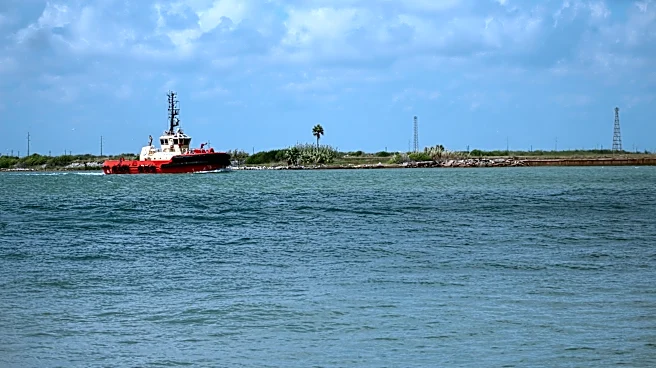
Over the past 200 years, Harbor Island has been home to a lighthouse, port, cotton compress, shipbuilding firm, an oil terminal and a fabrication yard. People dumped unwanted cats on the island in the 1990s, according to the Caller-Times' archives.
Today, the Port of Corpus Christi owns a significant portion of the island, where it removed oil tanks and pipeline years ago.
ERF Port Aransas, which is associated with the Ed Rachal Foundation, has property on the island. The state of Texas and the Nueces County Navigation District own chunks of the island as well, along with Martin Midstream Partners, which has a terminal.
Tourists and Coastal Bend residents know Harbor Island as the spot where they board the Port Aransas Ferry when headed to Mustang Island.
Background of Harbor Island desalination plan
The plan to build a desalination plant on Harbor Island crystallized in 2018, when the Port of Corpus Christi began applying for permits. At the time, the port was also considering a controversial marine terminal for the world's largest crude oil carriers.
In Port Aransas, some residents opposed the Harbor Island desalination project because the port pursued permits to discharge brine into the Corpus Christi Ship Channel, which is believed to pose a greater risk to the marine environment than discharging offshore into the Gulf.
Port leaders maintained that they didn't intend to build or operate the facility themselves — they were beginning the permitting process in the hopes that someone else would take over the project, perhaps the city of Corpus Christi or another third party.
But the port and the city soon found themselves at odds.
In 2022, the Corpus Christi City Council passed a resolution asking the port to withdraw a loan application to the Texas Water Development Board for the Harbor Island desalination project.
The city had pending permit applications for desalination at the Inner Harbor Ship Channel and the La Quinta Channel and had already received a Texas Water Development Board loan.
City officials viewed the port's project as too expensive, as well as competition for their own desalination ambitions and a potential threat to the city's role as sole water provider for the region.
The environmental concerns of area residents on offshore discharge didn't stop the state from granting permits to Harbor Island. The Port Aransas Conservancy challenged the discharge permit in court.
But when the port expanded the scope of the project in 2024, upping the potential plant size from 50 million gallons of water per day to 100 million gallons of water per day, it applied for a new discharge permit, this time offshore.
The Nueces River Authority entered the picture that same year, submitting an unsolicited bid to lease the Harbor Island property from the port and develop the proposed desalination plant.
In 2025, the port committed to abandoning the original nearshore discharge permit upon receipt of the new offshore discharge permit and negotiated a lease agreement with the Nueces River Authority.
Included in the agreement was an incentive for the river authority to provide water to the city of Corpus Christi, with the port waiving part of the rent payment to account for a discount for the city.
That fall, the Corpus Christi City Council narrowly agreed to pay $2.7 million in nonrefundable fees to the Nueces River Authority in order to reserve water from the potential Harbor Island facility. The vote was 5-3.
Byrum visited the City Council several times to explain and pitch the Harbor Island desalination project, espousing total confidence in its feasibility when any doubts were raised.
The river authority promised it wasn't eyeing the city's water customers for potential customers for the rest of the plant's capacity.
Instead, it looked inland, securing reservation fees from smaller communities stretching toward the San Antonio region. This means that in addition to a large desalination plant, the Nueces River Authority will have to build a pipeline to deliver the water to these communities outside of the Coastal Bend. This will be a mammoth task of its own.
Earlier this year, Travis Pruski, then the Nueces River Authority's chief operating officer, sent a letter to the river authority's Board of Directors raising concerns about Byrum's leadership. The letter, which was leaked, alleged that Byrum had made overstated claims to the river authority board and potential customers about Harbor Island reservation fees, among other concerns unrelated to Harbor Island.
The board announced in a May 21 meeting that it had found "no intentional wrongdoing" by Byrum after an external investigation. Pruski resigned during the same board meeting. Several months later, Byrum announced his retirement.
In April, the Texas Water Development Board chose not to prioritize the Harbor Island project during a grant funding cycle because it didn't have enough money to fund all eligible projects.
But the river authority was later able to secure a smaller $7 million grant from the Texas Water Development Board to cover anticipated expenses for the Harbor Island project over the 2027 fiscal year.
The river authority intends to apply again for future state and federal grant opportunities, including from the Texas Water Development Board and the U.S. Bureau of Reclamation.
It's unclear if or when it might secure a more substantial funding source for the project, which is expected to cost billions.
In the meantime, the river authority has used reservation fees to pay for a feasibility study and for pipeline routing and easement procurement activities.
Last week, it received an offshore discharge permit from the Texas Commission on Environmental Quality.
This summer, the river authority chose IDE Technologies, an Israeli desalination firm, to design, construct and operate the plant.
"We've committed our resources and our reputation to come here and partner with you going forward," Ellison told the board.
Where plans stand now
The desalination facility would be built in two phases, Ellison said, starting with 50 million gallons of water per day.
IDE Technologies is in discussions with potential contractors to tunnel out to intake and discharge areas, as well as with geotechnical firms, Ellison said.
The desalination plant would be built with fabricated modules. For the company's previous plants across the world, this meant bringing in modules made elsewhere.
"What's interesting about the synergies here, you've got people in the neighborhood who know how to do this," Ellison said. "We're going to use, wherever possible, the local expertise."
Ellison also said the company intends to work with Del Mar College and Texas A&M University-Corpus Christi to help train the workforce.
Olivia Garrett reports on education and community news in South Texas. Contact her at olivia.garrett@caller.com.
This article originally appeared on Corpus Christi Caller Times: Harbor Island desal is moving along. How it began, what questions remain