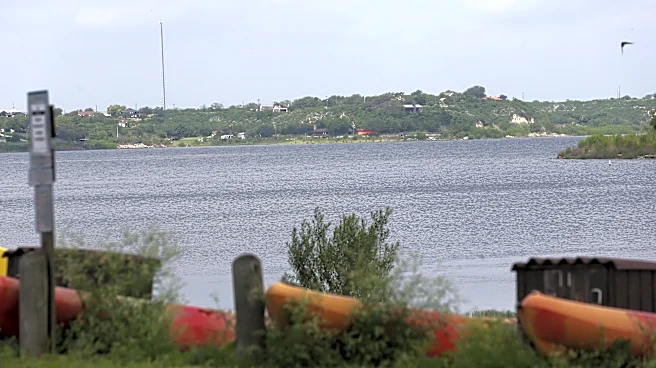

The region was fortunate over the summer, as waves of water from upstream flooding flowed into what had been critically low primary water sources, Lake Corpus Christi and Choke Canyon Reservoir.
But the
experience of facing what had been a nearly imminent water emergency hasn’t left the minds of many residents, and its passing hasn’t put a hold on efforts to expand the water supply.
It will be needed, many have said; history repeats itself, and there is a longstanding pattern of drought in Texas, and the Coastal Bend.
The Inner Harbor seawater desalination project is out — at least, for now — as well as a proposal by a private firm, AXE H20, that had proposed a public-private partnership for a desalination plant near the Barney Davis Power Plant.

Projects in progress include the continued development of the Nueces County Groundwater Program — comprising three well fields outside the corporate city limits — but others in active pursuit or consideration include additional groundwater well fields, as well as seawater desalination at sites other than the Inner Harbor.
Here’s a breakdown of some of the projects.
Evangeline groundwater
The Evangeline groundwater project has continued development, even as a question remains on the timeline that permits may or may not eventually be won.
It hasn’t been officially acquired by the city.
The developer of the project, Evangeline/Laguna LP, is required to meet certain conditions for the final transaction, including attaining all the needed permits for its operations.
While the project has been awarded a production permit, two other needed permits — for drilling and transport — are going to a contested case hearing, a legal proceeding that can take years to resolve and with no guarantee the permits would ultimately be awarded.
How much water would it generate?
The project is proposed to pump as much as 24 million gallons of groundwater per day from about 23,000 acres of property in San Patricio County, near Sinton.
Has the City Council approved it?
Preliminarily, yes. Some council members have suggested that could change, however, depending on the timeline of the project’s progress. That would largely be dictated by the contested case process.
The dates for the hearing have not been set, according to a Sept. 25 city memo.
What is the timeline for completion?
Unclear at the moment. City officials had initially believed the first phase of the project could launch operations in November, prior to the protests filed against the proposed drilling and transport permits.
Regardless, development of the well field has continued, including nearly 60,000 feet of pipeline installed, amounting to about 37% needed for operations, according to the memo.
What obstacles has the project faced?
The project has seen substantial objections by the St. Paul Water Supply Corp. and the city of Sinton, where officials have voiced concern that the well field would negatively affect the quality and accessibility of water in their communities.
Both rely on groundwater for municipal needs.
Disagreement lies between the city of Corpus Christi and the city of Sinton on whose studies are reliable in determining potential impacts, the city of Corpus Christi opposing the city of Sinton’s research findings.
What is the cost?
About $676.5 million, taking into account both water rights and capital costs, according to a presentation made to the council June 2.
Expenditures to date total about $120 million, according to the Sept. 25 city memo.
Harbor Island desalination plant
The project isn’t spearheaded by the city of Corpus Christi; instead, the Nueces River Authority is taking lead in pursuit of a private-public partnership, selecting its preferred developer, IDE Technologies, in May.
The Harbor Island property eyed for the plant is leased from the Port of Corpus Christi Authority.
How much water would it generate?
River authority officials have been planning a plant that would be capable of producing as much as 100 million gallons of treated water per day, according to previous Caller-Times reporting.
Has the City Council approved it?
The City Council approved paying the river authority a nonrefundable reservation fee for as much as 50 million gallons of treated water per day in October 2025.
What is the timeline of completion?
The site recently obtained an offshore discharge permit, issued by the Texas Commission on Environmental Quality, needed for its construction.
The plant is planned to go online in December 2029, officials have said.
What obstacles has the project faced?
The river authority will soon have a change in leadership.
The head of the agency, John Byrum, recently announced his planned resignation, his last day to be Oct. 31.
Nueces River Authority Deputy Director John Chisholm will take over as interim executive director after Byrum’s departure.
The agency has faced increasing scrutiny over the past year, in part related to the Harbor Island project, including allegations that Byrum had misrepresented water sales amounts.
A later investigation determined there was no intentional wrongdoing, previous Caller-Times reporting shows.
What is the cost?
The city’s nonrefundable reservation fee came in at $2.7 million.
River authority officials in an October 2025 council meeting estimated the project cost from $5.5 billion to $6 billion, to include a conveyance line, according to previous Caller-Times reporting.
The agency was recently awarded $7 million by the Texas Water Development Board, articles show.
Reclaimed water for industry
City officials are working with two industrial giants, Flint Hills Resources and Valero, to develop a system in which treated, but nonpotable, effluent will be made available for use in some of their plant operations.
How much water would this project generate?
The project, at complete buildout, is expected to be capable of providing as much as 16 million gallons of reclaimed water per day for industrial use, extending the volume available beyond the two companies.
It is expected to eventually provide as much as 8 million gallons of reclaimed water per day to Valero and 3 million gallons to Flint Hills Resources.
City officials have indicated that other industrial companies have expressed interest in the program.
Has the City Council approved it?
Yes. The council approved the roughly $107.5 million contract to construct an integral 10-mile conveyance pipeline that will run a path from the Oso Reclamation Plant to the Greenwood Water Reclamation Plant.
The council has also approved a 30-year purchase agreement with Valero and a five-year purchase agreement with Flint Hills Resources.
Flint Hills Resources’ agreement involves buying each year as much as 2 million gallons of reclaimed water, starting with 1 million gallons of water per day, sourced from the Alice Wastewater Treatment Plant.
Plans include the company taking responsibility “for all infrastructure, permitting, and operational costs associated with receiving and processing the reclaimed water, including the installation of a City-approved meter that the City will own and maintain,” according to a city memo issued in January.
Valero’s plans would be phased, beginning with 3 million gallons of reclaimed water per day, with an option of potential expansion eventually reaching as high as 8 million gallons of nonpotable water per day.
As part of its agreement, Valero would also commit to reimbursing the city for “chemicals, electricity, and mutually agreed‑upon treatment processes associated with producing and delivering the water,” according to a city memo.
“Valero will also pay its proportional share of operation and maintenance costs for shared delivery infrastructure,” it states.
What is the timeline for completion?
Work on the pipeline from the Oso Reclamation Plant to the Greenwood Reclamation Plant is expected to wrap by May 2027 and infrastructure that is the responsibility of the companies is underway.
Each company is expected to begin using early-phase amounts of reclaimed water within the next few months, according to the city’s Sept. 25 memo.
What obstacles has the project faced?
The project hasn’t seen significant opposition or major apparent obstacles.
What is the cost?
A total of about $107.5 million for the conveyance pipeline.
Barney Davis seawater desalination plant
There have long been proposals for development of a seawater desalination plant near the Barney Davis Power Plant site in the Flour Bluff area.
The idea has been revisited multiple times over the years with little movement.
However, the council showed support earlier this year to again return to the concept.
How much water would this project generate?
As much as 65 million gallons of water per day, according to the memo.
Has the City Council approved it?
The council earlier this year approved staff launching discussions with CPS Energy, a San Antonio-based public utility that now owns the plant, but there hasn’t yet been a contract or plans brought to the council.
If approved, what would be the timeline on completion?
Unknown. However, site surveys needed for discussion on a potential lease agreement are expected to be in talks soon, according to the city memo.
What obstacles has the project faced?
There hasn’t yet been a great deal of voiced opposition; however, the project has remained a concept and has not seen proposals, plans or contracts.
The property eyed for the project is not owned by the city, and its use for a desalination plant would need to be negotiated.
The city would also likely need to bring on board a private entity for a public-private partnership.
What is the cost?
No cost has been identified.
Corpus Christi Polymers
Like the Barney Davis concept, city officials have several times considered potentially employing a desalination plant at the site of plastics manufacturer Corpus Christi Polymers.
Neither the desalination plant nor the plastics plant has ever been completed.
In its most recent iteration, representatives are pitching selling the water treated by the desalination plant, once the facility is completed, to the city.
How much water would this project generate?
Developers have said as much as about 9 million gallons of water per day initially, and potentially expanding by another 5 million to 6 million gallons of water per day.
Has the City Council approved it?
The council approved the staff to enter into negotiations with Aquatech, a company representing Corpus Christi Polymers. However, there hasn’t yet been a contract to consider.
If approved, what would be the timeline on completion?
It’s estimated the plant would be complete in early 2027, according to the Sept. 25 memo.
However, when the company could begin selling water to the city may be months to years later.
What obstacles has the project faced?
Repeated attempts and failures to strike a deal over the years, and also potential environmental concerns.
The actual plant, only partially constructed, has not been fully developed.
What is the cost?
With negotiations ongoing, no cost has been publicly disclosed.
Li Ranch
How much water would this project generate?
Potentially 6 million gallons of water per day.
Has the City Council approved it?
The council gave preliminary approval to purchase water rights, but the transaction would not be final until the property owners met many of the same conditions outlined in the terms for the Evangeline project such as obtaining requisite permits.
The option cost rang in at about $317,000, according to the city’s memo.
If approved, what would be the timeline on completion?
Currently undetermined.
What obstacles has the project faced?
Much of the acreage is located within the property where the Evangeline well field is planned, and the project may face similar opposition.
What is the cost?
The groundwater rights, if the option were exercised, would cost as much as $38 million.
Seven Seas brackish groundwater
Helmed by Seven Seas Group, the proposal as planned would develop a well field on about 5,000 acres at Chapman Ranch.
How much water would this project generate?
At least 10 million gallons of treated groundwater per day, according to documents included in a May council agenda.
However, the Sept. 25 memo notes that the volume “will require verification through aquifer testing and hydrogeologic analysis.”
Has the City Council approved it?
The council approved opening negotiations on a sales contract; however, a contract has not yet come to the council for consideration.
Meetings are continuing with the firm to establish a potential contract, the Sept. 25 memo states.
If approved, what would be the timeline for completion?
Currently undetermined. Developers are in process of testing water samples, among other tasks, according to the memo. A report is expected by the end of September, it states.
What obstacles has the project faced?
None publicly voiced at this time.
What is the cost?
Not yet publicly available.
Inner Harbor seawater desalination plant
Corpus Christi’s proposed Inner Harbor desalination plant — what had been the city’s marquee project — has been in a continued state of flux for more than a year, predating a 6-3 vote in September 2025 against continuing a design contract for the facility.
A second design contract that had been in consideration, proposed by a different firm than the first, failed a year later, in a 5-4 vote.
How much water would it generate?
The plant would produce as much as 30 million gallons of treated water.
Has the City Council approved it?
No. After the most recent vote striking down another contract that would advance the project, council members have aired opposing views on its future.
Some on the council have asserted that they would pursue termination of the plant’s environmental permits to force the project off the table once and for all.
Proponents, meanwhile, have voiced optimism that a future council will pick up the torch. A new slate will be seated in January after the November election.
What is the timeline for completion?
Unknown when or if it would be completed.
What obstacles has the project faced?
The project has a long history of opposition based on environmental, neighborhood, capacity and cost concerns, both in the community and among council members.
The five council members who in the most recent vote rejected the contract cited one or more of those concerns.
Some have also stated the same volume of water can be secured through a combination of projects for less money.
Supporters have said the plant could be developed in a way that would safeguard the environment. They have also cited the project as the only one that is fully permitted and with the backing of state-approved low-interest loans.
What is the cost?
In the most recent iteration, developers estimated the price tag as about $979 million. It is likely that if the next council picked up the project, the cost estimate would not remain the same.
Kirsten Crow covers city government and water news. Have a story idea? Contact her at kirsten.crow@caller.com.
Reporter Olivia Garrett contributed to this article.
Consider supporting local journalism with a subscription to the Caller-Times.
This article originally appeared on Corpus Christi Caller Times: Water emergency is at bay, but these water projects are in the works