
There aren't many sports that center around women aggressively slamming each other out of the way or into the ground. There's only one that also involves a pair of quad skates.
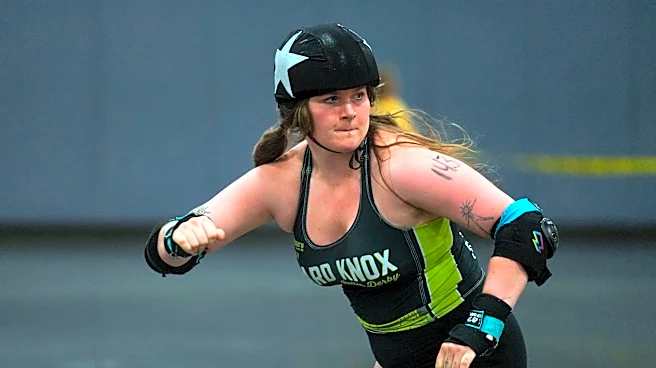
For Hard Knox Roller Derby's Alec Cunningham, the most unique part of her sport is just that: "Being able to go hardcore."
But the physical intensity isn't the only part of roller derby that sets it apart from other athletic competitions. Between the skating itself, the punny names and a long history of inclusivity, it's a totally distinct sport. The rules are unusual, but they share some elements with other games' structures. Cunningham, whose derby name is Flexecutioner, described a derby bout as "like football and NASCAR, but then throw in a little red rover."
Amid this
year's Hard Knox season − which marks the league's 20th − journalist Sophie Szydlik and I set out to learn a little more about the sport firsthand. We were quickly reminded that roller skating is hard enough on its own. Managing to skate while trying to survive some serious roughhousing? Now that's remarkable.
Roller derby has a long history. How it began in Knoxville
It's not surprising that this singular sport has a singular backstory.
Roller derby dates back to the 1930s, when sports promoter Leo Seltzer is said to have dreamed up a new event in hopes of enticing onlookers during the Great Depression, according to the Smithsonian Institution's Folklife magazine. He landed on skating after reading that over 90% of Americans had roller-skated at least once, ultimately concocting a race around a banked track. Racers competed in teams of two, typically comprised of a man and a woman.
The wipeouts were an inevitable component of these races, and in the late 1930s, journalist Damon Runyon told Seltzer the competition might be even more popular if the violence that thrilled the crowds became the central feature. A set of rules began to crystallize, with two teams competing, each trying to pass a member of the opposite team. The rowdy antics grew to include staged whuppings and rivalries not dissimilar from today's pro wrestling, and derby's popularity surged through the 1940s. It even started to be televised.
From its early days, roller derby included LGBTQ skaters, and it was progressive in its inclusion of people of color, too. Women were expected to participate in − and execute − the grueling beatings just as the men were. The pay scales, though, were not always so progressive.
Although Seltzer's son Jerry helped keep derby in the limelight for many years − guiding a resurgence in the '60s and '70s that brought derby to Madison Square Garden − Jerry Seltzer ended up shutting things down toward the end of 1973, citing increasing oil prices that made touring and heating the arenas costly, according to his New York Times obituary. Roller derby faded away.
Then came a revival led by a group of women in Austin, Texas, in the early 2000s. The roller derby they brought back drew on the old rules. The inclusivity persisted, too, this time in a more intentional, modern way. The Times reported these feminist skaters leaned into the notion of women's empowerment, and were the originators of the witty, gritty derby names skaters continue to take on, inspired by the local drag scene.
The sport spread wildly.
Originally called Hard Knox Rollergirls, the local organization began in 2006. A 2007 Knox News column about the league said the founders connected through the early social media site MySpace. At that time, participants included women from many walks of life: librarians, teachers, nurses and graphic designers. "It's an extremely tough sport," Jennifer Browning, who helped start Hard Knox, told Knox News then.
"These women are athletes. They're going as fast as they can on skates ... and being knocked down and getting back up and back in the game. It's absolutely exhausting," added Browning, AKA Beverly Killbilly.
Since then, Hard Knox Roller Derby has continued to grow. On Aug. 29, the organization will host a triple-header to celebrate its 20th birthday. The festivities will be at the World's Fair Exhibit Hall and include a display showing memorabilia from years past and bouts at 3, 5 and 7 p.m.
Pushing the limits − and each other
Today, participants range in age from their early 20s to their 50s, and anyone can join with the open-gender team, Mayhem. The other teams are the A-Team, the All-Stars; the B-Team, the Brawlers; and the C-Team, Chaos.
While plenty has changed since the inception of roller derby, and even since the birth of Hard Knox, the sport continues to empower its participants. That's definitely been the experience of Cunningham, who told Knox News "it's like the light switch comes on" when she steps into her derby persona.
"I get so amped up, and it's just a different life out there. You get so focused on the game," she said. "And things that you never thought that you could do, you're out there doing − on wheels."
If you watch a bout today, you'll see each team is made up of four blockers and a jammer. The jammer, marked by a star on their helmet, gets points for passing an opposing player. Blockers play offense and defense simultaneously, trying to help their jammer and slow down the other team's. That gets pretty gnarly.
The rules, laid out by the sport's governing body, the Women's Flat Track Derby Association, state that players can't hit each other with their heads, elbows, forearms, hands, knees, lower legs or feet. However, you can do plenty of damage with your shoulders and hips. It's common to end a game with bruising, and Velcro scratch marks from the protective gear players wear.
For some, it's a way to blow off steam. For many, it's bonding. "You're being so rough with your friends, but at the end of the day, we're complimenting each other," Cunningham said. "We're (like), 'Hey, amazing hit, you just knocked the snot out of me.'" She described the result as the ultimate camaraderie − one that's likely to keep rolling for another two decades.
Hayden Dunbar Evans is the storyteller reporter. Email: hayden.dunbar@knoxnews.com. Instagram: @knoxstoryteller.
Support strong local journalism by subscribing at subscribe.knoxnews.com.
This article originally appeared on Knoxville News Sentinel: Hard Knox Roller Derby skates into year 20 of camaraderie and clobberings