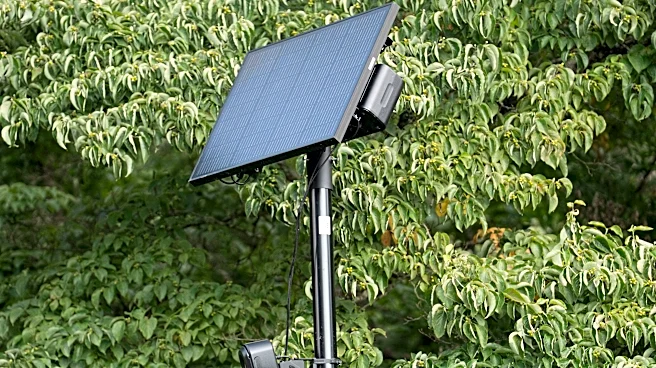


Fifty-eight percent of Knox County residents surveyed by a local Republican polling firm say they reject police use of Flock Safety surveillance cameras.
In a survey this week of 350 likely voters, Spry Strategies found that not only did a majority of respondents reject the AI-enabled license plate readers and surveillance cameras, but almost everyone polled was aware of the controversy surrounding the cameras nationally and at home.
"When I saw that data, I knew it was going to be a good poll because the information was out there," Spry Strategies President Ryan Burrell told Knox News. "Even for me, it's relatively new. I think social media has quickly spread the information."
The Knox County Sheriff's Office contracted with Flock and installed
some of its cameras before outgoing Sheriff Tom Spangler agreed to pause the rollout.
Flock Safety knows it has a public relations problem on its hands after news spread that officers had abused the system to track their personal contacts. The companyrecently announced new safety features around privacy and data protection.
Opposition to Flock cameras crosses party lines, and the local polling shows opposition is bipartisan locally, too.
Forty-nine percent of Republicans, 75% of Democrats and 58% of independents oppose the cameras and license plate readers, according to the survey. Fifty-eight percent of those polled are Republicans and 27% are Democrats, meaning the poll is a representative sample of Knox County's political makeup based on primary election ballots pulled in August.
"We tried to be as down the middle as humanly possible," Burrell said. "The fact that almost 60% oppose flock cameras, and it's a bipartisan opposition. People have developed really strong feelings in a short period of time."
Get the Daily Briefing newsletter: Keep up with the latest local politics and election news for Knoxville and Knox County
The polling is timely.
Knox County commissioners and representatives from Flock and the Knox County Sheriff's Office will have a public meeting at 1 pm. Aug. 24 to answer questions about the system. The sheriff's office has not released its data privacy policy for the system, including who has access to the data, how long it is stored and who can request to see it.
Representatives from Flock have already been meeting one-on-one with commissioners to answer questions, Knox News has learned.
Knox County commissioners could vote Aug. 31 whether to ban the cameras and license plate readers.
Burrell thinks unanswered questions led to some of the bipartisan opposition.
"I think ultimately, this is why people are taking it off the table," Burrell said. "These questions on data storage, data access."
Poll data shows voters don't necessarily want all the cameras to be removed, but they want to know how the cameras work and want secure guardrails to know the data won't be abused.
"This is the most consensus-driven finding in the survey and points to a clear, low-risk policy path: reform and transparency rather than an up-or-down fight over the cameras' existence," the poll's executive summary says.
Flock tensions flare in Sullivan County
On Aug. 13 in Sullivan County in far northeast Tennessee, tensions around the cameras boiled over. In the presence of a company representative, a commissioner called for the execution of the Flock CEO.
“They are one of the most corrupt companies in America. And, quite frankly, sir, I don’t think we can make America great again without hanging your CEO publicly for treason,” Commissioner Joe Carr of Kingsport said.
Jeff Cassidy, the Sullivan County sheriff,said Aug. 18 he had suspended his office's use of 10 Flock Safety license plate readers and asked county commissioners to put a referendum on voters' ballots regarding the future of the cameras.
Cassidy said he and others endured threats because of the department's use of the cameras.
Keep an eye out for Flock Safety in November, Burrell says
People care so much about elected officials' stances on surveillance that they're less likely to vote for candidates who support Flock Safety cameras. Fifty-five percent of respondents said they don't want to vote for someone who supports Flock cameras, while 26% said they would be more likely to support them.
"This makes Flock camera support a liability, not an asset, across the electorate as sampled," the executive summary says.
That could play out in Tennessee, where GOP U.S. Sen. Marsha Blackburn faces Democrat Jerri Green and several independent candidates in the gubernatorial election.
Blackburn won the GOP primary in Knox County comfortably, but the same constituency that nominated her said they oppose Flock cameras. Blackburn supported "the use of license plate readers, Flock cameras and other automated surveillance" in a Nashville Banner survey, though she also said " there is a big difference in having a license plate reader looking at a license plate and anything that would ever lead to some type of 24-hour surveillance.”
"It’s a commonsense measure to protect our communities,” Blackburn wrote to the Nashville Banner. “As governor, I will continue to advocate for the privacy of all those in Tennessee, while balancing public safety considerations.”
Independent Lauren Pinkston on her websitecalls for "clear, transparent policies on limiting data retention and data sharing." She said cameras should be limited and not used to track daily movement.
Green has not widely shared her position on surveillance.
Allie Feinberg is the politics reporter for Knox News. Email: allie.feinberg@knoxnews.com; Reddit: u/KnoxNewsAllie
This article originally appeared on Knoxville News Sentinel: Knox County voters oppose Flock cameras, and it crosses party lines, poll finds