



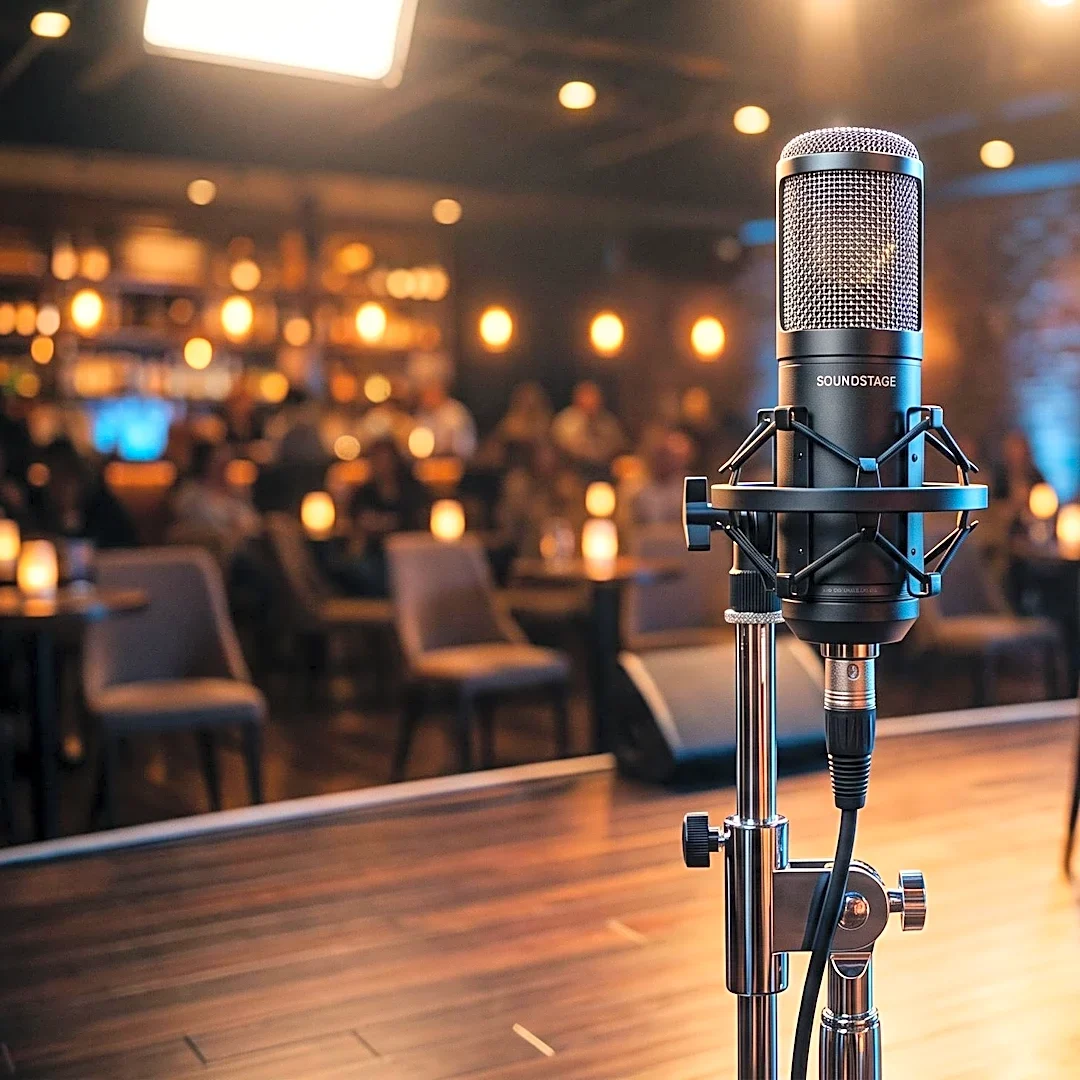


A groan. A gasp. A chuckle. A laugh.
The last sound is the goal. But each reaction serves a purpose for the comedians who check in with Justin Chavez and scribble their names on the list for a few minutes in the spotlight before a mixed crowd of stand-up fans and bar patrons wandering into Scruffy City Hall for a drink.
A backdrop painted to resemble the inside of a cathedral contrasts with some of the night's edgier punchlines, a few of which are met with silence. But this long-running open mic isn't a proving ground so much as a testing ground, where comedians gather each Wednesday to learn what's working and what still needs work.
Comedy is having a moment, from the rise of the "Kill Tony" podcast and the Austin, Texas, stand-up scene to the viral
clips embedded in our algorithms that give us laughter in heavy times.
And as East Tennessee has a moment of its own, with waves of newcomers arriving from across the country, Knoxville has become a laughingstock − a place where a once-scattered collection of open mics has grown into an ecosystem of comics, producers and venues riding a national comedy boom while carving out a scene all its own.
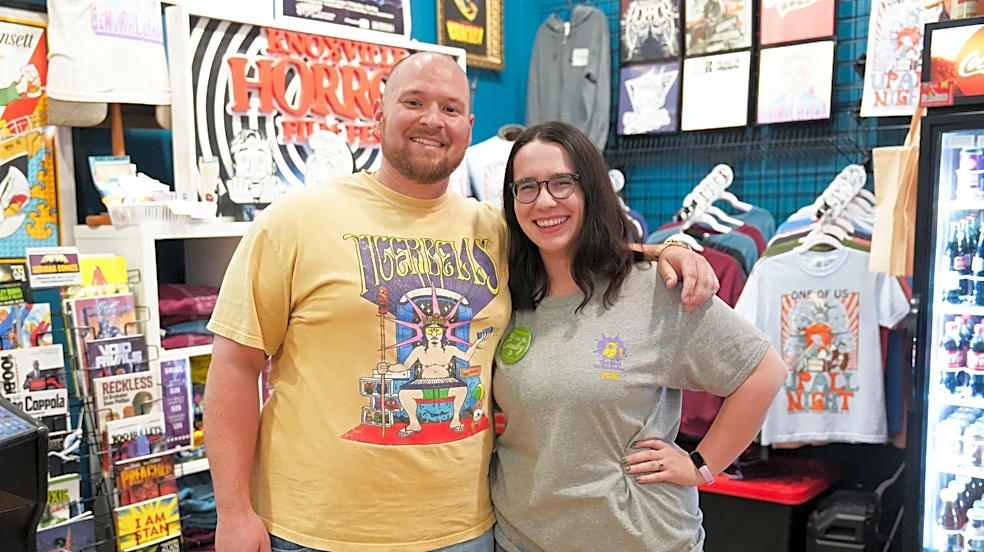
Chavez, a California native who moved to East Tennessee as a teen, is among the people helping shape the modern scene. He spent years working in finance but recently cut back his day job to devote more time to producing shows and building something he believes Knoxville is ready for.
"It will never be Nashville. We're not going to have Zanies-size crowds,” he told Knox News. “But could we have a 60-seat room that fills up every night? I think so."
Knoxville open mics: Where laughter begins with silence
With less than three years of stand-up experience under his belt, Chavez recently took over what's considered Knoxville's longest-running open mic, at Scruffy City Hall.
Open mics are the front door to comedy. They're where future headliners learn to fight through silence and where the funniest person in the friend group discovers whether those inside jokes translate to a room full of strangers.
Rowan Young struggled with the social environment at West High School before switching to online learning for her senior year. Depressed and "borderline agoraphobic," she decided to give stand-up a try at an open mic hosted by Knoxville comedy veteran Jeff Blank at the former Casual Pint downtown.
She bombed.

"I really did badly, and I'm ultracritical. So afterwards I was like, 'I'll never do that again,'" Young told Knox News. "But then (Blank) came up to me and he was like, 'Hey, you're funny. Come back.' And that was all it took. ... I never did sports as a kid, so I finally had an avenue to be competitive.”
Young did return and now runs Tiny Stage Comedy, a local production company that grew from backyard shows on a homemade, purple, literal tiny stage to co-hosting the inaugural Hoot in the Holler Comedy Festival in 2026 alongside Chavez and his production company, The Comedy Sphere.
The festival answered a question comics had been asking for 10 years since Knoxville’s short-lived Scruffy City Comedy Festival came to an end in 2016: Could the city support another event like this?
The answer was yes, said Chavez, who was left with a new and even bigger question: "What's next?”
A scruffy city without a club still finds the comedy spotlight
University of Tennessee student Riley Galvin threw his name into the bucket alongside more than 200 others in hopes it would be called next door at the Comedy Mothership, an Austin comedy club owned by Joe Rogan and the home of "Kill Tony."
The wildly popular and controversial live podcast randomly selects budding comics each week to perform a minute before a panel of established comedians and celebrity guests. It gave Galvin his moment on an episode viewed more than 2.2 million times on YouTube since airing in March.
"Whoever created the phrase, 'It's not about the size of the dog in the fight, it's about the size of the fight in the dog' clearly has never gambled on dog fighting," Galvin told a packed room. "Always bet on the bigger dog."
Knoxville has long played the underdog in Tennessee comedy, overshadowed by Nashville's clubs, industry connections and larger stages. While Nashville has Zanies and Chattanooga has The Comedy Catch, Knoxville has been without a dedicated comedy club since Side Splitters closed in Cedar Bluff more than a decade ago.
Instead, the Scruffy City scene has been growing through a patchwork of venues willing to put punchlines center stage after years of stand-up serving as a sideshow at festivals and other community events.
Happy Holler has become a hot spot for comedy, with Central Cinema and The Pirate Tavern ranking among local comics’ favorite places to perform. And while Knoxville might not have a permanent home for the scene, it has a pink house on Sevier Avenue where karaoke nights have been followed by morning laughter with a blind dating show between stand-up sets by Chavez and Young.

There's also the Frog Juice Boocherie, where local comics workshop material in a sober-friendly room, and some of the biggest touring names show up downtown to perform at local theaters. Aziz Ansari looked to bounce back in Knoxville, working out new material across two nights in 2018, and Dusty Slay recorded his Netflix special "Workin' Man" at the Bijou Theatre in 2023.
Shane Gillis and Kevin Hart have packed Food City Center in recent years for sets on the biggest of local stages, and Knoxville has produced some of its own stars. There's Henry Cho, whose Southern-Korean perspective helped make him a Grand Ole Opry regular and one of comedy's most recognizable clean comics. There's also Leanne Morgan, who will perform two nights at Food City Center in December following her Netflix show "Leanne" receiving an Emmy award in 2026.
Sometimes, the worlds of established and aspiring comedians collide at hair salons and other unlikely venues where Justin Mays produces shows for the global "Don't Tell Comedy" network. Revered by comics for the crowds they draw and the introductions they spark, these "secret" events are an influential part of a local comedy scene that is becoming increasingly difficult to keep under wraps.
'Relationships are everything ... You never know who's going to make it'
A chance encounter with Gillis after a show in Florida and his simple piece of advice – to find an open mic – convinced Mays to give stand-up a try. Five years later, Mays splits time between Knoxville and Nashville, where he works at Zanies while continuing to produce shows in East Tennessee.
Putting on “Don’t Tell Comedy” events, in which lineups and locations aren’t shared with ticketholders until shortly before the show, creates an environment of mystery that’s equally beneficial to audiences and performers.
“Relationships are everything in comedy, man,” Mays told Knox News. “You want to be nice to everyone as much as you can. … You never know who’s going to make it.”
One comedian who has benefited from those chance encounters – and, in turn, been given chances of her own – is Brandi Augustus.

The 41-year-old is building a touring career while remaining rooted in Knoxville, though the thought of life on the road was something the confident stage performer originally shied away from.
“When I traveled before, it was out of necessity,” she told Knox News. “We had to move from Jersey to Cincinnati, and it wasn’t good – like going on Amtrak when we were young and having a single mom with two young kids and all the Greyhound stuff. … I just had a lot of stuff tied into traveling mentally, and I’ve reframed that.”
Many of those emotions and experiences found their way into poetry, her first creative outlet, before what was supposed to be a two-week reset in Knoxville stretched into a 16-year stay and the beginnings of a comedy career.
Joseph Woods, better known as Black Atticus and later Knoxville's poet laureate, invited Augustus to host a poetry open mic at the Pilot Light around 2018. But a recent breakup left her reluctant to share the deeply personal poetry she had been writing.
Instead, she started telling stories.
Woods’ loud, infectious laugh told Augustus what he eventually put into words after about a month of seeing her on stage: “Man, you’re funny.” With his encouragement, she headed to a comedy open mic, and one introduction quickly led to another.
First came Beth Tomkins, who previously ran the open mic at Scruffy City Hall and booked Augustus for her first show. Connie Burrell, considered “Knoxville’s First Lady of Comedy,” booked her second show, and Mays booked her third. The opportunities started to snowball.
Augustus appeared at a “Don’t Tell” show alongside comedian and regular “Kill Tony” panelist Sam Tallent, who put her on at his Big Diamond Comedy Festival in Bentonville, Arkansas. That opportunity led to more bookings than any other experience in her career, she said, with headlining comedians inviting her to open shows across the country.
She has traveled from Knoxville to Nashville to Austin to Seattle to appear on festival lineups, opening spots and a niche series blending tabletop gaming with stand-up comedy. The travel she once loathed has become a major part of her life, and she’s learned to love it.
But more and more, she’s seeing shades of that same momentum happening here at home.
“People don't recognize renaissances when they're in them,” Augustus said. “And we’re in our arts renaissance right now.”

Part of that, she said, has to do with the state of the country and the state of comedy, which often move in opposite directions, much like folk music tends to flourish in difficult times.
“Life is really hard, and we are all in need of community,” said Young. “That’s the reason I keep doing the shows. Because it gives these people a place to gather and feel liked for a little bit and to feel like we’re all in it together and then to maybe carry some of that home with them.”
The promise and peril of going viral: 'That's a lottery ticket'
If open mics are the front door to comedy, comedy clubs are the staircase inside. They give comics a home where they can watch people a few steps ahead of them while working their way up the lineup without ever leaving the building.
But the absence of a Knoxville club isn’t necessarily the glass ceiling it once was.
“You’ve got the phone in your hands. It’s all in your control now,” Mays said. “You used to have to wait to be discovered. Now, your fans are discovering you. … Everybody on the internet’s discovering you.”

Comedy podcasts have launched careers, and 30 seconds of crowd work clipped for social media have turned little-known names into headlining acts.
People travel hours to Austin and sleep in their cars without a guarantee their name will be pulled from the "Kill Tony" bucket. But if that moment comes - as it did for William Montgomery, who started in Knoxville while attending the University of Tennessee - the Tony Hinchcliffe pipeline can create a direct path to some of the biggest stages in the country.
But not everybody appreciates the style of comedy the “Kill Tony” host promotes, even if he has helped make stand-up feel more accessible. In many ways, the podcast functions like a comedy club on a global scale, with comics hoping to work their way from bucket pulls to golden tickets and regular appearances before millions of viewers.
For a lucky few, it can be a chance to take the comedy world by storm. For others, the challenge is proving they are more than lightning in a bottle.
"Kill Tony" remains one of comedy's most polarizing avenues to stardom. Supporters credit Hinchcliffe with creating once-impossible opportunities, while critics question both his role as a gatekeeper and a style of comedy that often rewards provocation. Hinchcliffe drew widespread criticism for comments about Puerto Rico during the 2024 presidential campaign, and he repeatedly has faced backlash over material involving race and culture.

Young is among those wary of what that culture can encourage.
"So many male comics are like, 'I'm just being ironic,'" she said. "And I get it. But those people listening to you, they might not. And they might go home and think some of that stuff you said is cool. And that is scary."
While Augustus said the "Kill Tony" style is "not my type of comedy," she isn't ruling out putting her name in the bucket during a future trip to Austin. Chavez also sits near the middle, taking less of an issue with the show itself than with the belief that one viral moment can replace years of work.
"That's a lotto ticket," said Chavez, who remains less focused on creating stars than creating opportunities. "If all comedy's doing well, then my comedy's doing well. That's the way I look at it."
Knoxville comedy scene is ready for its next act
Chavez's rising-tides mentality is what drives him to create spaces where comics have something to work toward. The Hoot in the Holler Comedy Festival, headlined by Atlanta comedy duo Good Cop/Rad Cop, was one example that helped connect Knoxville to the broader comedy ecosystem developing across the Southeast.

Geography helps. Situated between comedy hubs like Atlanta and Nashville, Knoxville has become a convenient stop for touring comedians looking to fill out regional runs. Mays has used those connections to book talent through "Don't Tell Comedy" and for shows at what's become the closest thing Knoxville has to a comedy club in 2026: The Barrelhouse by Gypsy Circus.
With barrels stacked on display behind the stage, the private room at the regional cidery has become a recognizable calling card for Knoxville comedy.
"It's an iconic stage at this point. People see it. Comics come here, they record their sets, they post their clips," Mays said. "There's so many people when I bring the room up, they don't know what it is. And then when they see the picture, they're like, 'Oh, it's that place,' because the clips are so good."
The room has grown beyond a venue into a comedy destination operating under the @barrelhousecomedy banner on Instagram. The page promotes everything from national touring acts to local showcases to a Wednesday night open mic circuit shared with Scruffy City Hall, which allows comics to bounce between both rooms in the same evening.
One of the most recent headliners was Nashville-based Fiona Cauley, whose comedy ascent has intersected with Knoxville on multiple occasions, including a set alongside New York City comic Mark Normand at a "Don't Tell" show hosted inside a local furniture store.
"We leave Knoxville, we do a 'Don't Tell,'" Normand said on an April 2024 episode of his "Tuesdays with Stories!" podcast. "They always go into little kooky places like 'Fight Club.' It was great, meet the locals. A girl went up in a wheelchair, Fiona. She killed it."
Cauley would later appear on "Kill Tony" with Normand seated on the panel, and the pair have since crossed paths again on podcasts and in comedy circles as Cauley's profile continues to rise.

Considered one of Tennessee's fastest-rising comics, Cauley has remained connected to Knoxville. She returned to the Barrelhouse on Oct. 2, helping showcase local talent in the same kind of intimate room where comics often take their first meaningful steps beyond the open mic.
Most local comics agree: Knoxville still needs a dedicated club for the scene to reach its full potential. But in the meantime, established open mics, new festivals, "Don't Tell" shows and rooms like the Barrelhouse have created a pathway that didn't exist a few years ago.
"All the things are adding up to say, 'Hey, it looks like there's an opportunity to do something with this and make it good,'" Chavez said. "And I think that is such a great thing to do − to provide a group of 30 people hope that maybe they can do something with their dream."
Ryan Wilusz is the business growth and development editor for Knox News. Email: ryan.wilusz@knoxnews.com; Cell: 865-317-5138; Instagram: @knoxscruff.
Support strong local journalism and unlock premium perks at subscribe.knoxnews.com
This article originally appeared on Knoxville News Sentinel: Knoxville's funny business is booming. Now, the comedy scene wants a home