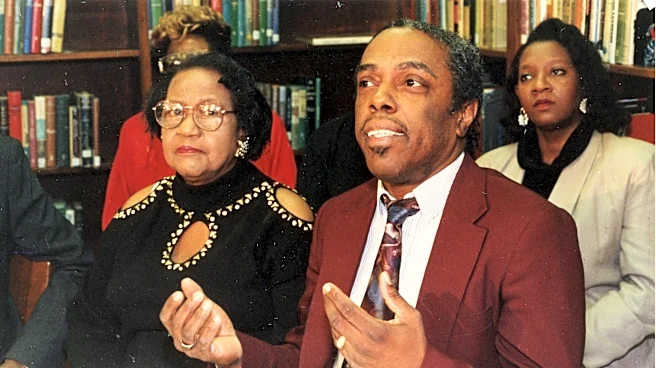






When Dewey Roberts II looks back on his 81 years, the 1989 civil rights complaint he filed against Knox County Schools with the U.S. Department of Education is the accomplishment that feels most significant.
But it's just one achievement in the very full life of the civil rights activist, who has been awarded the Whitney M. Young Jr. Lifetime Achievement Award by the Knoxville Area Urban League.
Roberts, who served as president of the National Association for the Advancement of Colored People's Knoxville branch, was honored alongside other award winners Oct. 8 during the Urban League's Equal Opportunity Awards Gala.
Roberts recently told Knox News he "wasn't expecting anything" when he filed the complaint with the U.S. Department of Education's
Office for Civil Rights, which stated the school system was racially discriminating against teachers and students and critiqued the transfer policy that allowed hundreds of students to attend schools outside zones where they lived.
But the result brought lasting changes across Knox County Schools.
Award winner's achievements shaped Knoxville as we know it today
Changes were drawn out and contested by multiple parties along the way, but the 1989 complaint led to the multimillion-dollar renovations of Austin-East and Fulton high schools, as well as the move to make Austin-East a magnet school.
The year after the complaint was filed, Roberts became president of the NAACP and served in the role for 16 years.
Roberts also was instrumental in Knoxville's establishment of the Police Advisory and Review Committee, or PARC, which Mayor Victor Ashe formed in 1998.
But Roberts laid the foundation for those successes even earlier, back when he was involved in the Civil Rights Movement.
Roberts' role at the heart of Knoxville's Civil Rights Movement
After becoming involved in the Civil Rights Movement in the early 1960s, Roberts cofounded the Committee for the Development of the Black Community, a group that protested racial injustice in Knoxville, whether by calling out the devastation caused by urban removal or by picketing a Cas Walker grocerystore.
"We picketed, we marched, and there was just that constant thing − but especially in the Movement − that your life was in danger. You just knew that, but it didn't deter you," he said. "In fact, it made you realize how important what you were doing (was). But I got a lot of ... death threats once I got in the NAACP. I got a lot of them during the Movement. But you just keep going."
Roberts met icons of the Civil Rights Movement during the period and collaborated with local leaders such as Avon Rollins and Sarah Moore Greene.
"What I can say about all the civil rights people that I knew and worked with, none of them ever felt like what they were doing was not going to work," he said. "They always had that vision that no matter what we're doing, we are actually going to come out in the end."
Those experiences have given Roberts a wealth of knowledge that Knoxville Area Urban League President and CEO Dr. Laurie Shanderson said she's leaned on during her time in the role.
"Being able to speak with someone and meet someone who was so significant in the Civil Rights Movement in Knoxville, it means a lot to me," she said.
The Urban League's board committee identified Roberts as the individual to be honored with this year's award. Throughout his decades of civil rights work, he collaborated with the Urban League and other organizations that often worked together to advance the movement's goals.
Roberts joked, "I like to take credit."
"But it really wasn't me," he said. "It was all those people around that made a difference."
'That belief that things can be better'
Roberts has done a lot of reflecting recently. His autobiography "My Moments in the Movement" was published last year, and Roberts said he feels lucky to have had a hand in history and living to see the outcome.
But the future gives him pause.
He sees us living in an era when racism is strong and in a society that is "going back in so many ways." There are lessons to be learned from how folks have navigated these challenges before, he said. Collaboration is one piece of that. And "it's got to be in your heart."
"As long as you have that, keep it in your heart," Roberts said. "And keep that belief that things can be better, will be better and better be better in order to make it better for the whole community."
Who else was honored at the Equal Opportunity Awards Gala?
Corporate Leadership Award: Clayton Homes
Minority Business of the Year Award: Asheville Highway Animal Hospital
Volunteer of the Year Award: Dr. Olga M. Welch
Community Champion Award: The Knoxville East Lions Club and Five Points Up
Hayden Dunbar Evans is the storyteller reporter. Email: hayden.dunbar@knoxnews.com. Instagram: @knoxstoryteller.
Support strong local journalism by subscribing at subscribe.knoxnews.com.


This article originally appeared on Knoxville News Sentinel: Civil rights legacy of Dewey Roberts II honored by Knoxville Urban League