








The story of the American Revolution most Americans learn has a geography. It begins at Lexington and Concord, moves through Boston and New York, pauses at Valley Forge and Saratoga, and eventually arrives at Yorktown. In that familiar story, the Southern Campaign seems all but forgotten. But it should not.
By 1780, the South had become the principal theater of the war, and some of its most savage fighting took place not between great armies of British redcoats and Continental soldiers, but between Americans themselves. Patriot fought Loyalist; neighbor fought neighbor; old grudges became political causes and political causes became blood feuds. The National Park Service rightly describes this struggle as an “oft-neglected” civil war within the larger
Revolution.
In the middle of that struggle came one of the most important, if not overlooked, American victories of the war: the Battle of Kings Mountain. On Oct. 7, 1780, approximately 900 Patriot militiamen surrounded a ridge in the Carolina backcountry where Major Patrick Ferguson and roughly 1,000 Loyalists had made their stand. Barely an hour later, Ferguson was dead and virtually his entire force had been killed, wounded, or captured. It was the first major break in a succession of disasters that had threatened to destroy the Patriot cause in the South.
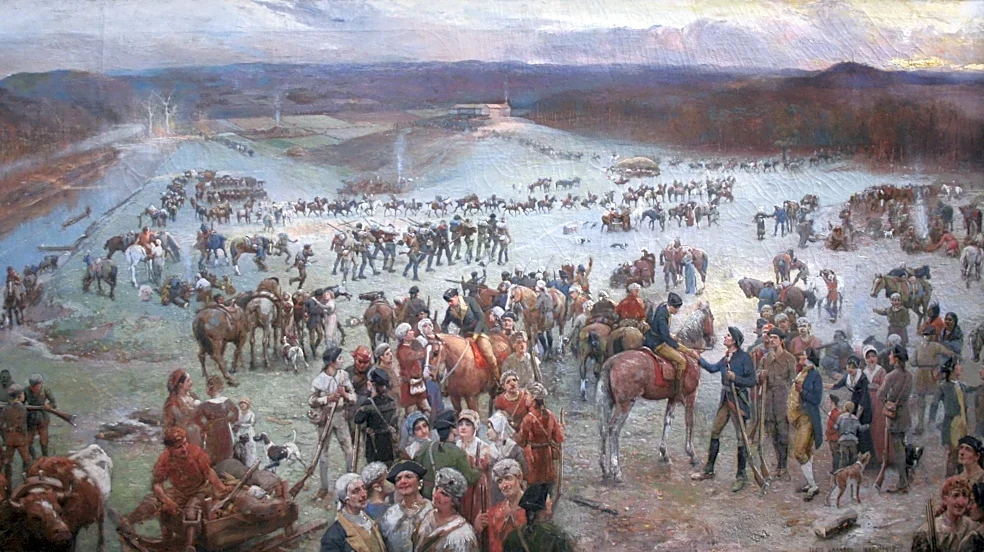
For East Tennesseans, the story had begun weeks earlier at Sycamore Shoals.
Major Patrick Ferguson makes an almost irresistible villain in the story. A Scotsman, professional soldier, talented marksman, and innovative military thinker; Ferguson was not an incompetent brute. He had designed the famous breech-loading rifle that bore his name and had earned a reputation as an energetic and effective officer. In 1780 General Cornwallis entrusted him with organizing the Loyalist militia and protecting the western flank of the British advance into North Carolina. Ferguson was, in fact, the only regular British soldier who would fight at Kings Mountain; most of the men who followed him there were Americans loyal to the Crown.
But Ferguson also possessed faith in himself which bordered on hubris. According to the recollections later preserved by Isaac Shelby, Ferguson sent a warning across the mountains that if the western settlers did not cease their opposition, he would “hang their leaders” and lay their country waste “with fire and sword.” This warning has become one of the foundational stories of the Overmountain Men and captures how Ferguson was remembered by the men who came after him: as a threat that had to be met before it crossed the mountains and threatened their homes. So instead of frightening the western settlers into submission, as Ferguson had hoped, the threat created the opposite effect.
They came looking for him.
John Sevier led some 240 men from the Watauga settlements; Isaac Shelby brought another 240 from Sullivan County. Joined by William Campbell's Virginians and then by forces under Benjamin Cleveland, Joseph Winston, and others, the army that had gathered at Sycamore Shoals crossed the mountains and pursued Ferguson into the Carolinas.
These were not Continental regulars. Many were farmers, hunters, tradesmen, and settlers accustomed to rifles and to fighting in heavily wooded country. Among the families associated with this frontier military community were the Beans. William Bean, remembered as the first permanent settler in what became Tennessee, served as a captain in the Washington County militia, while members of his family served in Sevier's forces and were remembered in the tradition of the Kings Mountain campaign. The story of Kings Mountain was woven into the families that had created the Watauga settlements and founded East Tennessee.
When the Patriots finally located Ferguson at Kings Mountain, they did not attack as a conventional 18th-century European army. They surrounded him.
The long, narrow ridge gave Ferguson the high ground, and his Loyalists repeatedly drove downhill with bayonets. But the Patriot riflemen gave ground, disappeared behind trees and rocks, and then returned. Again and again they climbed the slopes, firing from cover and tightening the ring around Ferguson's position. The fighting was close, confused, and ferocious. A battle much more characteristic of the brutal Southern backcountry than of the ordered lines associated with traditional 18th-century warfare.
Ferguson, who had boasted that he was “king of that mountain” and that “God Almighty could not drive him from it,” refused to surrender. Mounted on horseback and using a whistle to direct his men, he attempted to break through the Patriot line near the end of the battle and was shot down. With Ferguson dead, Loyalist resistance collapsed. His entire command effectively ceased to exist.
Then Col. Benjamin Cleveland, the enormous, hard-fighting North Carolinian who had joined the Overmountain force during its march, claimed Ferguson's white stallion as a prize of war. Ferguson had threatened the backcountry; now one of the backcountry colonels rode away on his horse.
But the real prize was strategic.
When word of the disaster reached Cornwallis, his advance into North Carolina stalled out. He withdrew toward South Carolina and was forced to reconsider a campaign that, only weeks earlier, had appeared almost unstoppable. Kings Mountain did not end the Southern Campaign, but it altered its momentum. It was followed by Cowpens, Guilford Courthouse, and a grinding campaign that steadily exhausted British power in the South.
Years later, one of the British Generals, Sir Henry Clinton, understood exactly what had happened. He called Kings Mountain the “first link in a chain of evils” that eventually ended in Britain's loss of America. That observation should make us reconsider the map of the American Revolution. Yorktown did not simply happen because Washington and Rochambeau marched south in 1781. The road to Yorktown also ran through Savannah, Charleston, Camden, Kings Mountain, Cowpens, and Guilford Courthouse.
The Southern theater was not peripheral to the Revolution's conclusion. It was where Britain's final great strategy for restoring its American empire was tested and broken. Modern scholarship increasingly emphasizes precisely this point: the Southern Campaign was central to the outcome of the war even though it has often received less attention in the national narrative.
And East Tennessee, years before there was a state called Tennessee, was part of that story.
The men who gathered on the Watauga did not know that Cornwallis would surrender at Yorktown almost exactly one year later. They did not know how historians would eventually describe Kings Mountain. They knew only that Ferguson had threatened their homes and families and that the Patriot cause in the South was in peril.
So they crossed the mountains.
And at Kings Mountain, they helped turn the tide of the American Revolution.
A. Warren Dockter is president and CEO of the East Tennessee Historical Society. This article is part of a series commemorating the 250th anniversary of America's independence.
This article originally appeared on Knoxville News Sentinel: Turning of the Tide: East Tennessee and the Battle of Kings Mountain | Opinion