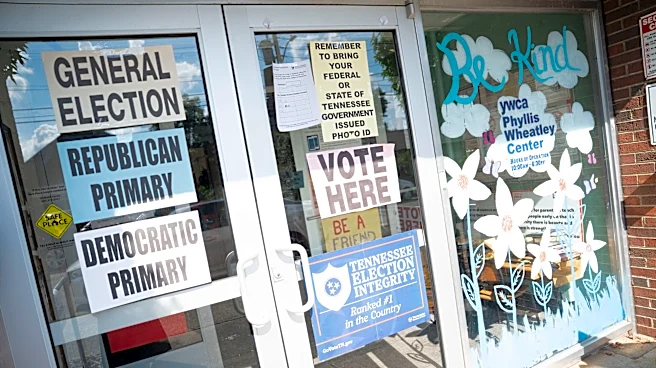









In addition to consequential races for governor, U.S. Senate and the state legislature, midterms voters will weigh in on three proposed changes to the Tennessee Constitution.
The changes, if approved, will make it easier to deny bail to defendants accused of serious crimes, ban a state property tax and enhance the rights of crime victims.
The bar for amending the Tennessee Constitution is high: An amendment only passes if most of the people who voted for governor also vote for the amendment. In other words, "the number of 'yes' votes must be more than half of all votes cast in the governor’s race," the Tennessee Secretary of State'swebsite says.
Here are referendum questions that will be on ballots statewide.
Tennessee constitutional amendment on bail denial
What it does: Allows judges to hold
defendants without bail before a trial if a defendant is accused of an offense punishable by the death penalty, an act of terrorism, second-degree murder, aggravated rape of a child, aggravated rape, grave torture and any crime where a person would be required to serve 85% of their sentence. Tennessee already allows judges to keep suspects in jail for the worst types of crimes, and this amendment would build on the list.
What do people in favor say? Supporters of Amendment 1, including Tennessee Senate Republican Majority Leader Jack Johnson, say judges may have compelling reasons to deny bail but must offer it for most cases. Changing the constitution would prevent people accused of dangerous crimes from doing more damage while awaiting trial, Johnson said.
"Our justice system should not allow dangerous defendants to secure their freedom simply because they have sufficient financial resources, while defendants accused of lesser offenses may remain incarcerated because they cannot afford bail," Johnson said in anopinion article for USA TODAY Network-Tennessee. "Importantly, this amendment does not mandate detention. It gives judges discretion to make decisions based on the circumstances before them."
What do people against say? Those against Amendment 1, such as the American Civil Liberties Union of Tennessee, say the amendment violates the American tenet of the presumption of innocence. Judges already have the power to make sure defendants return to court and don't commit other crimes, the ACLU says.
"The amendment would give the government more power to jail people accused of certain crimes who have not been convicted," ACLU wrote on its website. "Pretrial detention can have lasting consequences. Even a short time in jail can cost someone a job, housing, family stability and the ability to help prepare a defense."
It will cost taxpayers more because more people will be jailed for months. "Tennessee already spends substantial public funds on incarceration: TDOC reported $161.7 million in county and local-jail reimbursements for housing convicted felons in fiscal year 2024–25." County jail crowding also increases operational and healthcare pressures on local governments," the ACLU said.
What your ballot will say:
Shall Article I, Section 15 of the Constitution of Tennessee be amended by deleting the following:
That all prisoners shall be bailable by sufficient sureties, unless for capital offences, when the proof is evident, or the presumption great. And the privilege of the writ of Habeas Corpus shall not be suspended, unless when in case of rebellion or invasion, the General Assembly shall declare the public safety requires it.
and substituting instead the following:
(a) All prisoners shall be bailable by sufficient sureties unless for the following when the proof is evident or the presumption great:
- A capital offense;
- An act of terrorism;
- Second degree murder;
- Aggravated rape of a child;
- Aggravated rape;
- Grave torture; and
- Any other offense for which, as of November 3, 2026, a defendant, if convicted, could not be released prior to the expiration of at least eighty-five percent of the entire sentence imposed.
(b) In any case in which bail for an offense listed in subsection (a) is granted or denied before conviction, the judge or magistrate shall place in the record the judge's or magistrate's reasons for granting or denying bail.
(c) The privilege of the writ of Habeas Corpus shall not be suspended, unless when in case of rebellion or invasion, the General Assembly shall declare the public safety requires it.
☐ Yes
☐ No
Tennessee constitutional amendment on state property taxes
What it does: Makes it illegal for any future legislature to create a statewide property tax.
What do people in favor say? Gov. Bill Lee, Republican leaders in the state legislature and local GOP leaders like former Knox County Mayor Glenn Jacobs say the amendment would "protect you from double taxation after already paying property taxes at the local level," according to the TN Yes on 2 website.
What do people against say? The Tennessee AFL-CIO Labor Council is urging voters to select "no" because Tennessee hasn't had a property tax in more than 75 years, and no property tax is being proposed.
"Changing the state constitution could address a problem that doesn't exist while distracting from more pressing issues facing the state," the labor council said in a statement.
Tennessee had a statewide property tax until 1949 when it was repealed, according to ACLU Tennessee. States includingNew Hampshire and Vermontuse statewide property taxes to fund education.
What your ballot will say:
Shall Article II, Section 28 of the Constitution of the State of Tennessee be amended by deleting the following language from the first sentence:
In accordance with the following provisions, all property real, personal or mixed shall be subject to taxation, but the Legislature
and substituting instead the following:
In accordance with the following provisions, all property real, personal, or mixed shall be subject to taxation, but the Legislature shall not levy, authorize, or otherwise permit any state tax upon such property, and the Legislature
☐ Yes
☐ No
Tennessee constitutional amendment on victims' rights
What it does: Codifies an enhanced list of crime victims' rights, including the right to participate in the parole process, to be protected from harassment, to be informed of the minimum sentence and to know the scheduled release date. It also "maintains or clarifies" victims' existing rights to be informed about legal proceedings, to be present at public proceedings, to be informed of any release, transfer or escape, to talk to prosecutors, to make statements, to a speedy resolution of the case, to restitution and more, according to the Tennessee Secretary of State's website.
What do people in favor say? State Rep. Elaine Davis co-sponsored the amendment, which would bring Marsy’s Law to Tennessee. Davis wrote in an opinion column for Knox News that it would help bridge gaps in communication for victims who may not know their rights or don't understand the legal process.
"At its core, Marsy’s Law is about protecting victims and ensuring their voices are heard," Davis wrote. "But it’s also about something bigger: creating a justice system that helps prevent future harm by empowering those most affected."
What do people against say? ACLU Tennessee says Marsy's Law makes the state chose between supporting victims and protecting the constitutional rights of those accused of crimes by eliminating the presumption of innocence.
"Tennessee’s Constitution already gives crime victims important rights," ACLU's website says. "These include the right to receive information about a case, attend court proceedings, speak at key points in a case, seek restitution from the person who caused harm, and be protected from harassment or threats. Amendment 3 would erase the current constitutional provision and replace it with a longer list of thirteen rights, which a person identified as a victim could ask a court to enforce."
What your ballot will say:
Shall Article I, Section 35 of the Constitution of Tennessee be amended by deleting the section in its entirety and substituting the following:
Section 35. That to preserve and protect the rights of victims of crime to justice and due process throughout the criminal and juvenile justice systems, a victim, as defined by law and which may be expanded by the General Assembly, shall have the following rights, which shall be protected:
- The right to be treated with fairness for the victim's safety and dignity;
- The right, upon request, to reasonable notice of all public criminal proceedings and all public juvenile delinquency proceedings involving the accused;
- The right to be present at all public criminal proceedings and all public juvenile delinquency proceedings involving the accused;
- The right upon request to be heard in any proceeding involving release, plea, sentencing, disposition, and parole, as well as any public proceeding when relevant during which a right of the victim is implicated;
- The right to be heard and informed of all parole procedures, to participate in the parole process, to provide information to the parole authority to be considered before the parole of the offender, and to be notified, upon request, of the parole or other release of the offender;
- The right to be free from harassment, intimidation, and abuse throughout the criminal justice system, including reasonable protection, as defined by the General Assembly, from the accused or any person acting on behalf of the accused;
- The right, upon request, to reasonable notice of any release, transfer, or escape of the accused or convicted person;
- The right to full and timely restitution from the offender;
- The right to a speedy trial or disposition and a prompt and final conclusion of the case after the conviction or sentence;
- The right to be informed of the minimum sentence the offender will serve in custody and the scheduled release date;
- The right to have the safety of the victim, the victim's family, and the general public considered before any parole or other post-judgment release decision is made;
- The right, upon request, to confer with the prosecution; and
- The right to be fully informed of all rights afforded to crime victims.
A victim may assert the rights enumerated in this section, not as a party, but in the manner further provided by the General Assembly protecting the victim's right to standing. The General Assembly has the authority to enact substantive and procedural laws to further define, implement, preserve, and protect the rights guaranteed to victims by this section. This section must be interpreted to preserve and protect the rights of all persons to due process. This section, or any law enacted under this section, does not create a basis for vacating a conviction. This section does not restrict the powers of the District Attorney General or the inherent authority of the court.
Other than as provided in the preceding paragraph, this section does not create a cause of action or claim for damages against the state or a political subdivision of the state; an officer, employee, or agent of the state or of any of its political subdivisions; or an officer or employee of the court.
☐ Yes
☐ No
How is the Tennessee Constitution amended?
It's difficult to amend the constitution in Tennessee because, unlike several other states, Tennessee citizens can't initiate a referendum. Amendments must go through a lengthy process:
- Lawmakers introduce the amendment in the Tennessee House or Senate
- The General Assembly must approve the proposal for a first time with a simple majority
- The proposal gets referred to the next General Assembly elected after the proposal is passed the first time
- The new General Assembly must approve the amendment by a two-thirds vote of members in both chambers
- The proposal goes on voters' ballots for the next general election where a governor is elected
- The amendment passes if a majority of the people who voted for governor also vote for the amendment.
Allie Feinberg is the politics reporter for Knox News. Email: allie.feinberg@knoxnews.com; Reddit: u/KnoxNewsAllie

This article originally appeared on Knoxville News Sentinel: 2026 Tennessee ballot referendum questions: What to know about crime and taxes