
Each September, the quiet banks of the Watauga River at Sycamore Shoals offer a reminder that some of the most consequential moments in the American Revolution took place far from Philadelphia, Boston
or the camps of George Washington’s Continental Army.
On Sept. 25, 1780, more than a thousand Patriot militiamen gathered near present-day Elizabethton. The following morning, they began a remarkable journey across the Appalachian Mountains in search of a British force commanded by one of fiercest of enemies, Major Patrick Ferguson. Less than two weeks later, that journey would culminate at Kings Mountain.
But before there was a battle, there was a gathering.
As we commemorate the 250th anniversary of American independence, the gathering at Sycamore Shoals reminds us of something essential about the Revolution: American independence was not secured solely by famous generals and armies. It depended upon communities and upon individuals who chose to act.
By the autumn of 1780, the Patriot cause in the South was not merely in danger, it was approaching catastrophe. The crisis had been building for nearly two years. Savannah fell to a British expeditionary force on Dec. 29, 1778, and the following month British troops pushed inland and occupied Augusta, briefly restoring royal authority across much of Georgia. A combined American and French attempt to retake Savannah in the autumn of 1779 ended in bloody failure.
Then on May 12, 1780 Charleston fell to the British forces commanded by Sir Henry Clinton after a lengthy siege. More than 5,000 American troops surrendered, together with hundreds of artillery pieces and thousands of muskets, in what has been described as the greatest disaster suffered by the American cause during the Revolutionary War. It effectively destroyed the principal Continental army in the South and handed the British their greatest victory of the war.
Clinton soon returned to New York, leaving command of the southern campaign to Lieutenant-General, Lord Charles Cornwallis, with thousands of British and Loyalist troops at his disposal. Cornwallis was one of the most formidable commanders in the British Army: aggressive, brilliant, experienced, and charged with converting British military victory into permanent control of the Carolinas.
Then came another disaster. On Aug. 16, at Camden, Cornwallis shattered the army of patriot General Horatio Gates, the celebrated victor of Saratoga. Gates escaped and rode nearly 200 miles in about three ultimately retreating all the way to Hillsborough. The defeat was so complete that any organized resistance in the southern theater effectively disappeared for months. Charleston was occupied, the Continental army had been broken twice in a matter of months, British posts stretched across South Carolina, and Cornwallis was preparing to carry the war northward. To Americans living beyond the mountains, it may have even appeared like the Revolution was beginning to fail.
Ferguson soon turned his attention toward the settlements beyond the mountains. According to accounts preserved by the National Park Service, he warned the western inhabitants that if they continued opposing British authority he would cross the mountains, hang their leaders, and lay waste to their settlements. Rather than intimidate the frontier communities, the threat produced almost precisely the opposite result.
Men began to gather.
Among their leaders were several names that would become central to the history of Tennessee and the southern backcountry. John Sevier, already a prominent leader of the Watauga settlements, brought men from the Holston and Watauga country. Isaac Shelby, another experienced frontier militia officer and future governor of Kentucky, joined him. Men from North Carolina served under Charles McDowell, while William Campbell led Virginia militia south from the Abingdon area. More than 600 men associated with Sevier, Shelby, McDowell, and other local commanders assembled at Sycamore Shoals, while Campbell's Virginians increased the gathering to more than a thousand.
It is worth remembering what that meant in 1780. Tennessee did not exist as a state yet. These communities were on the western edge of North Carolina and Virginia, separated from the east by the Appalachian Mountains. There was no great Continental army waiting at Sycamore Shoals. These were militia; farmers, hunters, settlers, neighbors and family members, all bringing their own horses, rifles, equipment, and provisions. Any yet they came and their assembly transformed a collection of scattered frontiersmen into an organized military force which prepared to cross mountains few conventional armies would have willingly attempted with such speed.
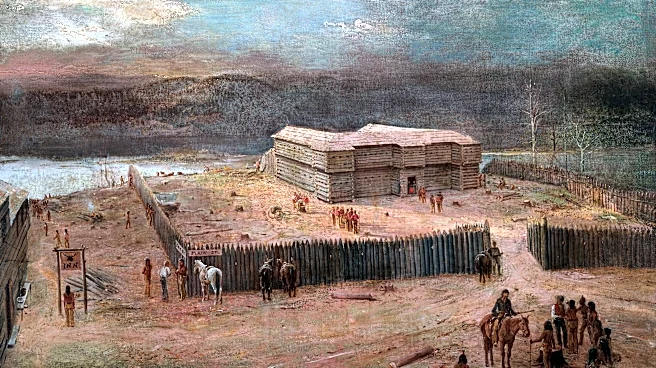
Sycamore Shoals itself was already a place of enormous importance. The Watauga settlements were an early center of political organization west of the Appalachians. The very formation of thew Watauga Association in 1772 revealed a desire for independence and local governance. The shoals had been the site of important interactions, negotiations, and conflicts among settlers and the Cherokee. In September 1780, the site once again became a meeting place where the history of the Appalachian frontier intersected with the larger history of America.
On Sept. 26, as they were departing, the Rev. Samuel Doak addressed the assembled men. His prayer drew upon the biblical story of Gideon, invoking the “sword of the Lord and of Gideon.” Then the column moved out from Sycamore Shoals and toward the mountains.
What followed was an extraordinary march. The men crossed the high country near Roan Mountain, enduring difficult weather and terrain, and descended toward the Carolina Piedmont. Along the way they would be joined by additional Patriot forces from North and South Carolina. Their pursuit of Ferguson ultimately carried them hundreds of miles from the places where they had begun.
But the importance of the gathering at Sycamore Shoals is not simply in knowing what came afterward. It matters because it demonstrates how the Revolution worked on the ground. How news traveled. How communities organized. How leaders could coordinate across political boundaries. How ordinary people came together, made decisions, and changed the course of history.
During America’s 250th anniversary, that is particularly important to remember. East Tennessee was not a distant spectator to the creation of the United States. Long before Tennessee became a state, the people living here were already participating in the struggle over what the new nation would become. At Sycamore Shoals, they did not wait for the Revolution to come to them. They crossed the mountains to meet it.
A. Warren Dockter is president and CEO of the East Tennessee Historical Society. This article is part of a series commemorating the 250th anniversary of America's independence.
This article originally appeared on Knoxville News Sentinel: Before a consequential battle was the gathering at Sycamore Shoals | Opinion