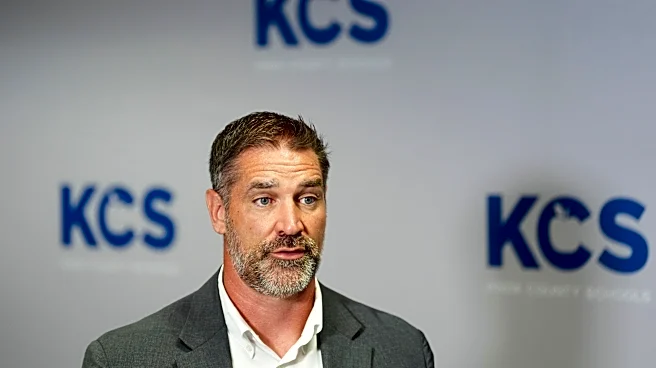




Knox County School students are back, and Superintendent Jon Rysewyk is ready to jump into action.
After a jam-packed summer of a book ban controversy, improved TCAP scores, funding cuts and school board elections, the district leader is looking forward to starting the 2026-27 school year on a positive note.
Rysewyk is continuing to reshape KCS in his fifth year at the helm. He sat down with Knox News for a Q&A this week.
This Q&A has been edited for length and clarity.
Rysewyk on what's next for TCAPs
Knox News: KCS has improved students' TCAP scores across the district for the past five years. What is the goal for this year, and what are the specific changes KCS instituted that have led to that success?
Rysewyk: You're right, five consecutive years, all four core subject areas.
And when we go back to four years ago, we really tried to carve out, why do we exist? What's our contribution to the community? It really is to try to get the next generation ready. You can't do that without excellence in foundational skills. There's so many theories, there's so many things, there's so many materials, there's so many trainings. How do we streamline this?
Science of reading is a big part of that. Using high-quality structural materials is a part of that. Making sure the interventions are aligned so kids, if they're struggling in a topic, they don't go to a different teacher using a different material. It really was systematically changing how we did stuff. There was a lot of compliance, but there wasn't a lot of alignment and coherence. That's been a huge part of getting us to there, that coupled with great teachers, are why we've made the consistent gain.
Get the Daily Briefing newsletter: Keep up with the top news about Knox County Schools
We started talking last spring, anticipating we're going to have good scores again. Take third grade reading: we (had proficiency in the) mid-30s and now we're right at 50. We've not been here before. The question that I asked Dr. (Keith) Wilson is to start working with his team on what does it mean to exceed 50%? Is it the same stuff, just every classroom, every day, pick the pockets where it's not happening and then figure out? We know systematically what needs to happen and how teachers need to be trained and how the interventions need to be aligned. Are we just not doing that at every place?
It really was about consistency. We know the recipe. We need to make sure that's happening everywhere.
On the upcoming special education plan
Knox News: How will the new special education strategic plan change the experiences of families in KCS?
Rysewyk: It is such a different animal than other things in education because you do have federal law and you do have a lot of things that govern that (and) are about compliance. They're all good, but there's so many of them that it's easy for that to start becoming a checklist of things to go, on paper, we've done everything, but we weren't always thinking about the impact on the kid. It wasn't intentional, but I think that was part of it.
I think, then, with parents trying to get involved in that process, it's like trying to solve a calculus equation sometimes. Trying to get those answers, I think sometimes the responses appeared to be very compliance-related because the number one thing is make sure we're legally following what happens.
I think we were probably a little tone deaf. People were going, “This is my son Adam. I'm not interested in compliance. I'm interested in making sure that Adam's getting everything he needs to be able to move forward.” And I really think there's a lot of systems and structures built on compliance for decades. I talked to Brad Carr (special education department leader) a lot about that. It was never a resistance of will to want to do it, but this is what we've done and kids have been relatively successful.But what got us here wasn't what was going to take us to the next level. I think a lot of it has come back into, instead of trying to get to the least restricted environment, let's just get them in that classroom. But once they're there, how do they incorporate with a (general education) teacher? How do they incorporate with their gen ed peers? How do they incorporate with the support? What does that support look like when you're pulling a kid out versus pushing a kid in? I think what you're going to see in this plan is this movement to center around the student. We've heard loud and clear and we agree.
We can talk about the perfect world. We can talk about the current reality. The plan is how we get from here to there.
I don't think it's going to be overnight. People aren't going to go, Wow, this one word's in this plan and now things are right. Dr. Carr realizes that too. That's why it's a five-year plan.
Rysewyk on future budget challenges and how KCS is planning for it
Knox News: After this summer's sudden budget gap, what is the district's most realistic forecast for next year: stable funding, deeper reductions or a budget increase?
Rysewyk: What was so critical about what happened over the summer, everyone reacted to the moment in time. We were looking more at the change to the structure, the long-term impact. We knew we'd come together and try to make the best decision to take care of our people, and we did. All 17 people who were eliminated landed and are now working for us in other positions. And then some vacant positions were eliminated. No human lost their job. Positions were eliminated. And that's a good thing.
The bigger thing we were trying to tell the (school) board at that point was, this is more than something that just happened as an isolated event. This is a change in the structure of our funding for the future.
For us to sit and hope that sales tax comes in great and covers is not a strategy. We worked this summer on it. We know we're going to have to make reductions again next year. You're left in this place where you (either) stop paying people what they're worth or you're going to have to work with a smaller team.

We want to preserve the classrooms as much as we can. But realistically, we started this year with six vacancies. We're under 10 for the third year in a row for teachers. And that's a huge deal. We've got to continue to pay our teachers. That's why you've seen theearly retirement incentive. If we're going to have to reduce at some point anyway − and I anticipate we will this year − if we can offer them a benefit for their service that will last them to 65 and cover their single insurance payment for that, it's a great option. It allows people to choose. We're going to have to reduce the positions from there, too. But instead of eliminating somebody, they choose to retire and we can grab the position without a human in that position. The funding structure has changed. That money's not coming back.
We see inflation in so many other areas. Every company is dealing with that. We're not unique, but when their growth does not exceed the rate of materials for construction and repair, gas for the buses or electricity, then that's even more money we have to get into that base budget. (Knox County Commission is) not wrong when they say we gave you more money than last year, but the cost to do business one year to the next is more. We're trying to think very conservatively. We're not waiting for budget projections. We're trying to be proactive and make moves that, again, take care of our people but still allow us to operate on a smaller footprint after this year.
Knox News: What conversations have KCS leaders had with local and state leaders to ensure there are no surprise budget cuts in the future?
Rysewyk: This is very unusual. This doesn't typically happen. I think there are a lot of things are at play in that decision.
We didn't take it as commission sending a message to schools that (the budget was) overinflated. It was more of, we have this much money and we have to take care of all these areas. In talking to some of them afterward, it was not ill-intended what they did, it was just trying to make a tough choice, again, to balance everything they have to fund.
Rysewyk on recent changes in classroom technology
Knox News: How do you strike the balance in student technology to ensure students are prepared for an increasingly digital world while parents push for less screen time?
Rysewyk: There was a lot of schools across the country trying to become one-to-one districts. That was the move. COVID-19 accelerated that because federal funds came in. And again, when people were working from home and taking classes from home, that happened. But I think we always evolve and adapt.
There's some early research coming out right now, and we need to continue to read that and look for more studies because it's not overwhelming at this point. But there could be some negative impacts of screen time, too. And we look at that just like everything else.
It's not going to go away. All of these kids were born into this. It's our job to get them ready. I think where we are in this conversation right now is I don't know that's a full pendulum swing back to like, let's eliminate it all. I think (the question is), What's its proper place? The counter swing to say no computers ever when we've learned a ton from quick assessments that we can make adjustments to how we instruct students, that's very important. The whole world's open to them.
AI is the same kind of way, so we build guidelines around that. There are some incredible things that it's going to open the world to for our kids. We can't say you can never touch it, but we also don't need them plagiarizing papers when they send them in, right?
It's still early in some of that to figure out exactly what it is, and that's why we've launched this committee. We won't get it right. There'll be times we'll probably over course-correct, and there'll probably other places that we'll say we probably should have done that earlier. But that's part of having the conversation, and bringing in parents and teachers to make sure as we adjust that we're not throwing the baby out with the bathwater, but we're also doing what research now says is best for students.
Rysewyk's advice for a first-time KCS family and joys of the first week
Knox News: What is the advice you would give a family in its first year with KCS about how to build relationships to help their child thrive?
Rysewyk: We don't want to replace the parent. We don't want you to drop your student off and then we've got them for seven hours and you come back and get them. They won't be as successful if the families are not involved.
Be in the school, have conversations with the principal. Every one of those leaders has a vision for the school. They all have different ways they plug in. We were at some schools the last two days and they all have on their boards their family night or their meet-the-teacher night. And I know everybody's schedule doesn't allow that to happen, but if you can send a member of your family to make that contact, that makes it so much easier.
Sometimes the parents or family can tell us some things about that student, that they're shy, they need to sit closer to the front of the room, all these things that we don't know that can be helpful. And, in return, it gives our teachers a chance to share things that they're learning about the student. Be engaged, take advantage of those opportunities to the extent you can and don't ever feel like you're on the outside.
Knox News: What's your favorite thing about the first week?
Rysewyk: It's that fresh start. So much happens in those two or three months of summer. We'll see kids grow. We'll see kids have different experiences. We'll see their life change somehow: they have a new baby brother or sister. I love that no matter where you left in May, it's a fresh August and new grade, new teachers, sometimes a new school. And it's just neat to see that happening across 60,000 students at the same time. They're all going through the same experience.
Caitlyn Meisner is the K-12 education reporter for Knox News. Email tips and story ideas to caitlyn.meisner@knoxnews.com.
This article originally appeared on Knoxville News Sentinel: Superintendent Jon Rysewyk Q&A on big issues facing Knox County Schools | Exclusive