





Just one traffic signal can make or break your daily commute.
A few extra seconds spent sitting at a red light can be the difference between making it to your destination on time or being late for school, a work meeting or a doctor’s appointment. The question – “Why won't this light turn green?” – has run through every driver's mind.
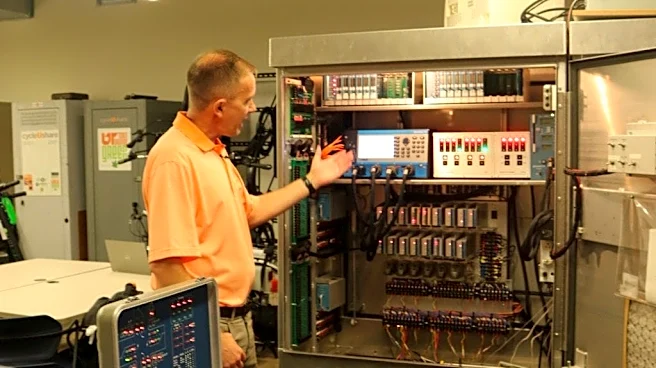
In Knoxville, the answer isn't tucked away inside a sophisticated command center with a magic switch. City traffic lights operate independently, and engineers must travel to intersections and manually adjust the box at the corner to update signal timing.
It’s an outdated system and one the city of Knoxville hopes to leave behind after receiving $32 million in federal funding to connect 134 intersections through a new
traffic management system city leaders hope will reduce backups and help traffic move more efficiently along some of the city’s busiest corridors.
A new Automated Traffic Management System, or ATMS, will allow each light receiving upgrades to send live data to a centralized system that engineers can monitor remotely and make real-time adjustments. This could mean adjusting signal timing during rush hour to push traffic through busy intersections or matching the timing on multiple intersections to reduce backups.
The city started working last year to upgrade signals on Middlebrook Pike with this automated system, and contractors also will be upgrading lights along Broadway, Chapman Highway and Kingston Pike.
More improvements are planned around the University of Tennessee at Knoxville campus, where Airton Kohls leads the university's Traffic Signal Academy that trains traffic engineers across the country on automation tactics. It will take years for the city to complete each ATMS project, Kohls told Knox News, but the result will be a “game changer.”
"Having the ability to remotely connect to traffic signal systems provides city personnel with a modern tool that can facilitate congestion mitigation and improve operations, leading to a safer and more efficient transportation system," Kohls said.
How traffic signals detect vehicles waiting at Knoxville intersections
Knoxville operates 400 traffic lights without a centralized system for real-time adjustments, Karen McKeehan, the city’s transportation engineering chief, told Knox News. The city’s traffic engineering department visits each light annually to perform routine maintenance but doesn't service traffic signals unless a driver submits a complaint through the city's 311 service number.
About 80% of Knoxville intersections have detector loops buried beneath the pavement that detect vehicles waiting at red lights, McKeehan said. When a vehicle's metal frame passes over the loop, cables send an electric pulse to the intersection's control box, McKeehan said.

This technology, however, has its limits. Detector loops can sense when a car is sitting directly on top of the sensor at the front of an intersection, but they can’t determine how many vehicles are backed up behind it and can easily be damaged by cracks in the roadway and general wear and tear on the wires.
Cameras or radar systems attached to traffic signals can detect backups and send live footage to traffic engineers, but less than 20% of the city’s intersections have these installed. The technology is better suited for wider intersections rather than entire corridors.
Both technologies are supplements to fixed timers, which are housed inside signal boxes at each intersection in the city and are manually adjusted by engineers. With new automated systems, McKeehan said, adjustments can happen more quickly and efficiently.
"It's really going to help us modernize our system and be more responsive to the demands of our users," she said.
Knoxville's ever-evolving traffic management system began in 1921
Traffic signals have come a long way since Knoxville began managing traffic a century ago.
Seven years after the first electric traffic light was installed in Cleveland, Ohio, Knoxville began managing intersections with “manned traffic towers” in 1921, local historian Jack Neely told Knox News.
The first electric lights installed in Knoxville used white for go, red for stop and green for when the intersection wasn’t monitored, he said. The red, yellow and green lights we know today were first installed in 1927 near Gay Street on Market and Union avenues.
As more residents purchased automobiles, traffic lights began popping up at other busy intersections and have continued evolving ever since. Most recently, the city replaced aging signals at five Gay Street intersections.
City leaders hope the latest automation upgrades will be far more transformative. The $32 million from the U.S. Department of Transportation will allow Knoxville to install fiber-optic cables, which will connect each light to the centralized system at just more than 30% of its intersections along some of its most-traveled corridors
Chapman Highway near Fort Dickerson and Kingston Pike near Neyland Drive are among Knoxville's busiest corridors, each carrying about 30,000 vehicles a day in 2024. North Broadway near downtown, which also is set for automation upgrades, has seen daily traffic counts decline to roughly 9,000 trips last year since peaking at 15,000 in 2007.
Traffic on Middlebrook Pike near Western Avenue has fluctuated between 13,000 and 16,000 daily trips since 2014, similar to average daily traffic counts each year on Cumberland Avenue near UT.
How are other cities in the region addressing traffic challenges?
Traffic volumes could increase as Knox County's population is expected to grow by tens of thousands of people over the next decade, and Knoxville isn't alone in trying to modernize traffic signals to accommodate an influx of new residents.
Nashville, the largest city in the state, similarly does not have an automated traffic system despite a population of more than 720,000, Aaron Cushman, assistant director of the city’s transportation department, told Knox News. But also like Knoxville, the capital city is in the process of installing an automation system for key corridors.

Nashville already uses LiDAR technology, which scans intersections to create a 3D map that can track the speed of cars and detect pedestrians in the roadway. It’s the same technology used in some self-driving cars, and experts have said it can drastically decrease the risk of accidents, especially between cars and people, by pinpointing pedestrians' exact location and knowing how fast a vehicle is approaching.
Huntsville, Alabama, which is closer in size to Knoxville and experiencing rapid growth of its own, is further along.
Nicholas Nene, traffic engineering director for Huntsville, told Knox News the city is preparing for rapid upgrades to all 400 signals in the city and plans to complete a systemwide overhaul within the next decade. The city has already connected 170 traffic signals to an automated system through a partnership with Google Fiber, allowing traffic engineers to log into a system on their laptops and adjust timing from anywhere.
Kohls, who leads the Traffic Signal Academy at UT, said an automated traffic system in Knoxville wouldn’t involve someone sitting behind a computer all day evaluating traffic patterns. Rather, it allows engineers to make adjustments as needed when there are repeated crashes, for example, or when a new apartment complex brings more traffic to an intersection.
Traffic lights a small part of a larger puzzle for Knoxville officials
City leaders have increasingly tried to balance the needs of drivers, pedestrians and transit users to keep up with Knoxville’s growth. Projects such as the South Knoxville Pedestrian Bridge and Sevier Avenue improvements have prioritized safer, more comfortable connections for people on foot.

The city took a similar approach on Cumberland Avenue, where a yearslong corridor project narrowed portions of the roadway from four lanes to three lanes and widened sidewalks to encourage pedestrians and discourage vehicles in 2017.
But even as the city encouraged alternatives to driving, vehicle traffic never disappeared on Cumberland Avenue, which is now a priority for the automated traffic system.
Perhaps the clearest example came in 2022 near the Starbucks on Cumberland Avenue, where vehicles waiting in the drive-thru occasionally overflowed into the travel lane and blocked traffic. This led the city to install a sign with lights that flashed when drivers approached the turn into Starbucks, Knox News reported at the time.
More challenges can be expected in the coming years, as Knox County’s population is expected to reach 569,734 in 2040 – an increase of roughly 75,000 compared to 2022, according to state data from the Boyd Center for Business and Economic Research at UT. Nearly 3,000 new residents moved to Knoxville between July 2024 and July 2025 alone − and when people move here, they bring their vehicles.

Knox County, according to a Tennessee intergovernmental relations agency report, is behind $5 billion in infrastructure improvements to keep up with the expected growth. Transportation infrastructure needs account for $2 billion.
Whether roads can keep pace with anticipated growth will depend on many factors, but city leaders see traffic signal automation as a key step in managing increasing demand on Knoxville's roads.
Sophia Tiedge is the growth and transformation reporter with Knox News. Email: sophia.tiedge@knoxnews.com
This article originally appeared on Knoxville News Sentinel: Why won't this light turn green? Knoxville has a $32M solution | Exclusive