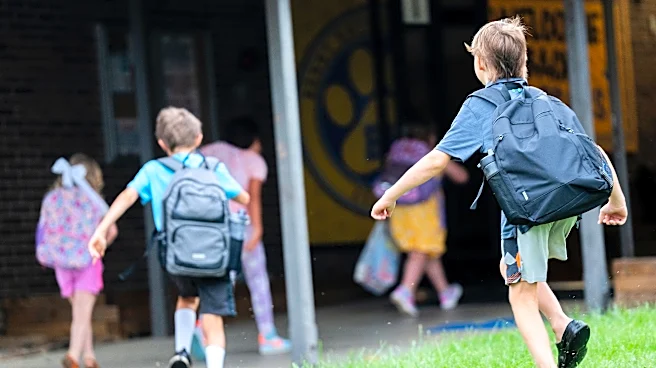

Knox County is growing fast. Thousands of people move here every year to work for one of the many large local employers or to retire with a better quality of life. But as the population continues to climb,
Knox County Schools has seen its enrollment decrease.
The numbers don't seem to add up, and community members have speculated on potential culprits: an influx of retirees, vouchers and private schools.
No single factor explains where students have gone. But data and interviews with experts suggest a growing number of families are charting a different educational path through private schools, homeschooling and other alternatives that have expanded rapidly since the COVID-19 pandemic.
Knox County Schools is enrolling fewer kids each year
Knox County has seen enrollment drop by 0.3% over the past three years, which may seem small. But losing students across the district has led to employing fewer teachers.
KCS had already eliminated 57 teaching positions due to fewer students before the recent round of budget cuts by the county and state. Thirty-five of those cuts were at the high school level, while the remaining 22 were at elementary and middle schools.
An analysis of enrollment data since the 2020-21 school year shows a majority of grades saw a decline in enrollment over the 2024-25 and 2025-26 school years. Only kindergarten, fourth grade and eighth grade saw more students in 2025-26 than they had in 2024-25. All other grades saw decreases of more than 1.5% in that time, with a 7.1% decrease in 10th grade being the largest.
Additionally, every student cohort shrank between the 2024-25 and 2025-26 school years. The class of 2027 saw the largest decline, losing 307 students, while the class of 2026 lost 211.
Even the younger grades weren't immune to enrollment declines. The cohort entering third grade lost 26 students between those two school years, part of a districtwide decline of nearly 1,300 students.
Enrollment data is not yet available for the 2026-27 school year.
Migration to Knox County drives increase as births begin to rise
More than 5,100 babies have been born in Knox County each year since 2021, according to the University of Tennessee at Knoxville's Boyd Center for Business and Economic Research. The number of yearly births in Tennessee has been steadily increasing after a dip in the years following the Great Recession and an even steeper decline in 2020, according to the Tennessee State Data Center.
Matthew Harris, an economics professor at the Boyd Center, said both migration and births in the county reflect steady growth. Since 2020, Knox County has grown by about 33,000 residents, with the largest influx in 2022 when 10,000 people moved here.
"All of our growth is coming from migration," Harris told Knox News. "The steady population growth that we're seeing should mean we have steady increase in enrollments. The population of school-aged kids isn't shrinking."
Fewer babies isn't to blame for declining enrollment, Harris said.
"People are finding alternative enrollment pathways for their kids," he said. "The public schools now have a decreased market share."
The role vouchers, religious schools play in declining enrollment
Private school is a popular avenue for K-12 education and has been for decades. But alternative methods to public education were reinvigorated during the COVID-19 pandemic.
Data gathered by the Homeschool Hubat Johns Hopkins University shows private school enrollment has increased in Knox County and other counties in East Tennessee in the years since the 2019-20 school year − when the pandemic upended schools across the country.
Private school enrollment grew by nearly 24% in Tennessee between fall 2019 and 2021, particularly in the kindergarten and early elementary grades, according to a 2023 report by the Urban Institute.
Nearly 4,000 Knox County students attended church-related schools in the 2020-21 school year, while nearly 6,550 attended other nonpublic schools, according to the Tennessee Department of Education. Nonpublic schools include private schools that are not affiliated with a specific church, though some may still have a religious focus.
That means families of more than 10,000 Knox County students chose not to enroll their children in KCS.
One driver is the dozens of religious private schools that have established themselves in Knox County. Since the pandemic, some have even started offering online programs.
First Baptist Academy enrolled 444 students last school year, while the Webb School enrolled 1,044. Some schools have fewer than 100 students, but collectively they represent a sizable share of Knox County's school-age population.
Grace Christian Academy, just across Oak Ridge Highway from the Karns community, had 945 students enrolled last school year. Enrollment Coordinator Amy Bryant told Knox News the school saw an influx of out-of-state families "seeking a more conservative way of life" after the pandemic.
"Families really desire that Christian education piece, so they want their kids to be in an environment every day that matches what they're trying to instill at home and what they're learning in the church," she said. "That Christian piece is more of a draw than anything."
Vouchers − which allow Tennessee families use state tax money to pay for private and virtual school tuition and fees − have "definitely increased interest" in Grace Christian, but have not been a driver of enrollment, according to Bryant. The school, which serves students from preschool through high school, has a lengthy waitlist.
Tennessee Department of Education data shows Knox County has a relatively high number of applicants for the voucher program's Education Freedom Scholarship. Last school year, 5,192 Knox County students applied, but the numbers don't show how many of them had existing vouchers or whether vouchers were granted.
Shelby County − the largest county in Tennessee, anchored by Memphis − had 8,433 students apply. For comparison, that's only 3,200 more than Knox County, despite Shelby County being home to 390,000 more residents.
Homeschooling in Knox County is more popular than ever
The COVID-19 pandemic changed a lot for parents, who began rethinking how their children were educated. Many decided to become their child's teacher.
Homeschooling isn't a new phenomenon. The data from Homeschool Hub shows more than 400 children have been homeschooled every year in Knox County since 2013. But the number of homeschooled children in Knox County nearly doubled between the 2019-20 and 2020-21 school years, jumping from nearly 850 to 1,754 children − a record high, based on available data.
The number of homeschooled children has since decreased to around 1,400 as of the 2022-23 school year (data from the past three years is not yet available). The uptick and continued popularity of homeschooling show the choice is deeper than a pandemic solution, said Celeste Carruthers, associate director of the Boyd Center.
"It wasn't a one-time blip of going to homeschool and then coming back (to public school)," Carruthers said, "or a small number of pre-K, kindergarten-age cohorts just starting in private school and staying there."
It was more of a "longer-term shift away from traditional public schools," she said.
Lisa Nocus didn't expect to homeschool her seven children, but that's become her life − so much so that she now serves on the board of the Christian-focused Smoky Mountain Home Education Association.
"(We wanted) to know what they were learning ... and to make learning fun and not just something you did for a test," Nocus told Knox News.
The desire for a Christian education is driving families who can't afford private school toward homeschooling, she said. It's what Emily Greer envisioned for her children, even before she ever met her husband and had children.
Greer uses the religious Classical Conversations curriculum, which also teaches Latin and debate.
"We love that it is Christian and it has a Christian worldview and that God is in the center of every subject," she said. "Every subject is integrated together. It's not like this is just math, just science, just history. You see the connection of everything, and it all points to God."
For more than 15 years, Greer has been the primary teacher for her children. This school year, she's tasked with one curriculum for each of the four: kindergarten, fifth grade, eighth grade and 10th grade. But she doesn't do it alone.
"Knoxville has so much support for homeschool families," she said. "You can certainly do it at home by yourself, and we tried that one year when I had my fourth baby."
Greer believes in the importance of a connected community and has since started her own homeschool group in Farragut. It's grown so much, she said, "We probably need to start another one pretty soon."
Between taking field trips, learning at the playground and taking an art class, her homeschooled children are "almost never home," Greer joked.
The Greer family is one of thousands in Knox County leaning on the homeschooling method, which has never been more accessible, with a plethora of online programs and dozens of Knox County groups that provide support.
"I'm super thankful just to have this opportunity, just to get to spend this time with them," Greer said, "and also to be there to see the light bulbs go off. I just would be sad to miss out on that."
So, where are all the kids?
They're in Knox County, but not all in Knox County Schools. And as more and more families rely on alternatives to public school, the more the district must compete to be parents' first choice.
Caitlyn Meisner is the K-12 education reporter for Knox News. Email tips and story ideas to caitlyn.meisner@knoxnews.com.
This article originally appeared on Knoxville News Sentinel: Why Knox County Schools is losing students despite the population boom