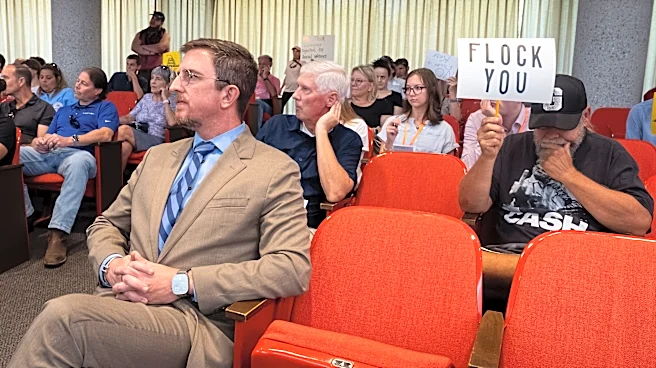









Knox County commissioners are demanding to know whether the county has an active and legal contract with Flock Safety after Mayor Glenn Jacobs and Law Director David Buuck said the sheriff's office is operating the company's cameras without an agreement.
They want real answers after a chaotic two-hour Aug. 24 meeting led to conflicting messages from Flock representatives and unprepared members of a sheriff's office that has been hobbled by a corruption scandal.
A hard deadline is coming up: Commissioners plan to vote Aug. 31 whether to ban the cameras. Commissioners from both parties expressed frustration with the lack of clarity from the department on how the camera agreements are structured, where the cameras were placed, policy specifics on how the camera data
is used and who is in control of the cameras at the department.
"These cameras need to be deactivated immediately," Commissioner Kim Frazier said Aug. 24. "You don't have an active agreement."
The Knox County Sheriff's Office has used Flock license plate readers since 2020, when it bought five through a service agreement. The contract allowed KCSO to build on the purchase in small increments, which kept the price under a threshold that requires approval from Jacobs or the county commission.
Over time, according to an Aug. 12 letter from Jacobs to Flock, KCSO spent $274,720 on its agreement, which is over the threshold required to receive county approval. Jacobs told the company its current contract is invalid.
KCSO procurement director Hugh Holt told commissioners when the previous agreement expired, the cameras "were rolled into the current agreement." The agreement Holt referenced is not a service agreement, he admitted, which is what Jacobs and the county think it needs to operate them.
KCSO now has 143 Flock Safety cameras, Capt. Tony Chamberlain said. He and Holt were repeatedly unable to provide specific details to commissioners about the cameras it currently operates. The department does not have a public policy for its planned surveillance center, which will run on data from the cameras if it becomes operational.
"I'm disappointed that people don't have the data, don't have the contract, don't know who did what," Commissioner Larsen Jay said. "It's been weeks since we set this meeting and it appears everybody took off and left you. I feel bad for you. It's not adequate. You should be overprepared and ready with a team who can build trust with this body. It's not there. I have been so supportive of every officer and our sheriff. KCSO doesn't always get a free pass."
Holt and Chamberlain said they had not been involved in efforts to build up the surveillance center until recently. KCSO's head of technology, Aaron Yarnell, retired this summer after he was indicted on corruption charges; KCSO's former attorney Houston Havasay no longer works for the department; and Sheriff Tom Spangler is fighting advanced pancreatic cancer.
Commissioners will vote Aug. 31 whether to ban the new license plate readers and limit surveillance tools. Because the sheriff's office doesn't have its own attorney and there's nobody to argue against Jacobs' opinion that the Flock contract isn't valid, commissioners expressed concern about the legal ramifications of their decisions.
"I hate that this has happened," Commissioner Terry Hill said. "I have lots of reservations. (But) we have a new sheriff in town, almost, we have a new mayor, almost. I'm wondering if it really isn't a wise decision to let our new sheriff have a chance to look at what he's got."
Knox County Mayor Glenn Jacobs says the sheriff's office contract breaks rules
Jacobs and his administration say KCSO ignored county rules in two ways with two different agreements in order to build up the surveillance center.
2020 contract
County code says the the mayor must approve contracts over $25,000 and both the mayor and county commission must approve contracts over $100,000.
Jacobs in 2020 approved a $13,750 service agreement between KCSO and Flock, but additions to the agreement made over time brought the total cost up to $274,720, which is well over the threshold for commission and the mayor's approval.
"I do not believe the 2020 contract between Knox County and your company is valid," Jacobs wrote to Flock regional sales director Alex Guth on Aug. 12.
2026 purchasing order
To spend $800,000 of a $1.5 million state grant approved in November to lease more cameras, KCSO used a tool in the county's procurement rules called a cooperative purchasing agreement without the knowledge of Jacobs and county commissioners.
Cooperative purchasing agreements allow local governments to adopt contracts for products already negotiated by other local governments so they don't have to take on their own competitive bidding process.
Tennessee law allows the county to "piggyback" off contracts from other municipalities if the county commission approves a cooperative agreement. For the Flock Safety contract, KCSO used a contract from a Houston-basedregional educational center.
Independently elected officeholders such as the sheriff don't need to get the commission and mayor's approval for products purchased through cooperative agreements, according to the county's procurement code. That meant KCSO could fly under the radar.
If KCSO didn't use the purchasing cooperative method, it would've had to ask the procurement department overseen by Jacobs to solicit bids from all providers, not just Flock Safety. And if Yarnell reported a service included in the contract, the commission would have to vote on the deal, according to purchasing rules. But he didn't, Jacobs said Aug. 24, and because Flock owns the cameras, KCSO should've used a service agreement in addition to the purchasing deal.
Had KCSO done that, Jacobs would've been able to approve – or deny – the deal. Jacobs has voiced strong opposition to the cameras because he thinks the use of them is a violation of personal freedoms.
Allie Feinberg is the politics reporter for Knox News. Email: allie.feinberg@knoxnews.com; Reddit: u/KnoxNewsAllie
This article originally appeared on Knoxville News Sentinel: Exasperated Knox County commissioners demand answers on Flock cameras