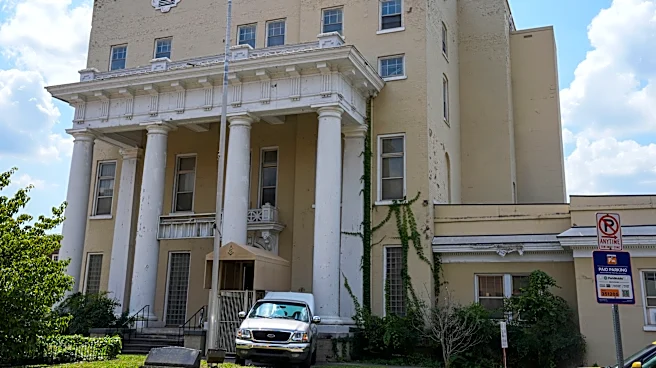









The Masonic Temple on Locust Street is slated to be demolished. Although actual demolition can't begin until Sept. 13, some preparatory work has already started.
The 60-day hold on the historic building's demolition remains in place, but other "development activities" are allowed during that time. Some minor construction work has begun on the interior. Workers have been seen entering and exiting the site.
Knox Heritage has attempted to communicate with the building owners to urge reconsideration of demolition or at least documentation of the building's history, but has been unsuccessful. Knox News' attempts to contact Masonic leaders associated with the temple also have been unsuccessful.
The Locust Street building has a fascinating past, but it
"has fallen into significant decay," according to a statement from the Masonic Temple Association shared by lawyer John Dupree. "Therefore, the Masonic Temple Association has suspended all meetings and activities at the property and, for the safety of its members, its neighbors and the public, has applied for a demolition permit."
The building's decline is attributed to antiquated construction standards.
"The building’s current condition is the result of years of disrepair, and demolition is rarely the best or only solution for a historic building," Knox Heritage shared in its newsletter. "Rehabilitation and adaptive reuse can often provide a path forward while retaining the history and character that make a community unique."
Because the temple is a historic building, there's a 60-day delay before the demolition permit is approved, but the clock is ticking. It was set in motion when Knoxville-Knox County Planning completed its review July 27. Demolition will be permitted starting Sept. 13.
The delay isn't meant to prevent the building's removal, but rather to allow time for documentation, salvaging or dismantling of historic materials or potential relocation before it is approved, according to Knoxville Building Code.
History of 505 Locust St.
The temple has been a Freemason meeting site since the 1910s. Before that, it was the mansion of Charles McClung McGhee, a financier, philanthropist and railroad executive who was the great-grandson of Knoxville founder James White.
McGhee's mansion was built by Knoxville architect Joseph Baumann in the early 1870s, according to Knox Heritage. The Masonic Temple Association hired A.B. Baumann to remodel the building as a temple in 1915, and it was completed in 1916. Some parts of the original interior remain.
In addition to his involvement in the booming railroad industry, McGhee served on the Board of Trustees for the University of Tennessee and in the Tennessee legislature. He was instrumental in starting the Lawson McGhee Library in 1885, and McGhee Tyson Airport is named for his grandson, Charles McGhee Tyson, a U.S. Navy pilot who was shot down and killed in World War I.
What is Freemasonry?
Freemasonry is a fraternal order that dates back more than 300 years. Its members prioritize core values of "brotherly love, relief and truth."
Each lodge has a room where meetings and ceremonies take place. The lodge room features Masonic symbols, such as checkerboard flooring.
Famous Masons include George Washington, Benjamin Franklin and John Hancock, and well-known local Masons include John Sevier, Winfield Dunn, Andrew Johnson and Andrew Jackson.

Hayden Dunbar Evans is the storyteller reporter. Email: hayden.dunbar@knoxnews.com. Instagram: @knoxstoryteller.
Support strong local journalism by subscribing at subscribe.knoxnews.com.
This article originally appeared on Knoxville News Sentinel: Minor work has begun at Masonic Temple. Demolition could start soon