









The empty warehouse on Washington Avenue − complete with broken out windows and graffiti-covered walls − has sat vacant for years. But at one time, it was a booming textile mill that helped earn Knoxville the title of "Underwear Capital of the World."
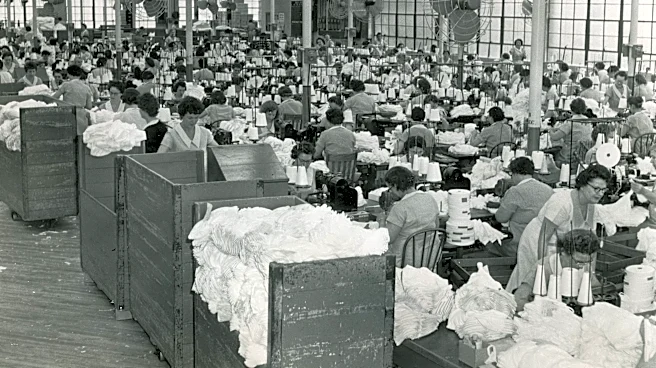
About 60 years ago, the Standard Knitting Mill produced 10,000 garments per hour, including underwear and hosiery. Now, it's stuck in a period of inactivity after years of failed or stalled development plans.
In all fairness, Knoxville isn't the only place to be dubbed the world's underwear capital. Places such as Piqua, Ohio, and Winston-Salem, North Carolina, have also claimed the questionably prestigious title. But the fact remains that by 1936, the textile industry in Knoxville was the leading
one, and the Standard Knitting Mill was the heart of the action.
Standard Knitting Mill story begins at turn of the century
The Standard Knitting Mill opened in 1901 at its current location. By 1921, it had around 800 employees, the Knoxville Sentinel reported.
As of 1936, textiles were the city's dominant industry, according to the Knoxville News Sentinel. An article from that year claimed Knoxville was the "greatest underwear producing city in the United States and probably in the world." The two main places that produced all this underwear were the Appalachian Mill and the Standard Knitting Mill, which collectively made enough underwear to clothe a quarter of the U.S. population.
The next year, the Knoxville Journal noted the mill's campus featured a hospital, dentist's office and library.
By 1940, after operating in Knoxville for nearly four decades, the Standard Knitting Mill employed around 2,500 people.
Project has been stagnant in recent years
The textile industry was still Knoxville's most popular by 1962, with a total of 30 factories in the city producing or processing textiles. Within the industry, female workers outnumbered male workers.
The Standard Knitting Mill was then employing 3,500 and creating over 42,000,000 pieces of clothing annually.
In the 1980s, the mill was purchased by Delta Apparel, part of Delta Woodside Industries. In June 1989, less than a year after the acquisition, employees learned the plant would close.
"They told us five weeks ago that we were going to get a new cafeteria, a raise, better benefits. They told us a year ago they were going to make this the most modern plant in Knoxville," said Betty Rudder, one of 630 employees who lost work with the closure.
A distribution center remained there until a relocation to Clinton in 2004, and some news articles cite 2007 as the year Delta vacated entirely. Then came a series of redevelopment projects for the property that fell through. One developer announced plans, then another bought it with a new vision. There was some discussion of using it as a central office for Knox County Schools and separately of Saw Works Brewing Co. moving in.
In November 2019, WRS Inc. Real Estate Investments acquired the site under Knoxville Mill Investment LLC for $4,075,000.
The South Carolina-based developer had to contend with pandemic-related challenges as well as the extensive environmental remediation required to clean up the property. In early 2022, two separate fires less than eight hours apart seriously damaged the site.
Almost seven years since the acquisition, a website bearing the WRS logo for the Standard Knitting Mill still lists the status as "planning in progress." The same site describes the future of the Standard Knitting Mill as a mixed-use development with "loft-style apartments, specialty retail/market/restaurant space and creative office space" and shows renderings and plans.
But now, WRS is off the project. A tax credit for textile mill revitalization that's offered in its home state but not Tennessee, along with an unmarked KUB water line discovered under the structure, caused WRS to lose millions, KCDC CEO Ben Bentley said at a city council workshop Aug. 27.
"Now we know a lot more facts about this and maybe the next developer, because of that information that can be shared with them, will have better success," Bentley said.
A new developer is being sought. Rebekah Jane Justice, Knoxville's chief of urban design and development, said at the meeting, "We are willing and ready to talk to interested investors to bring something to life here."
A call to the WRS main line and other attempts to contact employees were not returned.
Hayden Dunbar Evans is the storyteller reporter. Email: hayden.dunbar@knoxnews.com. Instagram: @knoxstoryteller.
Support strong local journalism by subscribing at subscribe.knoxnews.com.
This article originally appeared on Knoxville News Sentinel: Mill that helped make Knoxville 'Underwear Capital of the World' sits empty