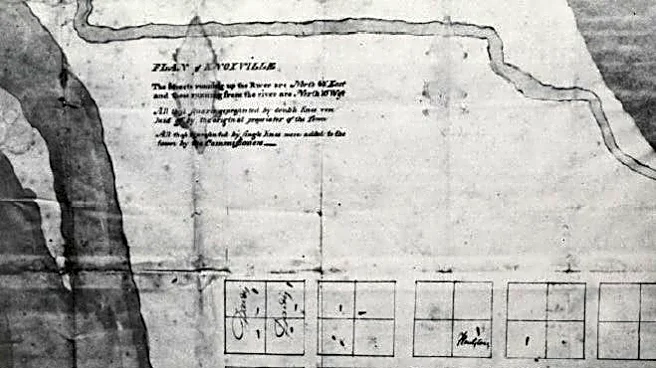







Knoxville can trace its origins back to 64 lots sold in a land lottery exactly 235 years ago.
The lots, purchased Oct. 3, 1791, form a square bound by streets today known as Church Avenue, Central Street, Neyland Drive and Walnut Street. That exact chunk of downtown marks the city's genesis.
Now that section includes landmarks such as the Blount Mansion, the Andrew Johnson Building, St. John's Episcopal Cathedral, the old Knox County Courthouse and the Howard H. Baker Jr. U.S. Courthouse. But once, those lots represented Knoxville's humble beginnings along the Tennessee River.
How Knoxville began all those years ago
James White is well known as Knoxville's founder. He came to the area that would become Knoxville from North Carolina after serving as a captain in the Revolutionary War
and earning for his contributions 1,000 acres of land, on part of which his two-story log cabin, known now as James White's Fort, still stands, according to Visit Knoxville.
The history section on the fort website says White partitioned his acreage, ultimately forming Knoxville. Each of the 64 lots was half an acre, and in total, they made up 16 blocks and appear more or less as 16 city blocks today. White divided them along with his son-in-law, Charles McClung, and sold them off in a lottery, save for several he reserved.
The date of the land lottery has been historically contested, but the consensus has been to defer to a Knoxville Gazette article from Dec. 17, 1791, that cites the land lottery as having happened Oct. 3, 1791. That's the day the city of Knoxville recognizes as its anniversary.
Land lotteries were a typical method for dividing up frontier settlements, according to an East Tennessee History Center story map. In this case, 79 men drew numbers, with some having partnered up for the drawing. A Knoxville Journal article from 1929 described them as being pulled from a box. They cost $8 each. In the end, some of the participants settled, while others sold their lots and left.

White, McClung and other early Knoxville residents
White named the new town for Henry Knox, who was President George Washington's secretary of war.
Following the establishment of Knoxville, White went on to serve as a general in the War of 1812, and to donate the land for Blount College, which would eventually become the University of Tennessee. McClung became one of Knox County's two representatives who helped draft the Tennessee constitution.
"Many of the lineal descendants of these two illustrious, brave and worthy pioneers are now residents of that prosperous city and are prominent in various honorable professions, industries and occupations," says an article that ran in the Knoxville Daily Tribune for the city's centennial in 1891. "And, they are at all times ready to aid in every work which will add to the prosperity and fame of the city."
There were many other early settlers in Knoxville besides these two. Your family might even be descended from one of those who made a home in Knoxville's first lots, which appeared in a list published by the Knoxville Sentinel in 1911.
- James White
- James W. Lackey
- His Excellency William Blount
- James Armstrong
- William Davidson
- Andrew and J. Belfour
- John Hays
- Thomas Amis
- Jacob Brown
- Jacob Knox
- James Richardson
- William Boyd
- Thomas Amis
- James Hodges
- Hon. Judge Anderson
- John Gehon
- Ignatius and J. Chisholm
- John Carter
- James Cozby
- Thomas King
- Rev. Mr. Carrick
- Jacob Carper
- John Love
- John Owens
- James Greenway
- Jacob Carper
- George Roulstone
- Reserved lot
- Reserved lot
- Andrew and J. Belfour
- John Rhea
- Matthew A. Atkinson
- Rev. Mr. Carrick
- John Stone
- Hon. Judge Campbell
- Reserved lot
- Reserved lot
- Samuel Hannah
- Jacob Carper
- George Roulstone
- Andrew Green
- John Adair
- William Lowry
- Nathaniel Cowan
- Samuel McCaughey
- WIlliam Henry
- William Cox
- John Chisholm
- John King Sr.
- Lewis Newhouse
- Peter McNamee
- Nicholas Perkins
- Daniel Hamblin
- John Hackett
- Jacob Carper
- Robert Legitt
- Adam Peck
- David Allison
- James and W. Lea
- John Troy
- William Small
- Hugh Fulton
- James Miller
- Thomas Smith
Hayden Dunbar Evans is the storyteller reporter. Email: hayden.dunbar@knoxnews.com. Instagram: @knoxstoryteller.
Support strong local journalism by subscribing at subscribe.knoxnews.com.
This article originally appeared on Knoxville News Sentinel: Where did Knoxville start? On 64 lots by the river sold 235 years ago | Exclusive