







At Vine Middle Magnet School, artificial intelligence is helping shape daily lessons − but students never touch the technology.
Instead, they start class with pencils and notebooks, practicing word patterns and other foundational reading and math skills in short routines generated from that day’s grade-level lesson their teacher learns from grant-funded AI tool.
Vine is using a $50,000 grant from the Tennessee nonprofit SCORE to pilot the approach with PIVOT, a company that uses AI to help create the routines. Teachers can revise the material, but the goal is to save them planning time while helping students build skills many have not yet mastered.
“Our students are struggling and they're missing some foundational skills, which you can see in the outcomes
in our achievement scores,” Vine Principal Robin Curry told Knox News.
Why Vine Middle students needed this new AI tool
Vine has ranked among Knox County’s lowest-performing middle schools on TCAP in recent years. In 2026, 9.1% of students were proficient in ELA and 8.5% in math.
The next-lowest middle school rates were at Northwest Middle, where 17.6% of students were proficient in ELA and 18% in math.
Amy Galloway, the executive director of PIVOT, said many students arrive in middle school with skills below their grade level.
"That's a significant challenge when it comes to instructional delivery for teachers and for leaders," she said. "We want to see an increase in the percent of students who are proficient as a grade-level reader."
Goals like this are why SCORE created the AI Innovation Fund in the first place. The nonprofit awarded nine schools the funds to use new technology, said Mary Cypress Metz, the SCORE senior vice president of strategy.
"We believe that AI has the most opportunity when it really is being used by those who are closest to students," Cypress Metz told Knox News. "We were not looking for, how do we just throw a tool in front of a student? We were really looking for, has there been consideration about how to responsibly use this to to drive student outcomes?"
'It's really giving students confidence'
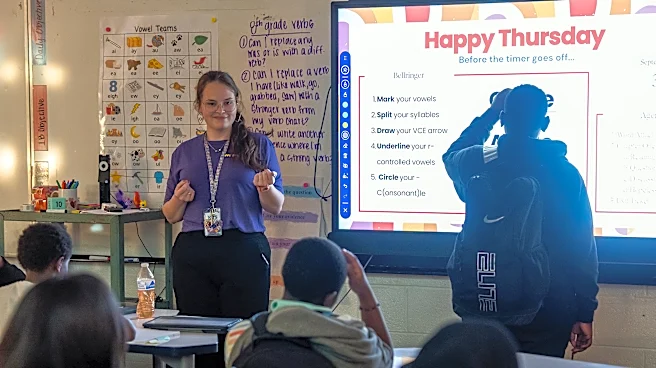
As students enter Renee Robinson’s seventh-grade ELA classroom, they grab pencils and notebooks and turn to the day’s warmup on the board.
For each of three words − cable, apple and purchase − students complete five steps: identify vowels, divide syllables and mark particular spelling patterns.
After five minutes, the class reconvenes. Robinson asks several students to complete the steps in front of the class on the front board. Afterward, she asks how students are feeling with a thumbs up or thumbs down. Then, they move onto the grade-level content.
These words weren't pulled at random. Galloway said these routines are aligned with the lesson of the day to "close the gaps you would need to access that material."
Curry said the exercises teach students to recognize spelling and syllable patterns − for instance, how the double consonant in “apple” signals where to divide the word. The goal is to give students strategies they can apply to unfamiliar, more complex words.
"People are just used to thinking foundational skills are just elementary school, but what do you do when you have 80% of your kids who still have those gaps?" Curry said.
"The majority of our time should be on that grade-level content," Curry added, "but we've got to get them the skills to be able to reach the rigor of the standards."
Amelia Wright, a sixth and seventh grade ELA teacher at Vine, has recognized the growth in confidence in her students in just a few short weeks since the first day doing the work.
"I'm seeing a lot of the students who last year were not willing to try to read or really felt uncomfortable reading. They have a lot more confidence this time around," Wright told Knox News. "You get to see their face light up when they have the answer."
"They thought maybe it was a little elementary school, but as we've gone on, they really love it. Because they come in and they get to start their day with something they feel confident in," Wright said. "They know that they're going to get it right. And even if they don't, they know that the bellringer is more for growth."
How this AI tool is helping Vine teachers
The grant was designed to test whether AI could support teachers’ planning rather than add another platform for them to manage.
"It requires a lot of planning, a lot of time looking through the curriculum to figure out which words or which skills students need," Curry said. "AI is going to help take that lift of planning and doing the work of identifying the content that needs to be taught."
PIVOT, on behalf of teachers, feeds the daily lessons into the technology and asks it for a specific routine for that day. But, of course, teachers can make adjustments.
Wright said the AI tool not only has learning benefits for students, but for her as a teacher, too.
"It's taken away some of the research that we've had to do in the past if the students were struggling with reading," Wright explained. "In the past, if a student struggled with reading, we would have to go and do our own research on figuring out where they're struggling and how to bridge that gap."
As Vine continues the pilot, Curry said she wants the school to celebrate early progress while waiting for it to appear in student data.
"We're celebrating progress. We're trying it and we're seeing success in kids for sure. But we hope to see that show up in the data."
Caitlyn Meisner is the K-12 education reporter for Knox News. Email tips and story ideas to caitlyn.meisner@knoxnews.com.


This article originally appeared on Knoxville News Sentinel: This Knox County classroom is using AI, but not how you'd expect