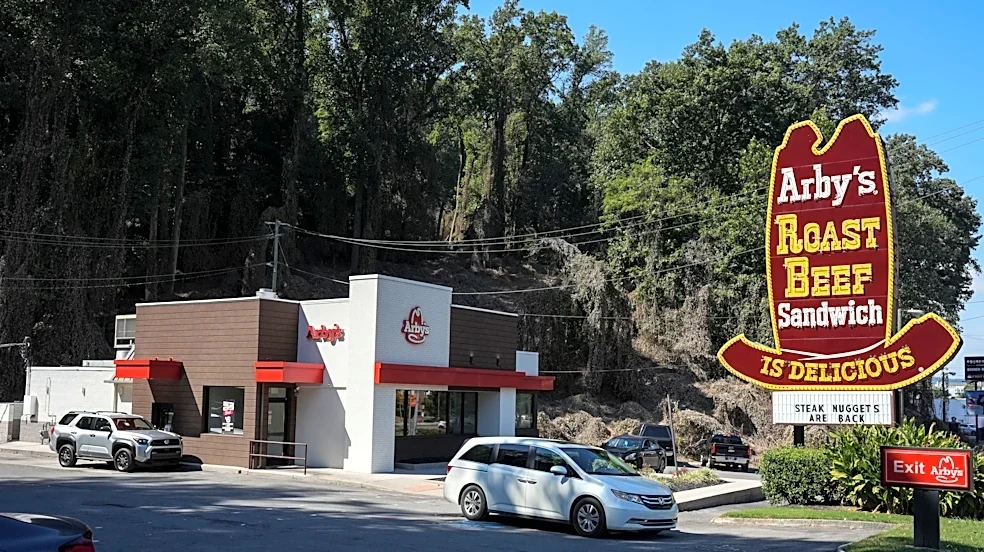







You might have noticed that the "Jungle Arby's" looks a little less, well, jungle-y.
That's because the lush greenery that once made the Chapman Highway fast food joint internet famous is dying.
As hard as that might be to hear, it's actually a good thing, as the foliage is mainly comprised of kudzu, an invasive species with an aggressive growth rate − up to a foot a day, according to the Nature Conservancy − that takes space away from native plants, and then some. It can quickly get out of control to climb trees, telephone poles and structures and is often called "the vine that ate the South."
Although kudzu's strands coil like curly fries, the plant isn't so easy to get rid of − but the city is undertaking an effort to do just that.
What the kudzu removal process looks like
In blocking
out sunlight for native plants, kudzu creates environments that are less biodiverse, which isn't great for the landscape, or for anyone who appreciates nature. "For good healthy habitat, you want as much biodiversity as possible," Knoxville's urban forester told Knox News recently. "Because with biodiversity comes all the other great things, like wildlife and fauna and species richness."
To eradicate the kudzu, four contractors are using herbicides to combat the kudzu problem in a few parts of town: William Hastie Natural Area, Tyson Park, Third Creek Greenway and Fort Dickerson. The latter backs up to the Arby's in question. A grant awarded through the federal Inflation Reduction Act (IRA) in 2024 is helping fund the removal project.
In these places, the process is anticipated to take around three years. There's a lot of precision involved to avoid damaging native plants. Another reason kudzu removal is difficult is that when a vine comes in contact with the ground, it can form new roots. That also means it often has connections spanning property lines, said urban forester Krouse. He told Knox News that the Arby's property owners are cooperating with the city's efforts to remove the vine.
"It's got this nostalgia to it, but what people don't realize is there's a maintenance side of it on the other end of it," he said.
And the plan isn't to just kill the kudzu and call it a day. With the invasive vine gone, some native plants will come back naturally, and Krouse said more will be added as needed as part of the restoration process, including fast-growing tulip poplar and loblolly pine.
So if all goes well, a new sort of jungle will begin to flourish behind the Arby's, meaning there's a good chance in the future you can once again enjoy your beef 'n cheddar against a backdrop of leafy green.
Hayden Dunbar Evans is the storyteller reporter. Email: hayden.dunbar@knoxnews.com. Instagram: @knoxstoryteller.
Support strong local journalism by subscribing at subscribe.knoxnews.com
This article originally appeared on Knoxville News Sentinel: Why it's for the best iconic lush greenery at 'Jungle Arby's' is dying