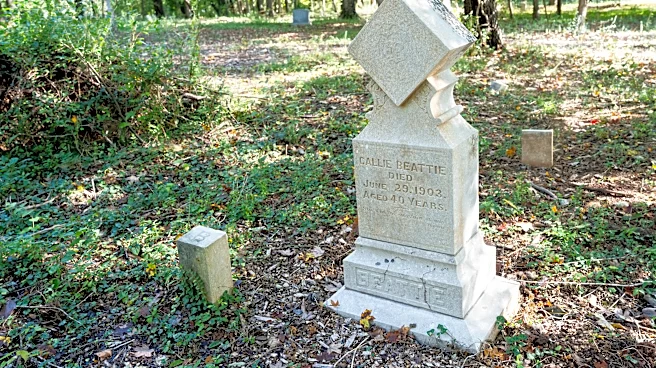







The Mysterious Ten Cemetery sat overgrown and untended, with downed trees and thick brush interspersed amongst fallen tombstones. Now, this historic final resting place for Black working-class Knoxvillians has been restored, and the lives of those buried there honored in the process.
In the historically Black community of Oakland, in Northeast Knoxville off Tazewell Pike, the Mysterious Ten - the women's auxiliary group of a fraternal organization - performed charity work during the post-Reconstruction era, offering burial assistance for members and their relatives so that they were laid to rest in this cemetery. But over time, the burial site at 3945 Oakland Drive declined as nature took its course.
When Aaron Collins and William Isom realized
they had both been contemplating the history of the graveyard, they decided to collaborate on an effort to rehabilitate it. "It was a jungle," said Isom, who is the director of the nonprofit Black in Appalachia.
Restored ceremony reveals fascinating post-Reconstruction history
It was a journey that required much physical labor. Brush was cleared, tombstones were reset, and a grant from Tennessee America 250 helped cover, among other things, the removal of many dead and downed trees on the site. Then there was the research, conducted in partnership with the Afro-American Historical and Genealogical Society of East Tennessee.
Many of those interred at the Mysterious Ten Cemetery are buried in unmarked graves, and many lived not in Oakland, but in the Bottom − the Knoxville neighborhood later destroyed by urban removal − and had used Mysterious Ten's services. The group was a sisterhood connected to a Black fraternal organization called the United Brothers of Friendship. The latter started in 1861 − before the Civil War's end − in Louisville, Kentucky, with membership that included free and enslaved persons.
The recent research conducted as part of the restoration identified stories of those interred at the site, such as Patrick Henry Venable, a brick mason who came to Knox County from Virginia in 1885, and the Rev. Shepherd J. Jordan, who took on the role of pastor at the neighborhood's Foster Chapel in 1935, according to a release. Starting around 1900, burials began there, and the people laid to rest include both formerly enslaved people and the children of formerly enslaved people, Isom said.
"When we talk about Black history, oftentimes we talk about these great figures, like these big, big, great figures that maybe had a lot of money or had some means," he told Knox News. "I think that it's really important to recognize and document and preserve the stories of the people that actually made the Black community function: these workers, these poor, working-class people that actually made the Black community function on a day-to-day basis."
The cemetery shows also the relationships and networks formed by Black Knoxvillians post-Reconstruction, highlighting "the diversity of not just Knoxville's history, but the diversity within Black stories as well." Now that history is preserved and much more easily accessible.
A rededication ceremony is slated for 11 a.m. Oct. 31 at the cemetery, located at 3945 Oakland Drive.
Hayden Dunbar Evans is the storyteller reporter. Email: hayden.dunbar@knoxnews.com. Instagram: @knoxstoryteller.
Support strong local journalism by subscribing at subscribe.knoxnews.com.
This article originally appeared on Knoxville News Sentinel: Restored historic cemetery was 'a jungle,' now highlights stories of past