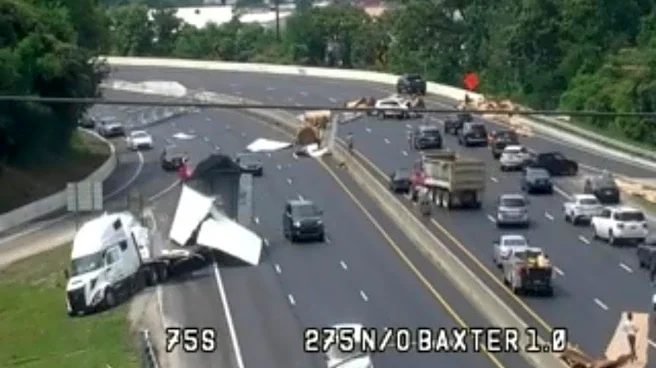


Tennessee needs $87 billion to maintain roads and bridges and expand capacity between fiscal year 2028 and 2055. Decisions made by the next governor will lay the groundwork for how the state approaches the challenge.
Four candidates are leading the race to replace term-limited Republican Gov. Bill Lee: Republican Sen. Marsha Blackburn, Democrat Jerri Green, independent David Hatley and independent Lauren Pinkston. Each has a different vision for how to update Tennessee's transportation dilemma.
A report published in Septemberfound Tennessee isn't making enough money to keep up with the growing demands on its 95,000-mile transportation network.
The report suggests three scenarios the state could choose from or combine to move the needle:
- Increase user fees and create new sources of revenue
- Transfer more money from the state's general fund
- Borrow money for projects
One suggestion
that's gaining support from Democrats across the state but wasn't in the report is the "pot for potholes" proposal, which would legalize recreational marijuana and allocates tax revenue for transportation infrastructure. The"Pot for Potholes Act" failed to pass out of state House and Senate committees last year.
Get the Daily Briefing newsletter: Keep up with the latest local politics and election news for Knoxville and Knox County
Knox News asked each gubernatorial candidate the same set of questions about each scenario:
- Would you use scenario 1 in the report, increasing user fees and creating new revenue? What factors are you considering?
- Would you use scenario 2 in the report, transferring more money from the general fund? What factors are they considering?
- Would you use scenario 3 in the report, using debt financing to fund projects? What factors are you considering?
- The report says the best solution may be a combination of all three scenarios. What are your thoughts about that?
- What conversations have you been having with lawmakers? What solutions are you proposing?
- Is there anything the report got wrong or that it's missing? Do you have an alternative solution in mind? If so, what is it?
Here's what they said.
Sen. Marsha Blackburn
In lieu of addressing each question individually, Blackburn sent a statement:
"As governor, one of my first actions will be to complete a DOGE to remove waste, find savings, and reduce what we spend. From there, we must bring innovative solutions to congestion and surface transportation, and choice lanes are one consideration. That's the only way we will meet our growth needs, as our infrastructure has not been able to keep up with the growth of our state. We'll invest in an infrastructure that grows with us, which includes more than just our roads: our rails, rivers, runways, and water, wastewater, and broadband as well."
Jerri Green
In lieu of addressing each question individually, Green sent a statement:
"Tennessee's roads and bridges are in need of serious investment, but putting that burden on everyday Tennesseans through higher gas taxes, extra tolls, delivery fees, or diverting money from our schools and other essential services misses the mark, especially when working families are already struggling to cover the cost of everyday essentials.
"The recent report lays out three possible paths: jack up user fees, move money around from the general budget, or borrow through debt. But sticking strictly to that menu forces us to accept false choices.
"We shouldn't have to choose between nickel-and-diming commuters or depriving Tennesseans of the services that make their lives a little easier. We aren't trapped in that corner unless we let ourselves be. Getting things done in Nashville takes real partnership, sure, but it also demands fresh thinking that the state's current playbook completely leaves out.
"Instead of leaning on everyday residents, the smarter move is building independent revenue streams that don't put more strain on working families. Look at common-sense ideas like 'Pot for Potholes,' legalizing and responsibly taxing cannabis products the way neighboring states are already doing, combined with cracking down on corporate tax loopholes. That combination can close the gap on funding for infrastructure projects, and crucially, it makes major corporations finally pay their fair share."
David Hatley
Would you use scenario 1 in the report, increasing user fees and creating new revenue? What factors are you considering?
“No. Scenario 1 takes the gas tax from 27 cents to 36 cents by 2030 and then ties it to inflation. It adds a fee on packages delivered to your door and charges more to register the heavier trucks and SUVs that make up about 30% of the passenger vehicles in Tennessee. After all that, the report says it still falls about $1.3 billion short of TDOT’s total needs over the final years of the projection. I’m not going to raise taxes on Tennesseans, and certainly not for a plan that doesn’t close the gap.”
Would you use scenario 2 in the report, transferring more money from the general fund? What factors are you considering?
"This is closer to how I think, with one big change: Scenario 2 still raises the gas tax to 36 cents and adds other tax and fee increases, and I’d take all of those out. What it gets right is that roads need a commitment TDOT can plan around. The legislature has moved nearly $6 billion in one-time money to roads since 2022, so the state already uses the general fund for this. It just does it in a way nobody can plan a 10-year project list on. I’d start with taxes drivers already pay, like the sales tax on vehicles and tires, and phase those toward roads. The factor I’m weighing is what gets displaced, because every general fund dollar comes from somewhere. That’s why an independent auditor and a real public checkbook come first. I expect that auditor to find real savings, and I’d dedicate those savings to critical projects like roads.”
Would you use scenario 3 in the report, using debt financing to fund projects? What factors are you considering?
“I’ve borrowed to build factories and I lived through 2008, so I know both sides of debt. You borrow for something that pays you back. You never borrow for payroll or patching. The report’s example borrows $10 billion over 10 years and pays about $5.6 billion in interest to avoid about $7.3 billion in construction inflation. That leaves about $1.7 billion once you subtract the interest, and it rests on an assumed 4 percent inflation rate. The report says that figure leaves out benefits like congestion relief and safety, and that it isn’t tied to specific projects. Even so, that’s a thin margin for a $10 billion bet. I’d consider bonds for a short list of specific projects, named publicly, each with a dedicated repayment source from existing revenue and a hard cap on annual debt service. Tennessee’s AAA rating is not something I’d put at risk.”
The report says the best solution may be a combination of all three scenarios. What are your thoughts about that?
“I agree there’s no single fix. The report says plainly that no one source closes the gap, and the commission is careful to say it isn’t endorsing any scenario. Here’s my order. Start with the dollars we already have and prove they’re being spent well. Then dedicate the taxes drivers already pay. Borrowing comes next and stays limited. Raising taxes on Tennessee families is not part of the plan.”
What conversations have you been having with lawmakers? What solutions are they proposing?
“As an independent, I don’t owe either caucus anything, and roads aren’t a partisan issue. The legislature asked for this report, which tells me lawmakers know the current model is running out. I’ve said I’ll put a long-term road funding plan in front of them, and I’d rather write it with them than hand it to them.”
Is there anything the report got wrong or that it’s missing? Do you have an alternative solution in mind? If so, what is it?
“The report is honest about its limits. Staff say they couldn’t evaluate individual projects and relied on TDOT’s own planning documents for the needs number. So the gap is TDOT’s estimate of its needs, and TACIR didn’t check it project by project. The $2.5 billion is a projection of the annual gap in fiscal year 2047-48 if nothing changes. Before the state builds a 20-year plan on that number, I want it verified. It also treats construction costs as a given. Costs rose about 12% a year from 2021 to 2025, and nine years after the IMPROVE Act, fewer than half of its 962 projects are finished or under construction and 204 haven’t started. That’s a delivery problem as much as a revenue problem.
"My plan: pause the state gas tax to give families relief and backfill every dollar so TDOT, cities and counties don’t lose a cent. The backfill comes from dollars the state already has, and I’d put the new independent State Auditor to work finding the savings to sustain it. That means forensic and performance audits of state agencies, starting with TDOT’s needs list and its contracts, with every finding tracked in public until the agency fixes it. Every dollar of waste the auditor finds goes to roads. During the pause, put a long-term plan before the legislature that doesn’t depend on a tax that’s fading away. Dedicate the vehicle-related taxes drivers already pay to roads, and stop state contractors from writing campaign checks to the people who award their contracts.”
Lauren Pinkston
Would you use scenario 1 in the report, increasing user fees and creating new revenue? What factors are you considering?
"Some states charge vehicle registration fees based on a car’s weight. Tennessee should consider doing this as well. Because heavier cars create more wear and tear on roads, it would be fair to charge the owners of these cars a bit more. Further, these registration fees could be indexed to inflation so that the state continues to collect revenue at the same level over time.
"Business services have evolved but Tennessee’s tax structure has not. The state should consider levying a tax on Uber, Lyft, DoorDash, Amazon, and other delivery or rideshare companies. For example, Minnesota has a 50-cent fee on all deliveries of $100 or more. My concern is passing charges down to users, however, and I am considering creativetax solutions that protect Tennesseans from companies passing down regular fees for services to avoid this penalty themselves. Businesses use our roads, it is fair to charge them for the wear and tear they apply."
Would you use scenario 2 in the report, transferring more money from the general fund? What factors are you considering?
"Gov. Lee, his cabinet, and Tennessee lawmakers have continuously kicked the responsibility of infrastructure funding down the road, and those roads are now filled with potholes that are costing taxpayers unnecessary vehicle repairs.
"In 2024, the state legislature had budgeted $3M from the general fund for road repairs. After Hurricane Helene, the legislature immediately redirected these funds to begin road repairs rather than tapping into FEMA funds, which should never have happened. FEMA is paid for by Tennessee taxpayers through federal taxes, and the program is designed to allow states to immediately deploy aid with guaranteed reimbursement. The state could have directed infrastructure repairs to begin while retaining the $3M in the state budget apportioned for critical infrastructure needs in other parts of the state.
"Tennessee’s General Fund is used to finance the state’s day-to-day operations, and has many competing policy priorities. While our state has had budget surpluses in recent years, that surplus cannot be counted on in the future. Lower federal matches for programs like SNAP and TennCare, and funding issues with other state programs likethe Tennessee Education Lottery Scholarship, will result in increased costs to the General Fund and competing priorities to transportation needs.
"With close to $100B in state and local government project needs in the coming years, we must conduct a serious audit of our state budget for better efficiencies, and begin planning for external funding to catch up on infrastructure now failing 100 years after the New Deal era of road, bridge, dam, and rail projects."
Would you use scenario 3 in the report, using debt financing to fund projects? What factors are you considering?
"Since 1977, Tennessee has not used general obligation bonds or other debt financing tools to finance transportation projects, making it one of only four states not to do so.
"Our legislators have touted this fact with a sense of pride, but taxpayers are the ones paying for shortcomings of our infrastructure needs on a daily basis.
"Especially now that it is becoming more challenging to fund Tennessee’s transportation needs, Tennessee is forced to consider debt financing as a fiscally responsible way to fund transportation construction needs. These are projects with long lifespans, with material and labor costs that continue to rise with inflation. A stable rate of debt repayment means that financing these projects over time is beneficial to our state budget.
"While this in itself cannot be the entire solution, bonded projects make funding our state’s transportation infrastructure needs more equitable and more cost efficient. As with any responsible debt, our payment plans must be responsibly accounted for in long-term budget priorities."
The report says the best solution may be a combination of all three scenarios. What are your thoughts about that?
"I absolutely agree that a combination of scenarios is the best solution. The state needs more annual revenue for road repairs. This could be accomplished by general fund transfers and a combination of changes to existing fees and new fees.
"But it might also make sense to use targeted borrowing for large projects that will take years to complete. These projects benefit from a guaranteed funding pool."
What conversations have you been having with lawmakers? What solutions are they proposing?
"I have asked a TDOT administrator as well as state lawmakers how they intend to fund these projects. “We need more money,” was their only response. Outside of reforming education, reducing the 90K daycare slot deficit in the state, and addressing a criminal coordination of political pressure within our state government, this infrastructure backlog will be the most significant leadership challenge for Tennessee’s next governor to overcome with the next two Tennessee General Assemblies."
Is there anything the report got wrong or that it’s missing? Do you have an alternative solution in mind? If so, what is it?
"The TACIR report says that 'continued growth is driving needs for additional long-term investment.' The Legislature must allow counties to use impact fees that charge developments for their true cost on public infrastructure. This will mitigate some of the burden on existing city and county budgets, especially as cities and counties own 85% of roads.
"I will direct each of Tennessee’s nine congressional representatives to coordinate their requests for federal earmarks to be brought back to their districts. Local government leaders need to know that they can ask for this type of funding, and it has been frustrating for me to hear from city mayors in Tennessee that they didn’t know they could ask for federal funding requests from their colleagues in D.C.
"As a core principle, growth should pay for growth. The next governor in Tennessee needs to be the type of administrator who arms local governments with effective tools for managing growth in a way that benefits taxpayers the most. Private citizens should not bear the burden of increased pressure on our infrastructure while new industries move to Tennessee for the benefit of our tax haven."
Allie Feinberg is the politics reporter for Knox News. Email: allie.feinberg@knoxnews.com; Reddit: u/KnoxNewsAllie
This article originally appeared on Knoxville News Sentinel: Tennessee's roads need help. How will the next governor fix the problem?