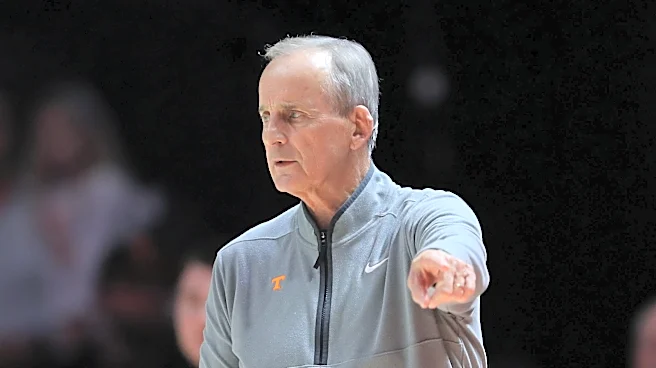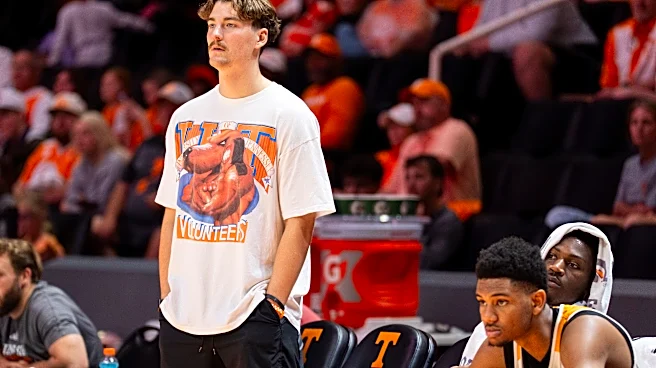


Tennessee basketball coach Rick Barnes is in a bind as he tries to settle on the best lineups for a frontcourt thrown into flux by transfer Jalen Washington's ongoing eligibility lawsuit against the NCAA.
"It is a concern. I mean, it changes some things with us,” Barnes said of his frontcourt depth on Oct. 6. “But we're trying to prepare both ways.”
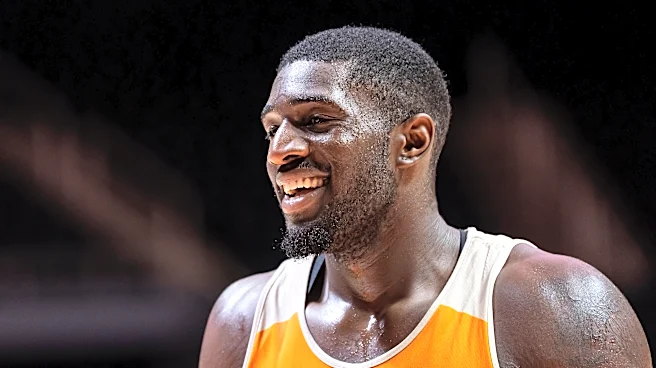
Given all the turnover his roster has undergone, Barnes is leaning on one of his two returning players: sophomore forward DeWayne Brown II. Mature beyond his years, disciplined and steady, Brown could be the answer for a frontcourt with so many moving parts.
“I feel like I'm playing with a little bit more confidence. I'm kind of settled in,” Brown said. “As freshman, I was always kind of settling in as a player,
but I feel like now it was just the game has kind of slowed down. … And the coaches told me they expect that out of me.”
How DeWayne Brown II’s discipline and sharp basketball IQ were built
Brown has been put through trial by fire on the basketball court since he was in high school. Assistant coach Gregg Polinsky, who is based out of Brown’s hometown of Hoover, Alabama, saw it up close while watching Hoover High School practices.
“DeWayne had the advantage of playing for terrific high school coaches. If you ever went to one of their practices, they start with individuals at 5 a.m., then their practice started at 6 a.m. No nonsense, really good teachers,” Polinsky said. “So we can’t take all the credit for DeWayne. A lot of it happened in high school.”
By the time he graduated, Brown had won 117 total games and three Class 7A state championships with the Pirates. Hoover and coach Scott Ware were the incubator for many of the standout traits and skills Brown has carried with him into college.
The Pirates instilled in Brown a sense of toughness and discipline. They also trusted him enough to handle the basketball, push the team up the floor in transition and refine his passing instincts by facilitating offense in games.
“I would say it came from high school. I feel like I've always been a pretty good passer, so Coach Barnes does a good job giving me certain actions where I can make decisions,” Brown said. “I just feel like I just always had it.”
Upon arriving at Tennessee, Brown, at 6-foot-8, was slightly undersized for someone who was expected to swing between power forward and center. With veterans Felix Okpara and J.P. Estrella in place to take most of the frontcourt minutes, Barnes thought Brown would be best served by using a redshirt for his first season.
That notion didn’t last long.
Polinsky was immediately struck by Brown’s humility and mental fortitude, which helped him survive grueling practices and tough love from his coaches early in his freshman season.
“It's hard enough to fight the opponent and win at certain venues and all. But if you're not receptive to coaching, how do you improve?” Polinsky said. “It's really hard for any of us to be objective with ourselves.”
To get to the point where he was regular in the Vols rotation, appearing in all 37 games during the 2025-26 season, Brown had to be mature mentally and physically.
He had the mental side largely developed but Okpara, a 6-11 and 243-pound senior, helped refine the physical toughness through one-on-one battles in practice.
“Felix, he was a big brother to him. Didn't treat him like a freshman,” said sophomore guard Troy Henderson, a part of Brown’s recruiting class at UT and the other returning player. “So (DeWayne), he's doing a good job now, just picking off what he learned from them and applying it to now.”
Brown raised the expectations for himself with a strong freshman season and he’s taking on even more responsibility as a sophomore.
DeWayne Brown II’s value to Tennessee basketball goes beyond the box score
Brown’s stats from his freshman season won’t blow anyone away − 4.8 points, 3.6 rebounds and 0.9 assists per game.
But Barnes saw him as critical to what Tennessee was doing on both ends of the court.
“It was really interesting as we showed people, when we bring them in through the recruiting process … highlights of what we want. One day, I was telling the coaches, ‘All these highlights, Dwayne's in them,’ ” Barnes said. “He's a guy making it all go in and outside of his position to the perimeter guys.”
Brown said he didn’t expect to play as much as he has to this point in his career, but the experience has translated to a natural leadership role as the Vols introduce 13 new players for the 2026-27 season.
He is now a central part of the roster and one of the most important voices guiding the Vols on and off the court.
Brown, typically a quiet person, has taken ownership of that role. And he was even selected by his peers to serve as vice chair of the 2026-27 SEC men’s basketball leadership council.
“I'm more of a leader,” Brown said. “I use my voice more and Iead a lot by example. … The coaches told me … they want me to be that person for this team knowing that I was one of the returning guys who actually played last year. But I feel like it was something I embraced.”
Barnes has admitted he has “no clue” what his lineups will look like when the regular season begins on Nov. 2, as he juggles a future with or without Washington.
But Brown could be the key piece to solving what is for now a complicated frontcourt puzzle at Tennessee.
“DeWayne was the biggest surprise a year ago. And he's just kept working. We certainly appreciate him wanting to be here,” Barnes said. “I can't imagine where we would be without him.”
Stephen Thompson covers Tennessee Volunteers men's basketball. Email him at stephen.thompson@knoxnews.com and follow him on X @stephenethom.
This article originally appeared on Knoxville News Sentinel: Why DeWayne Brown is key to complicated frontcourt for Tennessee basketball, Rick Barnes