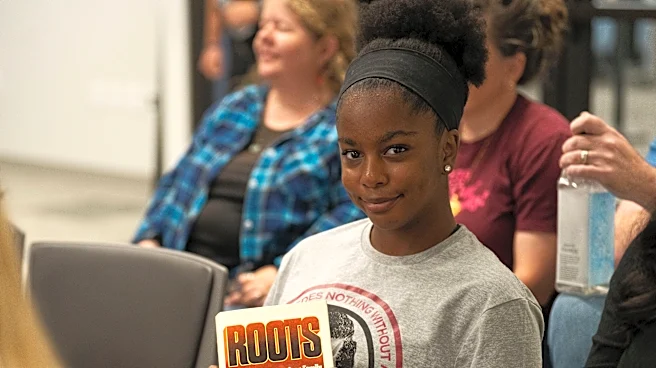





On May 12, Knox County Schools quietly removed "Roots" from its library shelves. Two weeks later, after the story went international and the phones at the district office wouldn't stop ringing, the book came back - "effective immediately," the superintendent's memo said, as if immediacy were the same thing as good process.
It isn't. The real story shouldn't be about one book. It's about the other 123 and counting.
That's how many titles remain off KCS shelves under the state's Age-Appropriate Materials Act. One hundred twenty-three decisions made by an internal committee, with no public notice, no published minutes, and - until "Roots" forced the district's hand, no public rationale at all. We only learned how the process works because a Pulitzer
Prize-winning novel about slavery got swept up in it and enough people cared enough to ask why.
Several Knox County clergy, along with concerned, faithful neighbors, have decided to test why that is. We think the public deserves transparency, and we think students deserve access to diverse, well-managed libraries that are not amputated of material in a biased manner.
KCS says it's simply applying AAMA's language as written: no nudity, no depictions of sexual conduct, no excessive violence. That sounds neutral enough. But look at what's actually come off the shelves, and a pattern emerges that the neutral language can't quite account for: the list skews heavily toward books already targeted in national campaigns against titles dealing with race and LGBTQ life. The AAMA’s stated descriptions are subjective enough that many books that would qualify for bans have gone untouched.
We don't raise that lightly. Impartiality isn't a modern bureaucratic ideal to us; it's an old, plain instruction. Deuteronomy tells judges not to be partial, to hear the small and the great alike, regardless of who stands to gain. James goes further: showing favoritism among God's people, he says, is itself a betrayal of the faith. Scripture doesn't treat "we applied a neutral rule" as a defense when the rule keeps landing on the same kinds of people. It asks what the rule actually does, not just what it says.
The Bible itself contains graphic sexual violence and many passages that break AAMA's own expressed rules in isolation, yet very few of us who have read and cherish it would call for its removal, because we know that the text's darker moments don't define it, and its positive force far outweighs its graphic passages alone. That’s not a special exemption for scripture; it's how education works with any serious book. If that logic holds for the Bible, it has to hold for "Roots" and many of the other 123 titles as well, because any single passage may not outweigh the overall benefit of the work as a whole.
Maybe it's a coincidence that so many of the books targeted are by diverse authors or feature diverse characters. Maybe it’s just how the challenges were made. But a process with no public minutes and no published rationale doesn't let us tell the difference - and that unaccountability is precisely the problem. When a rule can only be defended after the fact, in response to a crisis, you don't actually know if it's a rule or a shield.
So here is what we have done: we've asked, through the appropriate process, for the district to review the Bible under the exact same standard. By AAMA's own language - nudity, sexual conduct, "excessive violence" - the Bible contains plenty that would meet the bar the district has already used to pull other books.
To be clear: we don't want the Bible removed. We want to know whether the standard KCS says it's enforcing is the standard actually being enforced. If yes, the Bible gets flagged like everything else, and the district can show its work. If no - if the "objective" language turns out to have room for judgment after all - then that judgment needs to happen in daylight, not behind closed doors.
We recognize this puts the school board in an uncomfortable position. Yet, as "Roots' taught us, the district's policies need to be examined in public, not apologized for after the fact.
And Knox County isn't alone. A lawsuit against Wilson County Schools alleges the same closed-door pattern: a review committee making removal decisions without the public notice state law requires. Districts across Tennessee have been passing lists of "already vetted" titles to one another like cheat sheets, encouraging neighbors to pull the same books without independent review. That's evidence the whole state is running this law through closed committee rooms, and a lawsuit shouldn't be the only way anyone finds out how. Knox County has a chance to be a district that changes that, rather than the next one sued into it.
None of this requires abandoning AAMA compliance. It requires basic transparency: publicly noticed committee meetings, published minutes, a specific written rationale tied to specific language for every removal, and outside review when a pattern of ideological skew is alleged.
These aren't radical asks. They're the baseline anyone should expect from a public body deciding what students can read. A policy that silences certain voices and not others is not good enough for our students who deserve real history, real representation, and access to important literature throughout history.
We're not naive about where this started. AAMA is redundant - Tennessee already has obscenity statutes on the books - and it was written without any carve-out for historical significance, literary genre or religious context, which is exactly how a Pulitzer-winning novel about slavery (and the Bible itself) ends up in violation. That's a legislative failure, and we think Nashville should hear about it too. But a poorly written law doesn't excuse a poorly run process. If anything, vague language makes the committee's discretion more consequential, not less - which means that public minutes and written rationale is even more important at the local level.
"Roots" got its hearing because enough people made noise. Since we began raising these concerns, the school board has approved a new formal review process that, among other things, mandates the reevaluation of the 123 books that were banned under the previous policy. This is a step forward, but a formal process isn't automatically a transparent or evenly applied one. Whether it brings publicly noticed meetings, published rationales, and impartial review - or just a tidier paper trail around the same closed room - depends on how the board carries it out, and on whether the rest of us keep watching.
We're asking our neighbors to keep showing up, at board meetings and in public comment, to see whether this process delivers the transparency, representation and equal access our children deserve - and to keep pushing until it does.
Signed, Rev. Chad Wright-Pittman, Rev. Caleb Gilmore, Rev. Rachel Penmore, Pastor Rebecca O’Malley, Pastor Mary Overstreet, Michael O’Malley, Rev. Tim Reynolds and Rev. Joseph Taber.
This article originally appeared on Knoxville News Sentinel: When KCS considers books to ban, it should show its work | Opinion