

There's no way around it: This is a pivotal season for Lady Vols basketball.
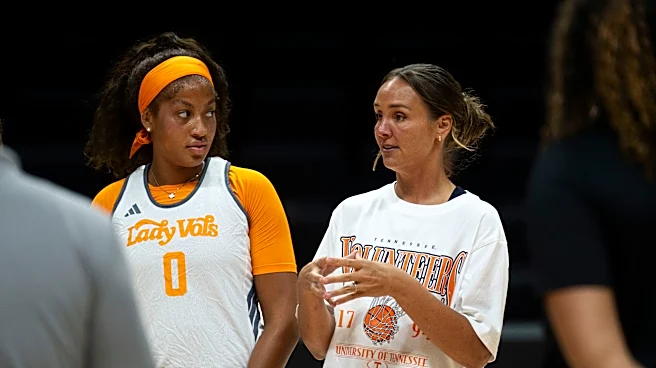
Tennessee coach Kim Caldwell enters her third season after the fallout from the worst season in program history. She has acknowledged her job could be on the line if the Lady Vols have another year like last year and don't move closer to their lofty expectations instead of further away.
Here are the five biggest questions for Caldwell and Tennessee before season begins against Duquesne at Food City Center on Nov. 2 (6:30 p.m. ET, SEC Network+).
How will Kim Caldwell handle pressure to succeed?
Caldwell has never lost in her entire career as much as she did last season, and she has never had a job that's comparable to the pressure cooker the Lady Vols can quickly turn into. Caldwell had moments last season that sparked
some backlash, like publicly calling the team out for quitting, and she admitted later she didn't like who she was at times during the tumultuous 16-14 campaign.
Last season was new territory for Caldwell to navigate – she had never failed to that extreme. Now the question is, how will she use that experience to handle the pressure of this season with her job potentially on the line?
Caldwell came off very reflective this offseason whenever she spoke with media. It seems like she learned and grew from last season, and she appears to be a better leader for it. But how will she handle the adversity that lies ahead, if the team loses a game they shouldn't or they get off to a shaky start in SEC play? Only time will tell.
Can effort beat talent?
There was a clear reset in recruiting strategywhen Tennessee had to replace its entire roster. The majority of players are more in line with what works best with Caldwell's system – they may not have been five-star recruits, but they're high-effort players who buy into her style of play.
It's a total flip from last season's roster, which was full of former five-star recruits and McDonald's All-Americans. It had the kind of talent from top-to-bottom that you'd expect from an SEC contender, but the team never came together on the court.
This season's roster feels like it was inspired by the quote made famous by Kevin Durant: "Hard work beats talent when talent fails to work hard."
That appears to be the underlying assumption – or rather, hope – with this roster, is that if you have a team fully bought in and willing to work harder, it doesn't matter that there's a talent gap.
Only problem is, you'd be hard-pressed to find a top program that isn't working hard. So, the question becomes, is it still possible to outwork elite teams with more talent? Is being a team full of underdogs united by the chip on their shoulders enough to take down top-ranked opponents?
How much will new assistant coaches elevate the product?
The offseason changes also included the staff. Caldwell hired Bill Ferrara and Isoken Uzamere to replace assistants Gabe Lazo, who was hired to coach UCF, and Roman Tubner, who's now on Louisville's staff.
Ferrara has a similar offensive philosophy to Caldwell, and he helped lead a high-scoring offense at Florida State. Sure, some of last season's offensive struggles can be attributed to roster construction. But the Lady Vols need a more reliable, consistent offense, especially if they aren't scoring as many points off turnovers against top opponents. Bringing Ferrara's offensive mind could be a huge asset.
Uzamere spent the last four seasons at Georgia, where she coached post players, worked on scouts and was a strong recruiter. She also coached with the Nigerian national team this summer and got to work on scouts and preparation for WNBA preseason games. Uzamere's experience feels like the perfect complement to Caldwell's staff.
The question is, will all those things elevate the product on the floor and lead to more wins this season?
Can this roster compete in the SEC?
Tennessee has gone 8-8 in SEC play in both of Caldwell's seasons, although those records played out in very different ways. The Lady Vols took a step backward last season, getting blown out by South Carolina, Ole Miss and LSU and falling to teams like Mississippi State and Texas A&M.
The style of play in the SEC is physical, and a team's success depends heavily on its ability to defend and rebound. In Caldwell's third season, she has the least amount of size on her roster. There are no forwards 6-foot-4 or taller, and Fatmata Janneh is the only proven rebounder in the SEC. Aaliyah Moore only played in six SEC games since Texas joined the conference.
Even if the Lady Vols find consistent success with their full-court press, that's only one piece of the puzzle to winning more SEC games. The other important factor will be if Tennessee can handle the physicality in the paint when defending and rebounding.
How much success can buy Caldwell another season?
There are a lot of factors that go into coaching changes, and it's not a forgone conclusion that Caldwell will get fired if this season isn't a smashing success. But with this program and its fan base, it's hard to imagine a scenario where Tennessee doesn't make a change unless this season goes significantly better than last season.
The bar of being better than last season isn't a hard one to clear, but how much better does it need to be for Tennessee to believe Caldwell is turning it around for the long run?
Ultimately, only athletics director Danny White can answer that question. But there's a couple scenarios where you could justify giving Caldwell, who has a 40-24 record at UT, another season. If Tennessee's record in SEC play is the same or worse, Caldwell would likely need an NCAA Tournament run that extends into the second weekend to feel safe. On the flip side, if the Lady Vols end up having a stronger SEC season and finish in the top four or five teams, they could probably lose in the second round of the NCAA Tournament.
But if Tennessee has another lackluster showing in SEC play and goes one-and-done in the NCAA Tournament – or worse case scenario, misses the tournament for the first time ever – a coaching change feels inevitable.
Since Caldwell, whose annual salary is $1 million, did not sign a contract extension after last season, her buyout is 50% of the annual compensation she would have earned between the termination date and end of her contract.
Cora Hall is the University of Tennessee women’s athletics reporter for Knox News. Email: cora.hall@knoxnews.com; X: @corahalll; Bluesky: @corahall.bsky.social. Support strong local journalism and unlock premium perks:knoxnews.com/subscribe
This article originally appeared on Knoxville News Sentinel: The 5 biggest questions for Kim Caldwell's third season with Lady Vols basketball