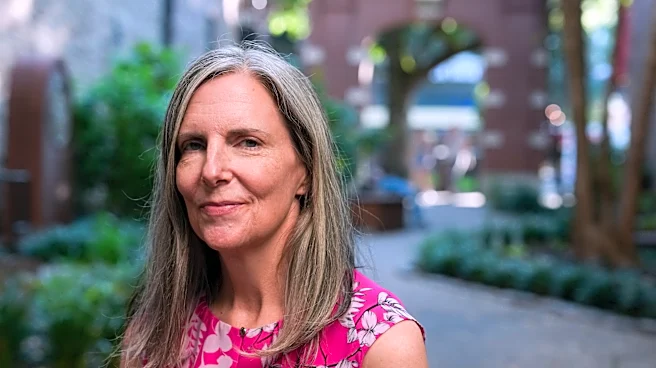

Jennifer Garrett didn't consider herself the perfect person to build the Knox County Virtual School from the ground up. But she was ready to take on the challenge.
"I knew education was on a cusp of something,"
Garrett told Knox News. "And I wanted to be a part of that, but I also wanted to be a part of making it right, not wrong."
Garrett, after more than 20 years in traditional, in-person teaching and leadership roles, booted up her computer and got to work as the COVID-19 pandemic started in 2020. She immediately knew education had entered a new era.
She got her start in KCS in 1998 at Karns Elementary School teaching kindergarten. In the early 2010s, Garrett was recruited to assist in the push for 1:1 digital classrooms to get one laptop in the hands of every student, then to lead various schools as assistant principal and manage the Dr. Paul Kelley Volunteer Academy campus.
"Knox County has been very dedicated to understanding that there has to be different schools and options for students. They've got L&N (STEM Academy), (Career Magnet Academy), Beaumont (Magnet Academy)," Garrett said. "That needs to be where we live."
Garrett feels 'deep sense of responsibility' to students
Building a virtual school for the district wasn't just a new project for Garrett. She's an educator, first and foremost, and what's right for students always guides her.
"We sometimes make decisions in education because they're easy to be implemented quickly. And I don't want that to be what I do," she explained, tears filling her eyes. "I want my work to be centered around what is right for students. And I knew I would keep my heart at that."
That responsibility weighed heavily on Garrett in the early months of the virtual school she helped pioneer for the families that opted out of in-person instruction in fall 2020, she recalled.
"There were many nights where I felt like, Am I failing? Am I doing this right?" she said. "I have the responsibility to either build something that'll be great for my district or if I don't do it right, it'll be the thing that failed."
She had an ambitious goal in offering live instruction for grades four through 12, just like an in-person school. But that meant managing a complex schedule on a daily basis for the elementary, middle and high school students.
Garrett knew she couldn't do it alone. She had to recruit fellow "believers" in this new model, and Nicole Buchanan was one.
"I was the one who at my brick-and-mortar school (Fountain City Elementary) became a virtual teacher during COVID," Buchanan told Knox News. "I became a believer that year. I realized you build relationships deeper with students and families virtually than I ever had in any of my years."
Building community, on and off the screen
The virtual school is a disparate community, with hundreds of students residing across Knox County, from Gibbs to Farragut and from Hallsto South Knox. Families must choose the school through the transfer process.
"When they come into a classroom, there isn't, 'Oh, you're from this community or you're from this community.' Those walls are taken down. They're just coming into a class," Garrett said. "Some of the things that had been inhibitors or barriers that they dealt with don't happen with us."
Garrett estimates the virtual school has about 350 students, but her team has the capacity to serve around 600.
In addition to full-time virtual learners, the teaching team handles specialized classes that aren't offered at specific schools. For instance, virtual teachers handle Spanish classes for Whittle Springs Middle School.
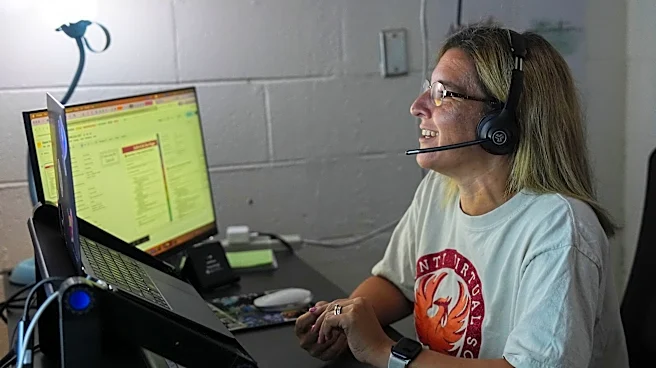
They even offer courses for students at Karns Middle School. Half of the virtual school teachers work from darkened classrooms there everyday. The other half work at Holston Middle.
"Students are engaged throughout all the learning. That is probably the most key aspect of what we do that other people aren't doing," Garrett said. "You could visit any class. I could take you down the hall to any class at our school, and it's the same."
In one classroom, a middle school teacher calls out to students like any other class. She's asking them to recall the 13 colonies and where each is placed regionally. The difference is, the teacher is seated in front of a massive television screen with students' faces spread across it alongside a live look at the screens the students are seeing at home. Students are visibly engaged, giggling at a joke and sending emojis in the chat.
A student-favorite activity is the annual board game and crafting extravaganza the school hosts before the December holiday break. The virtual school even holds an annual in-person prom and graduation.
A mosaic of students
Garrett said there are several reasons families seek out virtual education. Some may be traveling athletes, are parents themselves, are former homeschool students or they may struggle with mental health issues.
"You aren't coming to our school because you're getting something less or something's wrong with you. You're coming to our school because you deserve something different to be successful," she said. "We're going to provide that for you."
Ensuring every child has access to quality education is paramount for Garrett. It's why she believes so deeply in this model, especially at public schools. Any student can join the virtual school − they don't even need to buy a computer.
"Never, in any stretch of the imagination, should education − which is what is going to reform and change our world − be something that people who have money get and others don't."
Caitlyn Meisner is the K-12 education reporter for Knox News. Email tips and story ideas to caitlyn.meisner@knoxnews.com.
This article originally appeared on Knoxville News Sentinel: KCS virtual teachers are passionate advocates for a new way of learning