
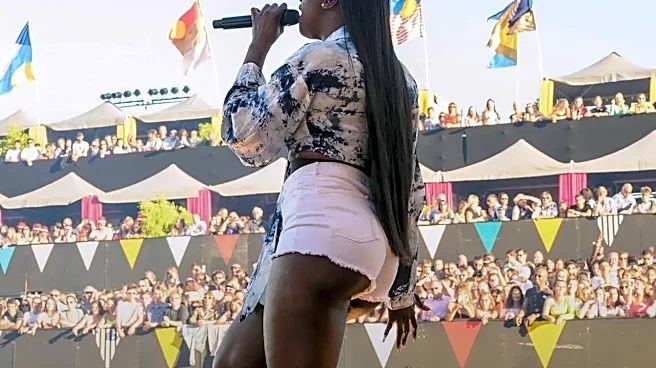
6. The Headliner Victory Lap: Lowest Risk
This is the safest bet in the festival playbook. An artist like Charli XCX, who headlines this year, arrives with a catalog of established hits, a polished stage production, and a massive crowd that bought tickets specifically to see them. The narrative
is already 90% written: a triumphant celebration. The primary risk isn't catastrophic failure, but something more mundane: being merely fine. In a headlining slot, meeting expectations is the baseline. The challenge is to create a transcendent moment that elevates the performance from a predictable victory lap into something truly legendary. The story is almost guaranteed to be positive; the only question is how positive.
5. The Genre-Defining DJ Set: Low Risk
Whether it’s a main stage act like Rüfüs Du Sol or a techno titan like Boris Brejcha holding court in the SOMA tent, the big-name DJ set has a clear, achievable mission: keep the energy high and the crowd moving. The narrative is less about specific songs and more about creating an immersive, collective experience. The structure is built on predictable drops and euphoric builds, a formula designed for mass appeal. The risk here is not about the performance falling apart, but about it being forgettable. In a sea of electronic acts, a set can easily blend into the background if it doesn't bring a unique visual flair or an unexpected track selection to define its story.
4. The Esteemed Indie Mainstay: Medium Risk
For bands like The Strokes or Death Cab for Cutie, a festival slot is a balancing act. They have devoted fans, but they are also playing to thousands of casual onlookers. The narrative risk lies in the setlist. Do they play the beloved deep cuts for the diehards, or stick to the radio hits to keep the broader crowd engaged? Leaning too far in either direction can fracture the audience. Go too obscure, and the energy dips. Play it too safe, and they risk appearing like a human jukebox, detached from the material. The ideal performance threads the needle, creating a story that satisfies both longtime followers and new converts.
3. The Legacy Act: High Risk
Bringing a legacy act like past performers The Who or Paul Simon to a festival is a potent but risky move. The entire performance is framed by nostalgia. The central question in the audience’s mind is: ‘Can they still do it?’ When it works, it’s a powerful, cross-generational moment. But when it doesn't, the narrative can be cruel. A shaky voice, low energy, or an over-reliance on bygone glory can tarnish a legacy, turning a would-be triumph into a sad spectacle. When Paul Simon’s 2019 headlining set was reportedly under-attended compared to Childish Gambino’s, it highlighted the risk: nostalgia doesn't always guarantee a crowd. It’s a high-stakes gamble on cultural relevance.
2. The High-Concept Spectacle: Very High Risk
This is the performance as a grand, theatrical experiment. Think of Gorillaz, whose set depends on a seamless blend of live musicians and animated characters, or the wild novelty of The Muppets' Dr. Teeth and the Electric Mayhem playing their first-ever festival gig at Outside Lands in 2016. These shows are built on a compelling 'what if?' premise and often rely heavily on technology, elaborate costumes, or complex choreography. The narrative payoff can be immense, creating a one-of-a-kind spectacle. But the risk of a technical glitch, a conceptual misfire, or the gimmick overpowering the music is enormous. When the entire story of your set rests on a fragile, high-wire premise, the fall is a long way down.
1. The Surprise Guest: Highest Risk
No single element of a festival carries more narrative risk than the surprise guest. When it succeeds, it’s the stuff of legend—an unscripted, electrifying moment that defines the entire weekend, like when Paul Simon brought out Bob Weir for a historic collaboration. But it is the ultimate gamble. Awkward chemistry, technical difficulties, or a guest who feels shoehorned into the set can instantly deflate the energy. The main artist risks having their own performance overshadowed or, worse, derailed. The narrative is written in a flash, instantly judged by thousands and broadcast on social media. It can become an iconic 'I was there' story or a viral 'cringe' moment, making it the biggest roll of the dice an artist can take on stage.