






The Sympathy Shuffle
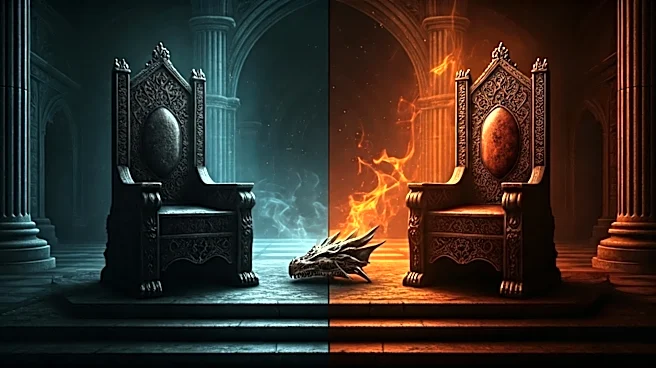
From its opening episodes, the series masterfully splits our allegiance by building a foundation of empathy for both future queens. We first meet Rhaenyra and Alicent as childhood friends, and the story deliberately grants us access to both of their perspectives.
We feel Rhaenyra’s frustration as she’s sidelined by her gender and her grief over her mother's horrific death in the birthing bed. We feel her yearning for a life beyond the rigid constraints of the court. But moments later, we are made to understand Alicent’s terror. She is a pawn in her father’s game, pushed toward a grieving, much-older king. Her sense of duty is a cage, and we see her sacrifice her own desires for what she believes is the stability of the realm—and the survival of her family. The show doesn't present one as right and the other as wrong; it presents two young women trapped by the same patriarchal system, reacting in different ways. This early investment ensures that no matter how far they diverge, a part of us remembers the girl they once were, making it impossible to write either off completely.
No Pure Heroes, Only Flawed Humans
Unlike its predecessor, Game of Thrones, which gave us the unimpeachable honor of Ned Stark as an initial moral compass, House of the Dragon offers no such comfort. Every major character is a cocktail of admirable and appalling traits. Rhaenyra is a sympathetic claimant fighting for her birthright, but she’s also a serial liar who can be callously indifferent to the consequences of her actions. Alicent begins as a victim of circumstance but curdles into a self-righteous zealot, willing to usurp the throne based on a deathbed misunderstanding and a lifetime of resentment. Then there's Daemon Targaryen, a magnetic monster who is both a loving husband (to Rhaenyra) and a murderous tyrant. By refusing to give us a clear hero, the show forces us into a more complex moral calculation. We aren’t choosing good vs. evil. We’re choosing between two deeply flawed factions and justifying our pick based on which flaws we’re more willing to forgive. That choice says as much about us as it does about the characters.
The Weaponization of Time
Perhaps the show’s most potent tool of manipulation is its use of significant time jumps. Leaping years forward in a single episode forces the audience to become active storytellers. We don't see the daily micro-aggressions that slowly poison Alicent’s mind against Rhaenyra. We don't witness every single moment of Rhaenyra’s growing isolation at court. Instead, we are shown curated, high-impact scenes and are left to fill in the narrative blanks. This is a brilliant trick. In filling those gaps, we project our own biases and interpretations onto the characters. If you are predisposed to sympathize with Alicent, you'll imagine a decade of legitimate grievances. If you're on Rhaenyra's side, you'll see those same years as a relentless campaign of petty persecution. Our allegiance becomes baked into the story we tell ourselves during the fade-to-black transitions, making our chosen side feel more personal and deeply held.
You Are a Lord of Westeros
Ultimately, the show positions the viewer as just another lord or lady of a great house being courted by the warring factions. Both the Greens and the Blacks are engaged in a relentless PR campaign. We hear the Greens’ arguments: Rhaenyra’s children are illegitimate, her behavior is scandalous, and a woman on the throne invites instability. Their case, while self-serving, is presented as a logical argument about tradition and order. Moments later, we hear the Blacks’ counter-narrative: Alicent is a usurper, a hypocrite hiding behind piety, and her sons are brutes. Her faction is defying the king’s sworn will. Both sides have a point. The show presents both sets of propaganda with such conviction that we, the audience, are forced to weigh the claims and decide which story we believe. We are not watching the Dance of the Dragons from a safe distance; we are sitting in the throne room, being asked to declare for a side.