






The Cyclops: A Giant Feat of Camera Tricks
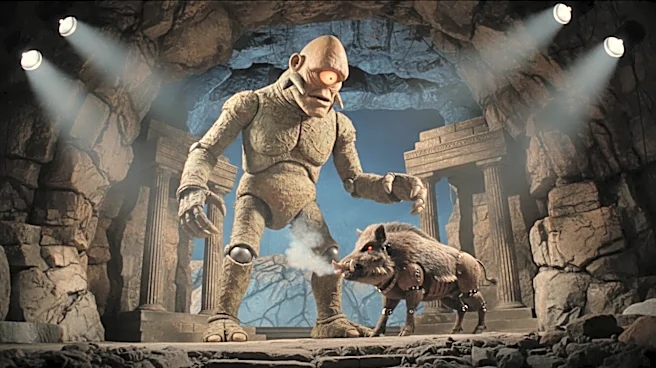
Polyphemus, the one-eyed giant, is arguably Odysseus’s most famous monstrous foe. For decades, bringing him to life was a masterclass in practical effects. The 1954 epic Ulysses, starring Kirk Douglas, relied on clever camera work and scale. The Cyclops
sequence, reportedly co-directed by future horror maestro Mario Bava, used forced perspective and oversized props to create the illusion of a massive creature looming over Ulysses and his men. They built a colossal cave set and had the actor playing Polyphemus stand closer to the camera to appear gigantic. The 1968 Italian miniseries L'Odissea, also featuring Bava's touch, took a similar approach, focusing on shadow and scale to build suspense before revealing the monster. These early versions were less about seamless reality and more about theatrical, atmospheric horror.
Circe's Menagerie: The Magic of Makeup and Animatronics
The enchantress Circe, who turns men into pigs, presents a different challenge: transformation. Early films often implied the change more than showed it. In the 1954 Ulysses, the dual casting of Silvana Mangano as both the loyal wife Penelope and the seductive Circe highlighted the psychological temptation. The transformation of the crew was more of a magical fade than a graphic metamorphosis. By the time of the 1997 NBC miniseries, The Odyssey, technology had caught up to mythology. The esteemed Jim Henson's Creature Shop was brought in to handle the effects. They created startlingly realistic animatronic pigs, including one that could talk, giving the scene a tangible and eerie quality that showcased the horror of losing one's humanity.
The Sirens: A Threat of Sound and Suggestion
How do you film a monster whose main weapon is a song? For the Sirens, it’s all about what you don’t see. Homer's text describes them as part bird, part woman, but many adaptations lean into psychological terror. In the 1954 film, Ulysses is tormented as the Sirens speak with the voices of his family, a clever and haunting interpretation. The Coen Brothers’ 2000 film O Brother, Where Art Thou?, a loose adaptation set in the American South, reimagined the Sirens as three beautiful women washing clothes in a river. Their hypnotic song, "Go to Sleep, Little Babe," lures the heroes into a stupor, showing how temptation can be just as monstrous as a physical beast. It’s a brilliant translation of the myth, proving the core threat is seduction, not necessarily sharp claws.
Scylla and Charybdis: A Whirlpool of Practical Effects
The twin terrors of the strait, the six-headed Scylla and the whirlpool Charybdis, were the ultimate test for special effects departments. Early adaptations often struggled to depict this sequence convincingly, sometimes simplifying it to a treacherous storm. However, the 1997 miniseries, a landmark for television special effects, went all in. Charybdis was a swirling vortex, but Scylla was the main event. Realized through a combination of puppetry and nascent CGI from the same team that would later work on major blockbusters, the monster's serpentine heads were shown snatching sailors from the deck of the ship. It was a horrifyingly literal depiction that won the production an Emmy for its visual effects and set a new standard for what was possible for mythological monsters on television.