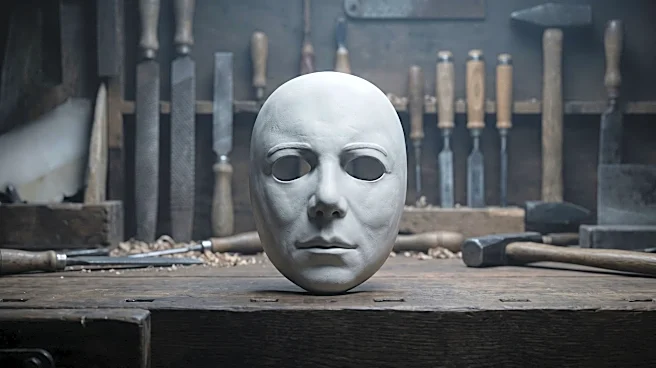






Some things are just etched into our cultural psyche. The shape of a Coke bottle, the golden arches, and the pale, emotionless face of Michael Myers. But that mask is more than just a horror movie prop; it’s a masterclass in brand identity.
The Accidental Genius of a Blank Slate
The origin
of Michael Myers’ iconic mask is the stuff of low-budget legend. In 1978, with little time and even less money, the production team for John Carpenter’s 'Halloween' needed something unsettling for their villain, 'The Shape'. Production designer Tommy Lee Wallace famously went to a Hollywood magic shop and bought a William Shatner Captain Kirk mask for under $2. They widened the eyes, spray-painted it a stark white, and removed the eyebrows and sideburns. The result was horrifying in its simplicity. It wasn’t a monster face, twisted in a grotesque snarl. It was a human face, stripped of all expression and emotion. This blankness became its greatest strength. The mask doesn't tell you how to feel; it’s a void that the audience fills with their own deepest fears. Is he angry? Is he emotionless? Is he something not human at all? You decide, and that’s terrifying.
A Timeless Design in a Changing World
While other horror icons of the era, like Freddy Krueger or Jason Voorhees, have designs rooted in specific aesthetics—a burned-flesh look or a grimy hockey mask—the Myers mask is almost abstract. Its featureless white visage doesn’t scream ‘1970s’ or ‘1980s’. It’s timeless. This simplicity is key to its longevity. Over the course of 13 films, the mask has changed subtly—sometimes due to different manufacturers, sometimes showing wear and tear—but the core design remains. This has allowed the character to be rebooted, retconned, and reintroduced to new generations without losing his core identity. An aged, cracked mask in 'Halloween Ends' tells a story of decay, while the pristine version from the 1978 original is unnervingly clean. Each version works because the foundational design is so strong.
The Face of a Billion-Dollar Franchise
Ultimately, the mask is a box office asset because it is the franchise. You can change the director, the storyline, and even the actor behind the coveralls, but as long as that white mask appears, it’s a 'Halloween' film. The film series has grossed over $884 million worldwide across its entries, proving the durability of its central villain. The 2018 reboot alone, which brought back a version of the classic mask, grossed over $255 million on a modest $10 million budget, becoming the most financially successful film in the series. Even sequels with mixed reviews, like 'Halloween Kills' and 'Halloween Ends', pulled in over $133 million and $104 million respectively. This proves the mask is the primary draw. It’s the visual cue that promises audiences a specific kind of dread, and it’s a promise that has consistently put viewers in theater seats for decades.
More Than a Prop, It's an IP
In business terms, Michael's mask is the franchise's most valuable piece of intellectual property. It’s the image on the posters, the t-shirts, and the Halloween costumes sold every October. This constant cultural reinforcement creates a feedback loop: the movies make the mask famous, and the mask’s fame helps sell the next movie. It has transcended the films to become a universal symbol for horror itself. While other slashers have their weapons or signature looks, none are as hauntingly simple and immediately recognizable as Michael's ghostly pale face. John Carpenter and his team didn't just create a scary movie villain; they accidentally created one of the most powerful and enduring brands in entertainment history, all born from a cheap sci-fi mask.