




The Perfect Blank Canvas
The white shirt is the alpha and omega of the male wardrobe. It’s a garment of firsts and lasts: first job interviews, first dates, weddings, and funerals. It’s democratic yet aspirational, worn by everyone from James Dean to your local barista. For a designer
showing in Paris, the epicenter of sartorial craft, this universality presents the ultimate challenge. When you present a white shirt on a runway, you are not just showing a piece of clothing; you are making a statement about your entire brand philosophy. It is the ultimate blank canvas, and what a designer chooses to do—or not do—with it speaks volumes. Is their vision about minimalist perfection? Romantic embellishment? Deconstructed rebellion? In a world saturated with logos and trends, the white shirt forces a designer to answer a fundamental question: without the noise, what do you really have to say?
There Is Nowhere to Hide
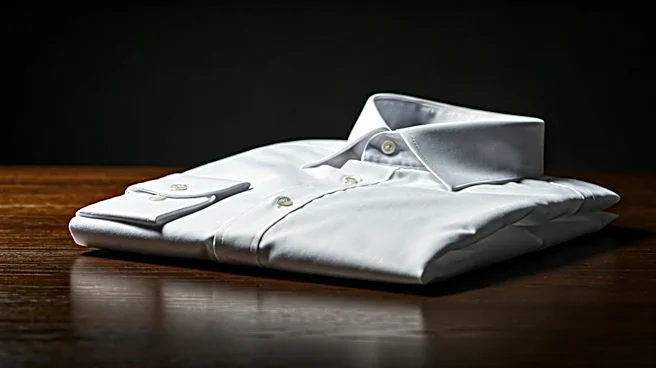
From a technical standpoint, the white shirt is unforgiving. A busy print or an elaborate silhouette can mask a multitude of sins, from imprecise stitching to a less-than-perfect fabric. A white shirt offers no such refuge. Every single element is laid bare for scrutiny. The crispness of the collar points, the tension of the placket, the precise roll of the cuff, and the quality of the fabric—be it a feather-light voile or a sturdy Oxford—are all under a microscope. A millimeter of difference in shoulder seam placement can change the entire posture of the garment. This is why it’s a test of a maison’s atelier as much as the creative director. It’s a quiet declaration of mastery. When a brand like Hermès or Valentino sends a perfect white shirt down the runway, they are flexing their technical prowess in the most subtle, powerful way possible. It’s a silent boast that says, “We get the fundamentals right, impeccably.”
A Test of Point of View
If every designer can make a white shirt, how do you make it *yours*? This is the conceptual test. It’s not enough for the shirt to be well-made; it must also be interesting. It has to carry the designer's unique signature without betraying the shirt’s essential character. For some, like Dries Van Noten, it might be about an unexpected, slightly oversized silhouette or a poetic choice of fabric that drapes just so. For a minimalist like Jil Sander, it’s about a monastic purity of line, where the beauty is in the reduction of every superfluous detail. For a more avant-garde designer, the challenge might be to deconstruct the shirt—to question what it’s made of and what it represents—while still retaining a ghost of its original form. The shirt becomes a vehicle for an idea. It separates the true visionaries from the mere clothiers. Anyone can copy a trend, but reinterpreting a universal icon in a way that feels both fresh and authentic is the mark of a true artist.
The Modern Litmus Test
In recent seasons, this test has felt more relevant than ever. As menswear moves towards a quieter, more personal form of luxury, the focus has shifted from loud branding to the intrinsic value of the clothes themselves. Designers are judged on their ability to create pieces that men will actually want to live in. The white shirt is the litmus test for this new reality. Can you create an object of desire out of the most common garment imaginable? Look at the runways: a billowing, poet-sleeved version tucked into high-waisted trousers at one show, a razor-sharp, almost architectural iteration at another. Each is a white shirt, but each tells a completely different story about modern masculinity. It serves as a reminder that true innovation doesn’t always mean inventing something new from scratch. Sometimes, it’s about seeing the oldest, most familiar thing in a brilliant new light.