



From Battlefield to Brooks Brothers
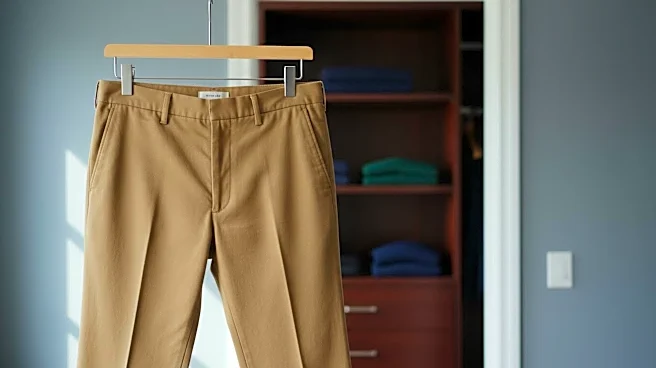
Much of the preppy uniform wasn't born in a lecture hall but on the battlefield. Take the quintessential chino pants. Their story begins in the mid-19th century with British soldiers in India who dyed their white cotton trousers with spices and coffee
to better blend in with the dusty landscape. This early version of camouflage, known as “khaki” from the Hindi word for dust, was all about function. American soldiers later adopted these trousers during the Spanish-American War in the Philippines. The durable cotton twill was often sourced from China, leading Spanish-speaking locals to call them "pantalones chinos," or Chinese pants—a name that stuck. After World War II, a surplus of military-issue chinos flooded the civilian market, where they were eagerly adopted by college students who appreciated their comfort and durability, pairing them with button-downs to create the now-iconic campus look.
Inspired by a Dog's Paws
Another preppy icon, the boat shoe, has an origin story that’s less about leisure and more about life-or-death practicality. In 1935, a sailor and inventor named Paul Sperry nearly lost his life when he slipped on the wet deck of his boat. His moment of inspiration came not in a workshop, but while watching his cocker spaniel, Prince, run across ice without losing his footing. Sperry examined his dog's paws and noticed a series of tiny grooves that provided natural traction. He used a knife to cut a similar herringbone pattern into a rubber sole, a process called siping, which effectively channeled water away and prevented slipping. He attached this sole to a leather moccasin-style upper and, crucially, made the soles white to avoid scuffing pristine boat decks. The U.S. Navy contracted Sperry to produce the shoe for its sailors in 1939, cementing its status as a functional classic before it ever became a fashion statement.
The Workwear Connection
While prep style often evokes images of an elite class at leisure, many of its core components are borrowed directly from the world of blue-collar work. The rugged durability of garments designed for laborers, sailors, and factory workers provided an authentic, practical appeal that was later co-opted and polished. Items like sturdy canvas jackets, originally made for construction workers, and denim, the ultimate American workwear staple, found their way into the preppy wardrobe. This adoption wasn't about mimicking the upper class, but about embracing authentic, well-made garments. The style's evolution shows a pattern of taking functional, hard-wearing pieces and integrating them into a cleaner, more refined aesthetic that valued quality and longevity over fleeting trends.
A Quiet Revolt in Style
Perhaps the most overlooked influence on preppy style is how it was adopted and redefined by Black culture. In the 1950s and 60s, Black students, artists, musicians, and activists took the so-called elite wardrobe of the Ivy League and remixed it, creating what is now known as “Black Ivy.” For figures like James Baldwin, Miles Davis, and Martin Luther King Jr., dressing in tailored blazers, crisp button-downs, and loafers was not about assimilation. Instead, it was a form of self-expression and a visual assertion of dignity and equality in a society that often denied them respect. This was a sartorial power grab, taking the uniform of the establishment and infusing it with a new, revolutionary coolness that continues to influence modern menswear today.