




A Building That Tells a Story
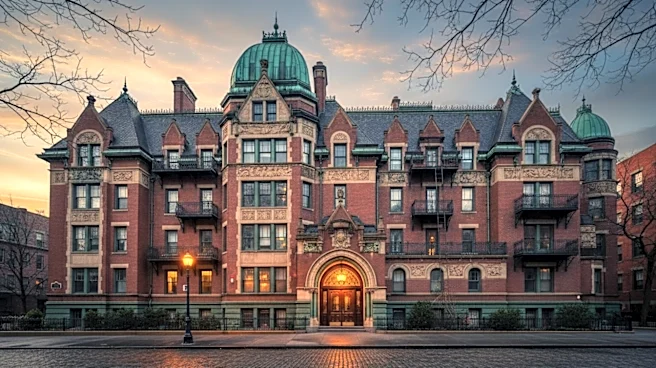
The Arconia, with its Gilded Age grandeur, serves as the perfect canvas for the show's intricate mysteries. Production designer Patrick Howe has spoken about creating a distinct “visual DNA” for the building, ensuring that while each apartment feels unique,
it still belongs to the same architectural world. The exteriors, filmed at the real-life Belnord on the Upper West Side, establish a sense of history and luxury. But it's inside the apartments—built on soundstages—where the real storytelling magic happens. Each space is meticulously crafted to be a direct reflection of its resident's personality, history, and secrets, turning set decoration into a form of narrative foreshadowing.
Charles’s Mid-Century Sanctuary
Charles-Haden Savage’s apartment is a study in controlled elegance. As a semi-retired actor who found fame on the 80s cop show “Brazzos,” Charles has money and taste. Production designers conceptualized his space as that of someone who invested well, resulting in a modern-but-not-too-modern renovation. The decor is filled with peg-legged mid-century furniture and tasteful, edgy art, including pieces by Saul Steinberg, an artist Steve Martin himself suggested. The palette of cool blues and organized, clean lines reflects a man who craves order and comfort. It’s the home of someone successful yet lonely, a space that feels both sophisticated and slightly hermetically sealed, much like Charles himself at the start of the series.
Oliver’s Theatrical Playground
In stark contrast to Charles’s restraint, Oliver Putnam’s apartment is an explosion of theatricality and glorious clutter. As a Broadway director famous for his flops, Oliver’s home is a monument to his dramatic flair and financial instability. The design is maximalist to its core: rich velvets, bold wallpapers depicting famous stages, and stacks of books and memorabilia from a career of near-misses. As Martin Short has noted, the apartment is Oliver; he can't sell it because it's who he is. It’s a space that screams performance, where every object has a story, reflecting a man who refuses to be edited down and lives his life as if permanently on stage.
Mabel’s Apartment-in-Progress
Mabel Mora’s apartment begins as a literal work in progress, a visual metaphor for her own life. She is renovating her aunt’s unit, and the initial state of raw stud walls and bare plaster perfectly mirrors a character who is figuring out her life and dealing with past trauma. Production designer Patrick Howe notes that as the renovation completes, the design choice was to keep it open and airy, using a louvered screen wall to maintain depth while allowing for privacy. The finished space is contemporary and minimalist, but not because of wealth. It reflects an artist’s curated taste on a budget—a space for someone intentionally traveling light as she pieces together a new identity.
Clues Hidden in Guest Apartments
The detailed character work extends to every resident and guest. Bunny Folger’s apartment was packed with the history of the Arconia, fitting for the building's matriarch. For season three, Meryl Streep's character, the struggling actress Loretta Durkin, lived in a cramped but cozy studio filled with items from a lifetime of hobbies and auditions. Set decorator Rich Murray even planted Easter eggs referencing Streep's own filmography, like an ottoman made from Kenyan coffee bean sacks (“Out of Africa”) and a Margaret Thatcher teacup (“The Iron Lady”). Similarly, Paul Rudd's Ben Glenroy had an egotistical penthouse, complete with a massive cobra sculpture, reflecting his self-obsessed celebrity persona. These details reward eagle-eyed viewers, proving that at the Arconia, every wallpaper choice and piece of furniture is a potential clue.