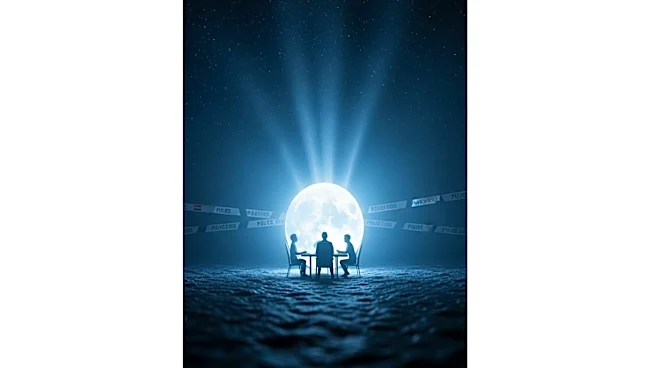

The Spielberg-Kamiński Lexicon
For three decades, the visual language of Steven Spielberg’s blockbusters has been shaped by one man: his director of photography, Janusz Kamiński. Since their first collaboration on 1993’s *Schindler’s
List*—which won Kamiński his first Oscar—the pair have forged a cinematic partnership as iconic as Scorsese and De Niro or Hitchcock and Herrmann. From the visceral chaos of *Saving Private Ryan* to the neon-drenched future of *Minority Report* and the chilling invasion of *War of the Worlds*, Kamiński’s lens is how modern audiences have experienced some of cinema’s most unforgettable moments. His style is so distinct, so influential, that it’s become more than just a look; it’s a grammar for depicting events that sit on the knife's edge between the miraculous and the monstrous. And if humanity ever has its own “Disclosure Day”—the moment we officially learn we are not alone—his visual vocabulary would be the only one that makes sense.
Light as Both Awe and Interrogation
Kamiński’s most famous signature is his treatment of light. It’s not just illumination; it’s an active character in the story. He floods scenes with searing, blown-out backlights that obliterate detail and turn figures into silhouettes. Think of the alien abduction scenes in *War of the Worlds* or the ethereal glow of the Mecha-creating beings in *A.I. Artificial Intelligence*. This light is dual-purpose. On one hand, it’s a visual representation of awe—the holy, divine power of something beyond our comprehension. It’s the “God light” beaming through a window or a cloud. On the other hand, it’s a harsh, interrogating force, like a police spotlight or a surgical lamp that strips its subjects bare. This duality is perfect for a first contact scenario. Is the light from the sky a sign of salvation or a targeting system? With Kamiński’s visual grammar, the answer is, terrifyingly, both at once.
The Reality of Desaturation
Many of Kamiński’s most famous films are strikingly muted. He often employs a bleach-bypass process that crushes blacks, blows out whites, and drains the color from the image, leaving behind a gritty, almost monochromatic palette. He used it to devastating effect in *Saving Private Ryan*, making the D-Day landing feel less like a movie and more like a recovered newsreel from hell. He deployed a cooler, blue-and-silver version for the sterile future of *Minority Report*. This technique does something crucial: it grounds the fantastical in a sense of documentary realism. A “Disclosure Day” wouldn’t be a vibrant, Technicolor affair. It would be gritty, confusing, and terrifying. By stripping away the saturated colors we associate with Hollywood fantasy, Kamiński’s style would make the impossible feel frighteningly tangible. We wouldn't be watching a slick sci-fi movie; we’d be watching something that feels like it’s happening, right now, outside our window.
The View from the Ground
For all the grand spectacle, the true power of the Spielberg-Kamiński partnership is its relentless focus on the human-level perspective. Even as giant tripods emerge from the ground in *War of the Worlds*, the camera stays with Tom Cruise’s character, panicked and scrambling on the street. The camera shakes, debris flies past the lens, and the focus racks desperately to catch a glimpse of the unfolding chaos. This is not the god’s-eye view of a disaster film general in a command center. It’s the terrified, partial, and subjective view of a person trying to survive. This human-centric framing is the final, essential ingredient. A real “Disclosure Day” wouldn’t be understood through a clean, wide shot of a spaceship over Washington D.C. It would be experienced through the cracked screen of a smartphone, the frantic chatter of a crowd, and the overwhelming feeling of being a tiny, fragile observer to an event far beyond your control. That is the perspective Kamiński has mastered.