






The Goal Heard 'Round the World
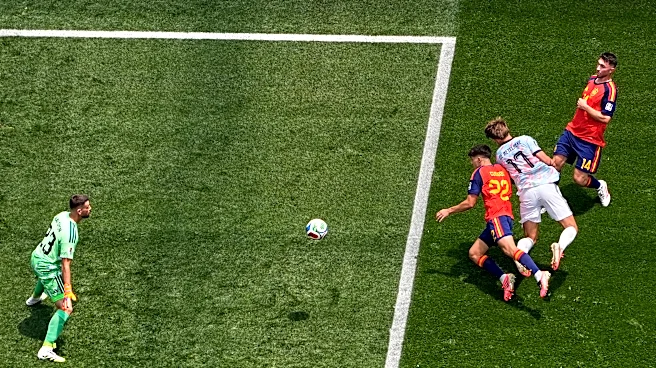
Picture the scene: It’s December 1, 2022, at the Khalifa International Stadium in Qatar. Japan, the underdog, is tied 1-1 with powerhouse Spain in a pivotal group stage match. A loss or draw has major consequences. In the 51st minute, Japan's Kaoru Mitoma
makes a desperate, sliding effort to keep a ball from crossing the end line, hooking it back into play for his teammate Ao Tanaka to bundle into the net. The assistant referee’s flag goes up immediately; the ball was clearly out. But then, the game stops. The anodyne graphics of a Video Assistant Referee (VAR) check flash on screen, and after a tense, multi-minute delay, the referee signals a goal. Japan leads 2-1, a scoreline that would hold, knocking four-time champion Germany out of the tournament in the process. The world was left baffled, staring at replays that seemed to show clear green turf between the ball and the white line.
Anatomy of a Millimeter
The core of the controversy wasn’t just about a close call; it was about the physics of a sphere and the limits of human perception. According to the laws of the game, the ball is only out of play when the entirety of it has crossed the line, whether on the ground or in the air. This means that even if the part of the ball touching the ground is outside the line, it can still be legally in play if its curvature overhangs the line by even a millimeter. What most television camera angles showed was a perspective that made the ball look completely out. However, the VAR officials had access to a goal-line camera, a bird's-eye view. This specific angle revealed what the naked eye and standard replays could not: a tiny sliver of the ball's circumference was still vertically aligned with the line. The decision was, by the letter of the law, correct. Yet for millions watching, it felt fundamentally wrong.
The Social Media Firestorm
If the controversy was born on the pitch, it exploded online. Almost immediately, social media was flooded with screenshots from broadcast feeds, presented as irrefutable proof that the officials had blundered. The image of green space between the ball and the line became a viral exhibit for the prosecution. This moment became a perfect storm of modern discourse: what you feel you saw versus what the technologically-aided officials ruled. FIFA eventually released images from the goal-line camera to quell the debate, but by then, the narratives were set. The incident became a global Rorschach test. For some, it was a triumph of technology ensuring accuracy. For others, it was technology stealing the soul of the game, creating a sterile, stop-start experience that undermines the immediate joy of a goal. The coach of Spain, Luis Enrique, even joked that the decisive photo must have been manipulated.
More Than Just a Game
Years later, the “Mitoma millimeter” endures because it’s a microcosm of our broader relationship with technology. The incident wasn't an isolated VAR debate; it was the ultimate example of the system's promise and peril. VAR was introduced to eliminate “clear and obvious errors,” yet here it was creating a firestorm over a decision that was anything but clear and obvious to the viewing public. It highlighted a growing disconnect in sports: the difference between a technically correct call and one that feels fair. The controversy fed into a larger critique that technology, while increasing accuracy, disrupts the emotional flow of the game, forcing fans to hold their celebrations until a remote official gives the all-clear. It was a debate about rules versus spirit, human perception versus digital proof, and whether the quest for perfect accuracy is worth the cost to the spectacle itself.