
The Blueprint for Psychological Terror
The single most unsettling detail in The Shining isn't a ghost or a line of dialogue; it’s the Overlook Hotel itself. Stanley Kubrick, a director famous for his meticulous perfectionism, intentionally
designed the hotel’s layout to be spatially impossible. This isn't about shoddy filmmaking or continuity errors, which are common in most movies. Instead, it's a calculated decision to make the setting feel fundamentally wrong, disorienting the audience on a subconscious level and mirroring the characters' descent into madness. The hotel's geography doesn't add up, its rooms shift, and its hallways lead to nowhere, creating a labyrinth designed not just to contain its inhabitants, but to break their minds. It’s a blueprint for psychological horror where the building itself is the primary antagonist.
The Case of the Impossible Window
The first and most famous clue to this architectural gaslighting appears early in the film. When Jack Torrance interviews for the caretaker job, he sits in manager Stuart Ullman’s office. Behind Ullman is a large window with a clear view of the sunny outdoors. However, everything the film shows us about the hotel's layout confirms that this office is located deep within the building's interior, surrounded by windowless corridors. There is simply no way for that window to exist. It’s a physical impossibility. Kubrick, known for his obsessive attention to detail, didn’t make a mistake. He placed that impossible window there to subtly tell the audience that the rules of reality do not apply at the Overlook. The building is lying to you from the very beginning.
A Labyrinth of Shifting Spaces
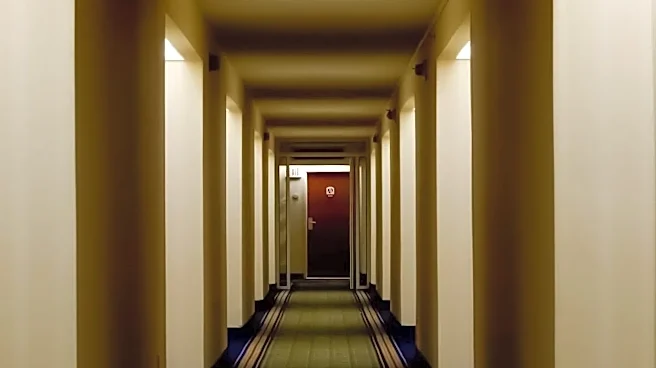
This architectural inconsistency extends far beyond a single office. When analyzed, the Overlook's floor plan is a chaotic mess. The grand Colorado Lounge, for example, is a massive space that simply cannot fit inside the hotel's exterior shell shown in the opening shots. The endless hallways that Danny traverses on his Big Wheel are even more disorienting; his routes through the hotel form illogical loops that defy any coherent map. Furthermore, details within these spaces constantly change. The iconic geometric pattern on the carpet in the hallway outside Room 237 inexplicably flips its orientation between shots. In another scene, a chair behind Jack disappears and reappears between cuts. These aren't just goofs; they are deliberate choices that make the hotel feel like a living, breathing entity that changes its shape when you're not looking.
Why It's So Effective
Kubrick’s method works because it preys on our brain's innate need to create mental maps of our surroundings. We instinctively try to understand the space we are in, and when that space contradicts itself, it creates a deep-seated feeling of unease. We may not consciously notice that Ullman’s window is impossible or that a hallway leads to nowhere, but on a subconscious level, our minds register the inconsistency. This spatial madness makes the Overlook feel inescapable, not just physically but psychologically. The characters aren't just lost in a big hotel; they are trapped in a structure that actively defies logic and reason. The horror comes not from what they see, but from the dawning realization that the very foundation of their reality is unstable. The hotel is a maze for the mind, and like its characters, the audience can never quite find its way out.