




The Challenge: A Wall of Sonic Bricks
When two guitarists in a heavy band both crank their amps with high-gain distortion, their sounds can easily blur together. This happens because distortion adds a huge number of harmonic overtones, causing the frequencies of each guitar to overlap and compete.
This phenomenon, known as frequency masking, is the mortal enemy of a live sound engineer. The result is often a flat, undefined roar where individual riffs and melodies get lost. At an outdoor festival like Austin City Limits, this problem is magnified. There are no walls for the sound to reflect off, which can thin out the sound, and engineers have to contend with sound bleeding from other stages. The goal isn't just to make the band loud; it's to make them powerful and clear, ensuring the audience hears the music as it was intended.
Carving Out Space with EQ
The most crucial tool for achieving clarity is equalization, or EQ. Think of the audio spectrum as a highway. If both guitars try to drive in the same lane, they'll crash. A good front-of-house (FOH) engineer acts as a traffic controller, using EQ to “carve out” a specific lane for each instrument. For example, one guitar might have its core frequencies boosted in the low-mids (around 250-500 Hz for body) while the other gets a bump in the upper-mids (around 2-4 kHz for bite and presence). The engineer will often cut frequencies in one guitar to make space for the other, ensuring they complement each other instead of clashing. This surgical approach means that even when both are playing at once, their fundamental tones occupy different spaces, allowing the human ear to distinguish them easily.
Painting a Stereo Picture with Panning
Another powerful technique is panning. Instead of having both guitars come from the center of the speaker system, engineers pan them to the left and right. This creates a wide stereo image that gives each instrument its own physical location in the mix. If you've ever listened to a hard rock record on headphones, you'll notice one rhythm guitar is often primarily in your left ear and the other in your right. This same principle is applied on a massive scale at ACL using giant speaker arrays. By panning the guitars even slightly away from each other, the engineer creates separation and width, making the entire mix feel bigger and more immersive. The lead guitar or a solo is often kept closer to the center to draw the listener's focus.
It All Starts on Stage
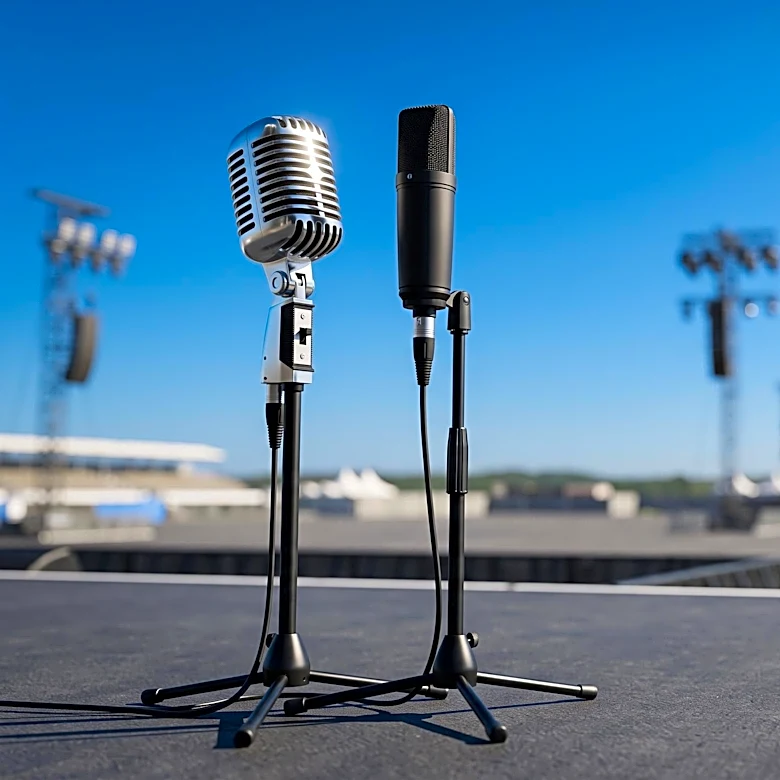
A great live sound is a collaboration between the band and the engineer. The process of separation begins before a single microphone is turned on. Guitarists often work to create complementary tones, with one using a slightly brighter amp setting and another a darker one. The choice of microphones and their placement on the speaker cabinets is also critical. Sometimes, engineers will use two different mics on a single cabinet to capture different characteristics—one for warmth and one for attack—and blend them. Furthermore, managing the on-stage volume is crucial. If the amps are too loud on stage, that sound blasts directly into the audience and vocal mics, limiting the engineer's control over the main mix. Smart bands angle their amps or use lower stage volumes, trusting the FOH engineer and the massive PA system to do the heavy lifting for the crowd.