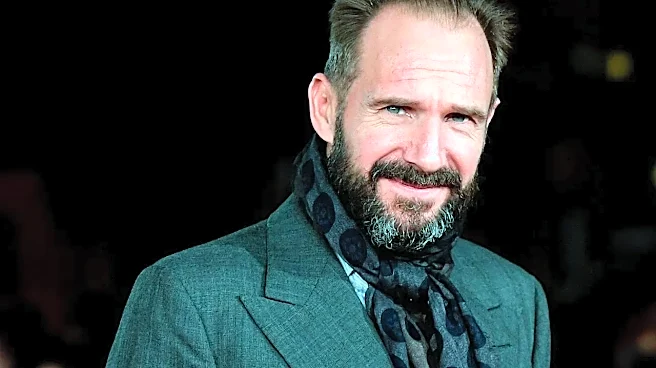









The news is out: Ralph Fiennes will portray President Snow in 'The Hunger Games: Sunrise on the Reaping.' It’s more than just perfect casting; it's a creative mandate to bridge the boy we met with the tyrant we know, completing a legendary villain's arc.
The Ghost of Panem Past
For years, President Coriolanus Snow was defined by Donald Sutherland's masterfully chilling performance. Sutherland portrayed Snow not as a cackling monster, but as a pragmatic, almost grandfatherly tyrant whose evil was rooted in a terrifyingly calm certainty. He saw himself as the necessary evil holding a fragile nation together, a man who would use any tool—from poison to propaganda—to maintain control. His Snow was a finished product: a man so steeped in power and paranoia that his humanity was a distant memory, masked by the cloying scent of genetically engineered roses. He was the snake that had long forgotten what it was to be anything else, respecting Katniss Everdeen only as a worthy adversary who showed him a life he might have once had. This portrayal set the benchmark, giving audiences a villain whose quiet menace was more terrifying than any overt display of rage.
The Boy Who Became a Tyrant
Then came 'The Ballad of Songbirds & Snakes,' which rewound the clock and dared us to sympathize with the devil. Tom Blyth’s young Coriolanus was ambitious, charming, and desperate, a boy shaped by wartime poverty and a fierce desire to restore his family's name. We watched as his capacity for empathy and love, particularly for Lucy Gray Baird, warred with his hunger for power and control. The novel and film detailed his descent, showing how betrayal, fear, and a core belief in humanity's inherent chaos transformed an impressionable student into a ruthless schemer. By the end, the boy nicknamed 'Coryo' was gone, replaced by a man who chose authority over affection, setting him on the path to becoming Panem's dictator. This prequel didn't excuse his future actions, but it provided the crucial, missing ingredient: context.
Enter Fiennes: The Master of Menacing Charm
The casting of Ralph Fiennes for 'Sunrise on the Reaping,' set during the 50th Hunger Games, is a stroke of genius. This is an actor who has built a career on portraying complex, intelligent evil. As Amon Goeth in 'Schindler's List,' he was not just a monster but a man whose cruelty was capricious and terrifyingly human. As Lord Voldemort in the 'Harry Potter' series, he balanced theatrical terror with a tangible sense of tragic, twisted humanity. Fiennes excels at playing characters who are both charismatic and chilling, whose intellectual superiority is their greatest weapon. He understands how to convey the internal life of a villain—the loneliness, the rage, and the moments of unnerving vulnerability—without ever asking for audience sympathy. He is the perfect actor to embody a middle-aged Snow, a man who has cemented his power but is not yet the fully calcified tyrant Sutherland portrayed.
Bridging the Narrative Chasm
This is why Fiennes' performance must connect the two previous portrayals. His task is not just to play Snow, but to embody the entire tragic arc. We need to see both Blyth's ambitious boy and Sutherland's cold-blooded ruler in his eyes. His Snow will be a man at the height of his power, a political operator who has fully embraced his philosophy of control but perhaps still feels the phantom pains of the heart he sacrificed. This new film offers the chance to show the man who remembers Lucy Gray, who is actively cultivating his rose garden to mask the scent of blood and secrets, and who is perfecting the political theater of the Hunger Games. Fiennes can show us the intellectual architect of Panem's cruelty, making the connection between the boy who felt betrayed and the old man who trusts no one. It's the connective tissue the franchise needs to make Snow one of modern fiction's most complete and compelling characters.