





The Down Payment on an Ocean
The first rule of building a cinematic ocean is that you can't just rent one. You have to build it from scratch, and the initial price tag is staggering. For James Cameron’s 1997 epic, Titanic, the studio didn't just build a nearly full-scale ship; they
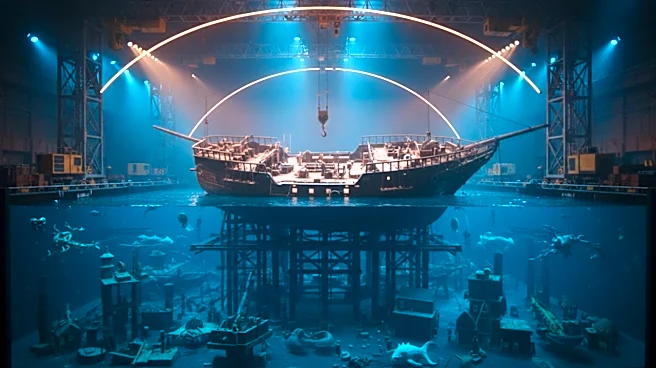
built the facility to house it. This involved constructing a 17-million-gallon horizon tank on the coast of Mexico. The tank alone, designed to create a seamless blend with the real ocean behind it, was part of a facility that reportedly cost $20-40 million to develop before a single frame was shot. Decades earlier, for The Abyss, Cameron famously took over two containment tanks at an abandoned nuclear power plant, filling them with 7.5 million gallons of water to simulate the deep sea. These aren't just pools; they are custom-built industrial facilities, the foundational capital expenditure in the high-stakes business of creating a believable aquatic world.
It’s Not the Water, It’s the Upkeep
Filling the tank is just the beginning. The real operational costs lie in managing millions of gallons of water. For Titanic, the water wasn't the frigid North Atlantic but a comparatively comfortable 80 degrees, requiring a massive heating system to keep actors safe during long shoots. Clarity is another non-negotiable expense. For Avatar: The Way of Water, the performance-capture system required the water to be perfectly clear. This meant an advanced filtration system was needed to handle any impurities. Bubbles were the enemy, as the motion-capture cameras couldn't distinguish them from the reflective markers on the actors' suits. This single technical constraint forced the production to ban scuba gear for many shots, requiring actors and crew to become proficient free divers. Even the color and chemistry of the water become a line item, with productions adding chlorine or other chemicals, sometimes leading to side effects like hair loss and skin burns for the crew, as happened on The Abyss.
The Human and Safety Premium
Putting actors in massive tanks of water introduces immense risk, which translates to huge safety costs. Every underwater scene requires a team of safety divers, often one assigned to each actor, ready to provide oxygen or assistance at a moment's notice. The grueling conditions are legendary. During the making of The Abyss, the cast and crew spent so much time underwater that they had to undergo decompression, and actress Mary Elizabeth Mastrantonio reportedly suffered an emotional breakdown from the strain. For The Way of Water, stars like Kate Winslet and Sigourney Weaver trained to hold their breath for several minutes to get authentic performances without the aid of scuba gear. This training, along with specialized medical and dive support staff, represents a significant hidden cost in the budget—a premium paid to ensure that the pursuit of cinematic magic doesn't end in real-world tragedy.
The Practical vs. Digital Paradox
In an age where entire worlds can be rendered on a computer, why spend tens of millions of dollars on a giant pool of water? The answer lies in the quest for authenticity. Directors like James Cameron argue that real water provides something CGI cannot replicate: genuine physical interaction. The way light refracts, the way a body struggles against a current, the splash and spray—these elements give a scene a tangible weight that audiences feel, even if they can't articulate why. The modern method is a hybrid approach. For Avatar: The Way of Water, Cameron’s team built a state-of-the-art tank not to replace CGI, but to enable it through underwater performance capture. The actors’ real, water-resisted movements were recorded and then translated into their Na’vi avatars. This makes the tank a high-tech stage—a practical element built to serve a digital end, proving that even in the age of VFX, there's no substitute for making a real splash.