
The Unchanging Uniform
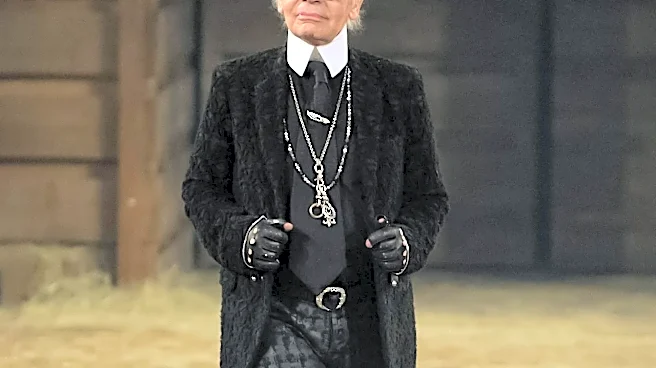
For decades, Karl Lagerfeld was a fixed point in the chaotic world of fashion. While hemlines rose and fell and trends came and went, his personal presentation remained strikingly consistent. The silhouette
was unmistakable: a slim-fit black suit, often by Dior Homme, paired with a crisp white shirt featuring a dramatically high, stiff collar. Add to that fingerless leather gloves, a neat, powdered white ponytail, and ever-present black sunglasses, and you have one of the most recognizable personal brands in modern history. He once said he was a caricature of himself and liked it that way, calling the ensemble a mask for a year-round Venetian carnival. This wasn't just clothing; it was a carefully constructed armor and a statement of intent, separating Lagerfeld the man from Lagerfeld the myth.
A Passion for the 18th Century
To understand the uniform, you have to understand Lagerfeld's deepest aesthetic passion: the 18th century. While he was a relentless modernist in his work, his personal tastes and collecting habits were firmly rooted in the era of Louis XV and the Enlightenment. He saw this period as the pinnacle of elegance and restraint. His homes were filled with 18th-century furniture, art, and decorative objects, curated with an expert's eye for style and character. This wasn't a casual interest; it was a profound intellectual and aesthetic connection. He saw the 18th century not as a stuffy, bygone era, but as an explosive, revolutionary period of immense creativity and intellect—values he championed in his own life and work.
The Ghost in the Machine
So, who was the specific reference? While Lagerfeld drew from the general aesthetic of the era, his look bears a striking resemblance to portraits of Georges-Louis Leclerc, Comte de Buffon, an 18th-century French naturalist, mathematician, and encyclopedist. Like Lagerfeld, Buffon was a towering intellectual figure of his time. Portraits show him with his hair pulled back and wearing the high, wrap-around collars common among the aristocracy. But for Lagerfeld, the connection was less about mimicking one person and more about embodying an archetype: the 18th-century wit and man of letters. He was drawn to the era's definition of wit as a combination of imagination, judgment, and knowledge. His look was a way of visually aligning himself with the intellectual rigor and aristocratic flair of the French Enlightenment.
Deconstructing the Details
Each element of Lagerfeld's uniform was a modern interpretation of this historical passion. The white, powdered ponytail was his version of the aristocratic periwigs of pre-revolutionary France, a style he adopted in 1976 when he grew tired of his naturally curly hair. The high, detachable collars, often from Hilditch & Key, served a dual purpose: they created a dramatic, graphic frame for his face while also concealing his neck, a practical consideration as he aged. The fingerless gloves added a rock-and-roll edge, but Lagerfeld himself once quipped they made his arms look longer, and in France, long arms signify influence. Together, the look was a masterful blend of past and present. As one writer noted, it was a conscious metaphor: the 18th-century collar and powdered hair paired with modern leather pants and sunglasses.