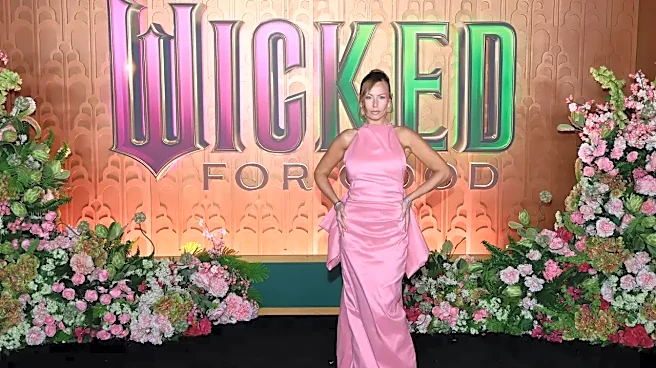







For decades, the 'Good Witch' meant pink bubbles, a shimmering gown, and a perpetually reassuring smile. But the story of 'Wicked' complicates that saccharine image, recasting Glinda not as a symbol, but as a complex woman whose goodness is earned.
Beyond the Pink Bubble
The
Glinda we meet in the 1939 film 'The Wizard of Oz' is a figure of pure benevolence, a magical guide who is inherently good. 'Wicked' introduces us to a far different character: Galinda Upland, a vivacious, ambitious, and deeply superficial student at Shiz University. Her primary concerns are popularity, status, and social acceptance. This initial portrayal is crucial because it establishes that Glinda isn't born a paragon of virtue; she starts as a privileged and often petty young woman. Her journey isn't about revealing her innate goodness, but about actively discovering and fighting for it. By showing us her flaws—her desire to be liked, her initial prejudice against the green-skinned Elphaba—the story grounds her in a relatable reality.
An Unlikely, Transformative Friendship
The engine of Glinda's transformation is her unlikely friendship with Elphaba, the future 'Wicked' Witch of the West. What begins as a rivalry between polar opposites—the popular blonde and the ostracized outcast—slowly evolves into a deep, complicated bond. It is through Elphaba that Glinda is forced to confront uncomfortable truths about Oz, its corrupt Wizard, and her own complicity in an unjust system. While Elphaba chooses to openly defy the regime and is branded 'wicked' for it, Glinda takes a different path, choosing to work within the system. This central relationship forces Glinda to choose between what is right and what is popular, a conflict that reveals the true cost of her public-facing identity as 'Glinda the Good'. Her goodness becomes less about magical prowess and more about moral courage and accountability.
The Meaning of 'For Good'
No moment crystallizes this theme more than the duet 'For Good'. The song functions as the emotional and philosophical centerpiece of the story. By this point, both women have made choices that have hurt each other and set them on divergent paths. The lyrics are a quiet, powerful acknowledgment of their mutual influence: 'Because I knew you, I have been changed for good'. This isn't a simple apology or a happy resolution. It's a mature recognition that their connection has fundamentally altered them, regardless of their public personas. The song reframes 'goodness' not as a fixed moral state, but as the positive impact people have on one another. It suggests that true change comes from empathy and the lasting imprint of relationships, a far more profound concept than simply being born 'good'.
A New Archetype for a Modern Audience
'Wicked's' re-imagining of Glinda resonates because it trades a flat symbol for a three-dimensional human. The classic Glinda was a comforting but unrelatable ideal. The 'Wicked' version is a flawed, often frustrating, but ultimately heroic figure whose journey feels more authentic. She grapples with privilege, responsibility, and the difficulty of navigating a world that demands conformity. This portrayal reflects a broader shift in storytelling, where audiences crave morally complex characters over simple heroes and villains. Glinda's arc—from shallow socialite to a woman burdened by difficult choices—makes her a more compelling and modern archetype. She proves that goodness isn't the absence of flaws, but the struggle to overcome them, a message that continues to connect with audiences decades after the musical's debut.