
The sweeping spectacle of the 'Wicked' films is undeniable, but the true genius lies in the details. Look past Elphaba and Glinda, and you'll find that the crowded streets of the Emerald City and halls
of Shiz University tell their own epic story.
More Than Just a Green Screen
In an era of filmmaking dominated by digital armies and computer-generated backdrops, director Jon M. Chu and production designer Nathan Crowley made a pivotal choice for 'Wicked': build it for real. Chu's vision was for an immersive, tactile Oz where the audience feels physically present, and that began with the environments and the people who fill them. The result is a world that feels lived-in, not rendered. Rather than a sea of digital extras, the crowd scenes are populated by hundreds of performers, each contributing to a tangible energy. This commitment to practical sets and real people grounds the fantasy, making the social and political transformations of Oz feel authentic and impactful. The crowds aren't just background noise; they are the living, breathing embodiment of Ozian society, reacting, judging, and shifting with the political winds.
A Story Told in Fabric and Form
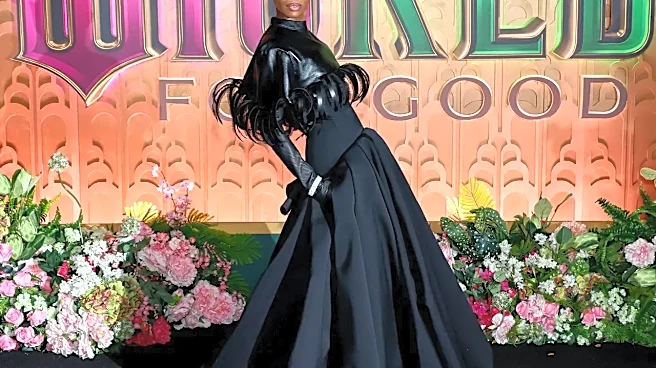
Costume designer Paul Tazewell, a Tony winner known for his work on 'Hamilton', treated every extra's garment as a piece of storytelling. In the Emerald City, the sea of green is anything but uniform. A closer look reveals a complex social hierarchy told through texture, silhouette, and shade. Tazewell designed over 1,000 unique costumes, ensuring that no two outfits in the bustling capital were identical. The designs draw from early 20th-century and 1930s fashion, creating a 'storybook' quality that is both fantastical and strangely familiar. The extravagant, sharply tailored green outfits of the city's elite signal prosperity and conformity, a visual representation of the Wizard's polished regime. This makes Elphaba's simple, textured black dress—a swirl of micro-pleated chiffon that took over 200 hours to create—a stark, rebellious contrast. The crowd's fashion isn't just decoration; it's a visual code for power and allegiance.
The Architecture of Oppression
The citizens of Oz are often framed by the imposing structures designed by Nathan Crowley, whose work on the films earned him an Oscar. The Emerald City itself was inspired by the grand, neoclassical look of Chicago's 1893 'White City', creating a sense of dreamlike awe mixed with intimidation. But even the famous Yellow Brick Road tells a darker story. In 'Wicked: For Good', we see that the road is a tool of oppression, its bricks dyed yellow from millions of tulips that Munchkins are forced to cultivate, stripping their land of its natural rainbow of color. The architecture and infrastructure are not neutral; they are extensions of the Wizard's power. The grandeur of the city's three main towers—assigned to the Wizard, Madame Morrible, and Glinda—and the sheer scale of the sets reinforce the might of the state, making the individual dissenter, like Elphaba, seem small and isolated. The crowd's movement through these spaces shows how public life is shaped and controlled by the environment itself.
From Shiz Students to City Dwellers
The evolution of the crowds mirrors the journey of the main characters. We first meet the Ozian public as the students of Shiz University, a world of cliques and vanity defined by their teal and coral school uniforms. The atmosphere here is one of youthful preoccupation, where popularity is paramount. This provides the perfect backdrop for the initial 'loathing' between the studious outcast Elphaba and the bubbly, popular Glinda. As the story moves to the Emerald City, the crowd becomes more anonymous and more powerful. They are the audience for the Wizard's propaganda and the jury for public opinion. During the heartbreaking Ozdust Ballroom scene, director Jon M. Chu uses the crowd's reaction to amplify Elphaba's painful humiliation, making every second of her isolation felt. This shift from a schoolyard social hierarchy to a citywide political body shows how public opinion can be manipulated and weaponized.