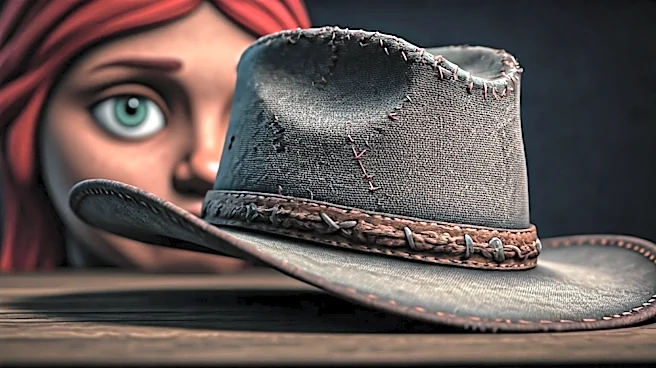










The Cowgirl Who Carries Scars
To understand Jessie, you have to go back to the darkness of a cardboard box. Introduced in *Toy Story 2*, her entire personality is built on the trauma of being abandoned by her first owner, Emily. Her vibrant, yodeling exterior masks a deep-seated terror
of being forgotten, of being packed away when a child grows up. This isn't just a backstory; it's her prime directive. Her claustrophobia is a physical manifestation of her emotional prison. Every decision she makes, from her initial reluctance to go to Japan to her fierce loyalty to the new “family” of Andy’s toys, is filtered through the lens of one question: Will I be left behind again? This fear makes her one of the most complex and empathetic characters in the entire Pixar canon, but it's also a potential narrative time bomb.
A Leader Forged by Fear
By the end of *Toy Story 4*, Woody has completed his arc. He accepts that his time as a child's toy is over and rides off into the sunset (or, rather, the carnival). He passes the metaphorical sheriff's badge to Jessie, anointing her the new leader of Bonnie’s toys. On the surface, it’s a perfect passing of the torch. But Woody’s leadership was defined by his selfless devotion to his kid. Jessie’s leadership, shaped by her trauma, is about something else: keeping the group together at all costs. Her mantra has always been about survival as a collective. We saw it in *Toy Story 3* when she convinced the others that going to Sunnyside Daycare together was better than being separated in the attic. While noble, this philosophy hasn't truly been challenged. As a leader, her greatest strength—her fierce commitment to the group—could easily become her greatest weakness.
The Case for a Flawed Hero
Herein lies the brilliant potential for *Toy Story 5*. The franchise's most mature themes have always revolved around purpose and letting go. Woody learned this lesson over four films. Now, it's Jessie's turn, but from the opposite perspective. What if her core belief—that the group must stay together no matter what—is no longer the right answer? A compelling fifth film wouldn't need a mustache-twirling villain like Stinky Pete or Lotso. The conflict could come from within. The antagonist could be Jessie’s own well-meaning but flawed ideology. The story could challenge her by presenting a scenario where what's best for an individual toy is to leave the group. Would she be able to accept it? Or would her fear of abandonment cause her to become an obstacle to another toy's happiness, turning her into an antagonist born of love and fear?
What a “Wrong” Jessie Looks Like
Imagine a plot for *Toy Story 5* where a new, important toy in Bonnie’s room has a different dream. Perhaps they want to become a “lost toy” like Woody, or their true purpose lies outside the bedroom. Jessie, as the leader, would see this desire as a betrayal, a crack in the foundation of the family she fought so hard to keep whole. Her attempts to “save” this toy from making what she perceives as a terrible mistake would drive the narrative. She wouldn't be evil; she would be wrong. Her journey would be the slow, painful realization that true leadership isn't about forcing everyone to stay, but about supporting them enough to let them go. It’s a story about learning that a family isn't defined by physical proximity, but by love and respect for each other's individual paths. Watching Jessie grapple with this would be far more powerful than any external threat, giving her an arc that rivals Woody's in its emotional depth.